English
 Español
 Português
 Français
 Deutsch
 русский
 한국어
 にほんご
 हिन्दी, हिंदी
 বাংলা
 Bahasa Indonesia
 Türkçe
 Việt
 dansk
 čeština
 עִבְרִית Ivrit
 Filipino/Pilipino
 български език (Bǎlgarski jazik)
 suomi
 norsk
 język polski
 ไทย
 ກະຣຸນາ
 Bahasa Melayu
 ភាសាខ្មែរ
 ဗာရမ်
 اردو
 فارسی
 Italiano
 Nederlands
 svenska
 Монгол хэл
 नेपाली
 සිංහල
 Ўзбек тили
 پښتوتۆرکجه
 Ελληνικά
 српски / srpski
 magyar
 українська
 Kiswahili
 Қазақ тілі
 Română
 Hrvatski
 Bosanski
 Kreyòl ayisyen
 አማርኛ
 Hausa
 Yorùbá
 Igbo
Are Single-Source Tool Cabinets Better for Global EPC Projects?
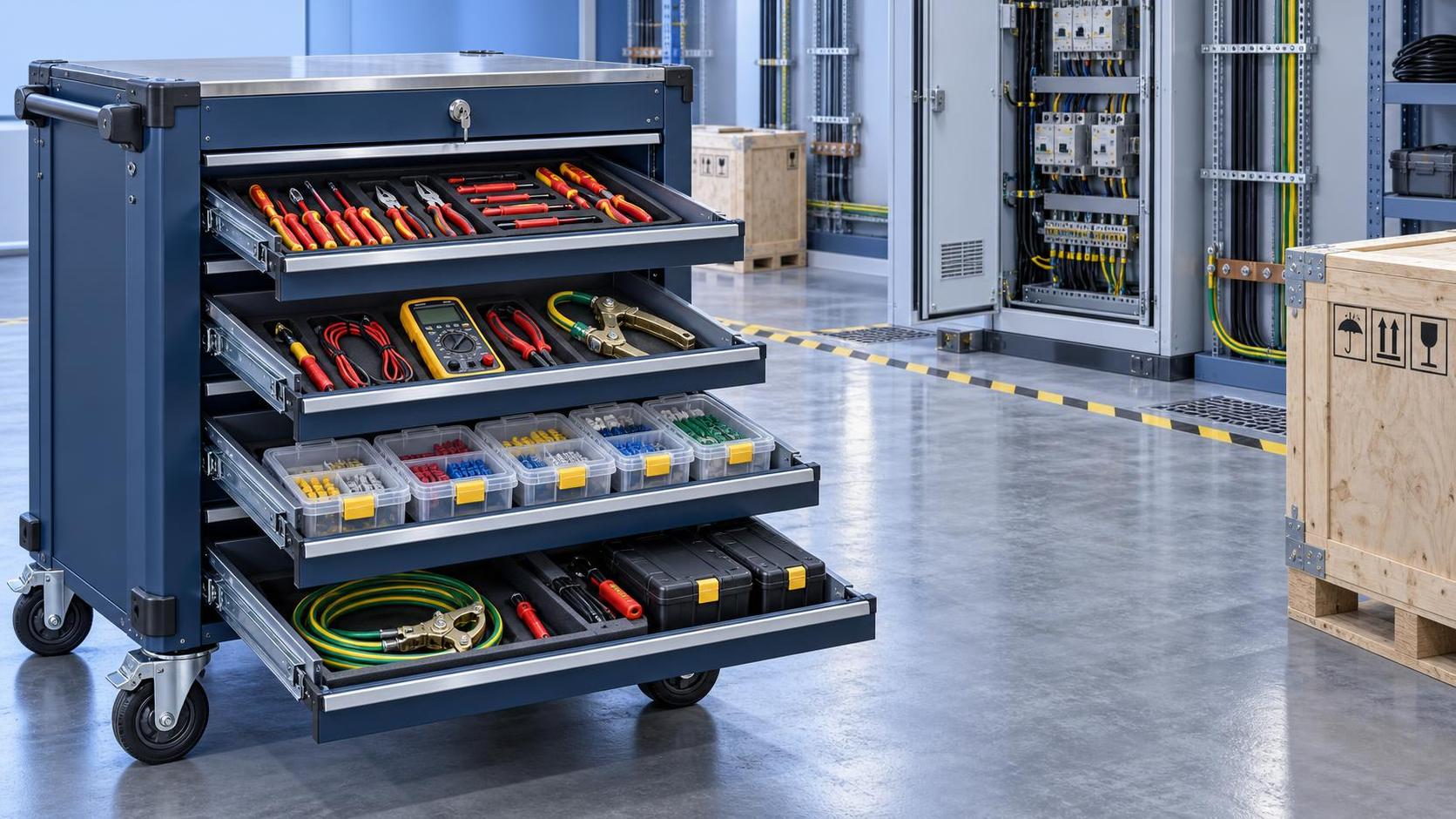
Often, yes—but only when the single source controls the details that affect field use, shipment, and replacement. For a global EPC project, a heavy duty tool cabinet is part of the working infrastructure around electrical installation, commissioning, and maintenance. It may store insulated hand tools, test instruments, grounding equipment, torque tools, drawings, consumables, or site-specific protective equipment. When cabinets arrive with inconsistent dimensions, drawer layouts, locking systems, coatings, or load ratings, the resulting disruption is rarely limited to storage. Tools become harder to locate, spare parts do not fit, and site procedures lose the consistency they were designed to maintain.
A single-source arrangement can reduce those variations. It gives one manufacturing route responsibility for cabinet construction, component selection, documentation, packing, and corrective action. That advantage is real when the project spans several countries or is delivered in phases. It is not automatic, however. A single source with weak engineering control, uncertain material availability, or limited export packing discipline can create a larger dependency than a carefully managed multi-source program.
Where a single source creates practical value
Heavy duty cabinets look simple in a specification: steel enclosure, drawers, locking doors, wheels or fixed feet, and a stated load capacity. The difficulty appears when the same cabinet must work at a fabrication yard, a substation construction area, a warehouse, and a remote commissioning location. A nominally similar cabinet from another source may have a different drawer pitch, handle profile, caster mounting plate, key code system, or internal tray arrangement. Those differences affect tool shadowing, spares planning, vehicle loading, and the way cabinets are positioned in a constrained work area.
With one source, the project can establish a controlled cabinet family. A base frame, drawer runner type, lock mechanism, finish, labeling method, and internal accessory interface are defined once and repeated across packages. A cabinet ordered for a later construction package should then accept the same dividers, foam inserts, replacement slides, and lock cylinders as the first delivery. This matters more than visual uniformity. It prevents field personnel from improvising around different storage layouts while handling calibrated meters or electrical safety equipment.
Consistency also improves handover. If a project requires an inventory to be transferred from construction to commissioning or from commissioning to operations, repeatable cabinet identification and internal arrangement make the inventory easier to verify. Cabinet labels alone are insufficient. The physical location of each class of equipment must remain stable enough that the label corresponds to the actual arrangement.
The cabinet specification still has to be technically complete
Single sourcing cannot correct an incomplete requirement. Many cabinet problems begin when “heavy duty” is treated as a product category instead of a set of measurable conditions. A robust inquiry distinguishes between total cabinet capacity, individual drawer capacity, and the load allowed when drawers are fully extended. A cabinet can withstand a substantial total static load while becoming unstable if the upper drawers are opened in the wrong sequence or loaded with dense tools.
For electrical project work, drawer loading often varies sharply. A shallow drawer holding insulated screwdrivers and labeling tools behaves differently from a deep drawer holding crimping heads, cable preparation tools, grounding clamps, or test leads in protective cases. The heaviest items should normally be assigned to lower drawers, but the design also needs to account for drawer slide strength, anti-tip behavior, and whether the cabinet will be moved while loaded.
Material language deserves particular attention. Cold-rolled steel may be suitable for an indoor controlled environment, while hot-dip galvanized or stainless construction may be considered where corrosion exposure is sustained and cabinet use justifies the added cost and weight. Neither option is universally better. A stainless exterior does not compensate for poorly protected fasteners, exposed cut edges, or carbon-steel drawer slides in a wet environment. Likewise, a painted steel cabinet can perform well when it is correctly prepared, coated, transported without damage, and used in a sheltered location.
Customization is useful only when it stays controlled
Global EPC packages often need localized contents without changing the cabinet platform. Voltage-rated hand tool sets, measuring instruments, cable termination equipment, and isolation devices may differ by work package or site practice. The better approach is usually to retain a common cabinet shell and vary removable internal elements: adjustable dividers, labeled bins, foam cutouts, removable trays, or lockable inner compartments.
Permanent customization should be reserved for genuine operational needs. Adding welded brackets, extra shelves, unusual handle positions, or dedicated charging compartments to every cabinet can complicate production and later repair. It may also change the center of gravity, internal clearance, or packing arrangement. A custom feature that works on a stationary cabinet in a workshop may be unsuitable for a mobile cabinet moved over uneven concrete or loaded into a service vehicle.
Foam inserts need the same discipline. They are effective for visual tool control when the tool set is stable and each cavity is clearly identified. They are less effective where the contents change frequently, tools are shared between tasks, or damp equipment is returned to storage. In those situations, modular dividers and durable trays may offer better cleaning access and flexibility. The choice should follow the equipment workflow rather than an assumption that a shadow board style layout is always superior.
Export packing can decide whether the cabinet arrives usable
A cabinet that passes final inspection but arrives with bent drawers, damaged locks, or chipped edges has not met the project need. Heavy cabinets are vulnerable during international handling because their mass places high stress on casters, handles, drawer fronts, and pallet contact points. Shipping damage is especially likely when drawers are not positively restrained or when packaging allows the cabinet to shift inside the crate or container.
A single source has a meaningful advantage when it owns both cabinet production and packing design. It can set a repeatable method for securing drawers, protecting corners, immobilizing casters, bracing doors, and marking lifting points. Packaging should match the transport route. A cabinet sent by sea into a humid environment needs protection from condensation and prolonged storage; one moved by road between multiple project locations needs resistance to repeated handling. Outer dimensions and gross weight should also be established early, because an apparently minor cabinet height increase can affect container utilization or warehouse handling equipment.
There is a distinction between transit protection and installation readiness. Excessive internal blocking may prevent damage but create a slow unpacking process if site crews need specialized tools to remove it. Conversely, minimal packaging can speed access but leave the cabinet exposed to impact. The appropriate balance is reached by considering the receiving conditions: whether a covered unloading area exists, whether a forklift is available, and whether the cabinet will be stored before deployment.
One manufacturer does not mean one undocumented assumption
The strongest single-source programs use a controlled technical package rather than relying on a prior sample or an informal description. The package should identify the approved cabinet configuration, finish, internal layout, accessory list, labeling convention, packing method, and inspection points. A reference sample can be valuable, but it should not replace a drawing and bill of materials. Samples age, personnel change, and later orders may be interpreted differently unless the accepted features are recorded.
Revision control becomes important when sites request small changes. Replacing a caster with an “equivalent” part, changing drawer slide sources, or using a different lock because the original is unavailable can alter field performance. The issue is not that all substitutions are unacceptable. The issue is whether the substitute preserves fit, loading behavior, environmental suitability, and spare-part compatibility. A defined approval route prevents an urgent production adjustment from becoming an unnoticed project-wide variation.
Inspection should focus on functional points, not only appearance. Drawers need to open and close smoothly under representative load. Locking must be checked with doors and drawers aligned. Welds, sharp edges, paint coverage around corners, and caster fastening deserve direct review. For cabinets with electrical accessory compartments, cable entries, internal separation, ventilation needs, and clearance around stored equipment should be specified according to the actual contents. A storage cabinet should not be treated as an electrical enclosure merely because it holds electrical tools.
When multiple sources remain the better choice
Single sourcing is less attractive when cabinet requirements differ fundamentally among locations. A compact, corrosion-resistant cabinet for an offshore-adjacent maintenance area and a large stationary cabinet for a protected inland workshop may not belong to the same platform. Forcing both into one range can produce expensive compromises. Separate sources can also be justified where local fabrication is needed for unusual dimensions, where delivery timing cannot tolerate one production point, or where a particular cabinet type is already integrated with existing site equipment.
The alternative should still be controlled. Multi-source procurement works best when it separates genuinely different requirements rather than allowing loosely equivalent cabinets to enter the same asset group. Common external labels, common inventory logic, and a minimum definition for load, security, finish, and repairability can preserve operational order even when the physical cabinets are not identical.
A second source is also different from uncontrolled parallel sourcing. A qualified backup configuration, documented before it is needed, gives continuity without requiring every order to be split. It should be evaluated for drawer geometry, accessories, keys, coatings, spare parts, and packing, not merely price and headline dimensions.
Questions that reveal whether the single-source option is sound
- Can the proposed cabinet platform retain the same drawers, runners, locks, dividers, and service parts through phased deliveries?
- Is the stated load rating tied to each drawer, the full cabinet, or a cabinet anchored in a particular condition?
- Will the locking system support the required access arrangement without creating a large collection of unrelated keys?
- Are movable cabinets designed for the actual floor condition and loaded weight, rather than for movement when empty?
- Does the packing method protect vulnerable components while allowing practical unloading and setup at the destination?
- When a component changes, is there a documented process to assess interchangeability before production proceeds?
Heavy duty tool cabinets from a single-source manufacturer are better for global EPC projects when repeatability is the primary need and the source can demonstrate control from fabrication through delivery. The cabinet itself is only one part of the decision. The larger value comes from keeping storage layouts, hardware, protection, spares, and documentation consistent across locations. Where local conditions or cabinet functions are fundamentally different, a defined multi-source strategy may be more reliable than artificial uniformity.
Next:No more content
Recommend
 Sep 18, 2026
Are Single-Source Tool Cabinets Better for Global EPC Projects?
Are heavy duty tool cabinets from single-source manufacturers better for global EPC projects? Explore how standardization, export packing, and spare-part control reduce site risk.
 Apr 10, 2026
Continuing its Strong Performance! JINPOWER Wins Multiple Bids for State Grid Hebei Power Projects
Recently, Hebei Jinneng Power Technology Co., Ltd. (hereinafter referred to as "JINPOWER") has achieved a series of successes in procurement projects of State Grid Hebei Power Co., Ltd., winning several key projects and becoming a focus of attention in the power industry.
- Apr 10, 2026
Continuing its Strong Performance! JINPOWER Wins Multiple Bids for State Grid Hebei Power Projects
Recently, Hebei Jinneng Power Technology Co., Ltd. (hereinafter referred to as "JINPOWER") has achieved a series of successes in procurement projects of State Grid Hebei Power Co., Ltd., winning several key projects and becoming a focus of attention in the power industry.