English
 Español
 Português
 Français
 Deutsch
 русский
 한국어
 にほんご
 हिन्दी, हिंदी
 বাংলা
 Bahasa Indonesia
 Türkçe
 Việt
 dansk
 čeština
 עִבְרִית Ivrit
 Filipino/Pilipino
 български език (Bǎlgarski jazik)
 suomi
 norsk
 język polski
 ไทย
 ກະຣຸນາ
 Bahasa Melayu
 ភាសាខ្មែរ
 ဗာရမ်
 اردو
 فارسی
 Italiano
 Nederlands
 svenska
 Монгол хэл
 नेपाली
 සිංහල
 Ўзбек тили
 پښتوتۆرکجه
 Ελληνικά
 српски / srpski
 magyar
 українська
 Kiswahili
 Қазақ тілі
 Română
 Hrvatski
 Bosanski
 Kreyòl ayisyen
 አማርኛ
 Hausa
 Yorùbá
 Igbo
Are Insulated Tool Cabinets Legally Required in HV Switchgear Rooms?
Are Insulated Tool Cabinets Legally Required in HV Switchgear Rooms?
Are insulated tool cabinets required by law in high voltage switchgear rooms? There is no universal rule requiring every HV switchgear room to contain a particular type of cabinet. The answer depends on the jurisdiction, the equipment being stored, applicable safety rules, and any site-specific requirements. What may be mandatory is suitable protection for electrical safety equipment—not necessarily a cabinet sold under the name “insulated tool cabinet.”
That distinction matters when reviewing a tender or responding to an audit finding. A storage cabinet may be necessary to meet a utility specification, protect rubber insulating equipment, or control moisture. But the presence of high-voltage switchgear alone does not establish a legal requirement for a heated cabinet. The useful question is: which obligation applies, and what storage arrangement will actually satisfy it?
Separate the law from the specification
In electrical projects, “required” can mean several different things. Legislation establishes enforceable duties. Technical standards describe recognized practices and may become binding through legal adoption, contracts, or other mechanisms. A network operator can impose its own engineering requirements. An employer can also make a dedicated cabinet mandatory through an electrical safety procedure.
These are not interchangeable. If a project specification says that a controlled-storage cabinet must be installed in each switching room, it is a contractual requirement even if national legislation does not name that product. Conversely, buying a cabinet that appears in a supplier catalogue does not prove that the site has met its legal duties.
When someone says, “The regulations require this cabinet,” ask for the document, clause, applicable edition, and scope. The provision may require protective equipment to be kept dry and undamaged rather than prescribe a cabinet design. That leaves room for engineering judgment, but not for ignoring the storage conditions.
United States: protection requirements, not a universal cabinet prescription
For workplaces within its scope, OSHA 29 CFR 1910.137 addresses electrical protective equipment. Its in-service care provisions require equipment to be stored so that it is protected from light, temperature extremes, excessive humidity, ozone, and other damaging substances and conditions. That is a specific storage duty; it is not a blanket instruction to install a named cabinet in every HV room.
Different requirements may apply to utility operations, construction work, or particular equipment. OSHA 1910.269, for example, includes provisions for live-line tools in operations within its scope. NFPA 70E may also inform a facility’s electrical safety program, but its applicability and enforceability should not be assumed simply because it is widely referenced. Check the actual work activity, applicable rules, and adopted requirements.
United Kingdom: suitability and maintenance are central
In Great Britain, the Electricity at Work Regulations 1989, Regulation 4 establishes duties concerning electrical systems, maintenance, work activities, and protective equipment. Protective equipment must be suitable for its use, maintained in a condition suitable for that use, and properly used. Regulation 4 does not itself prescribe a particular storage cabinet for every switchgear room.
A cabinet may nevertheless be a practical part of meeting those duties. If unsuitable storage allows insulating equipment to deteriorate, the absence of a named cabinet requirement is not a sound defence. Other jurisdictions need their own review; neither the US nor British approach should be treated as a worldwide compliance answer.
“Insulated tool cabinet” can describe two different things
Before comparing products, clarify the terminology. In this market, an “insulated tool cabinet” often means a cabinet for storing electrical insulating tools and protective equipment. It does not necessarily mean that the cabinet enclosure provides certified electrical insulation.
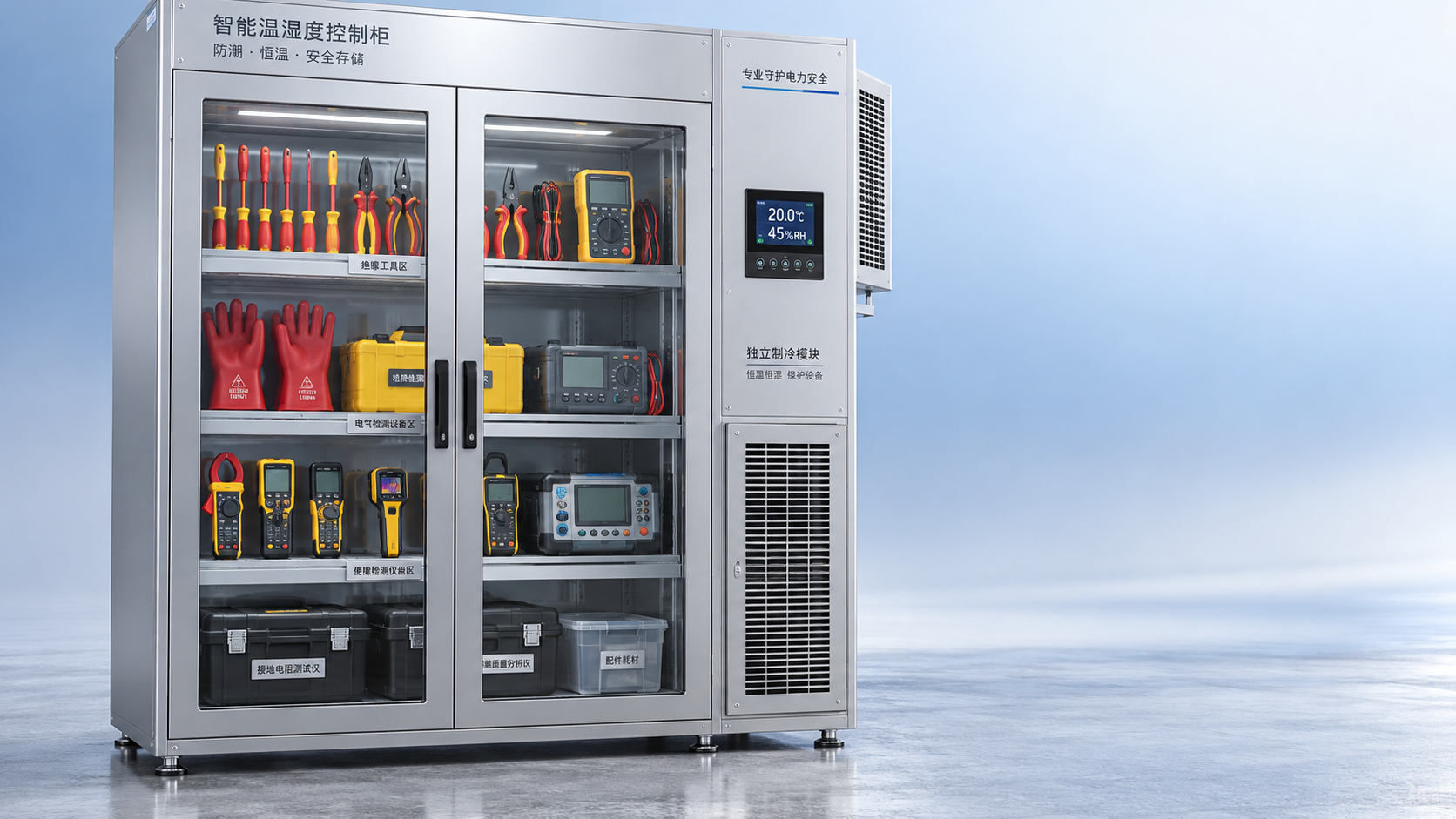
Many such cabinets have metal enclosures. Some provide heating, dehumidification, ventilation, or environmental monitoring. Their purpose is to help preserve the condition of gloves, insulating rods, voltage detectors, and other equipment—not to act as an electrical barrier against live switchgear.
A cabinet therefore does not reduce electrical approach distances, authorize live working, or compensate for inadequate isolation. Nor does a heated cabinet restore damaged equipment to serviceable condition. Electrical insulation performance belongs to the individual protective item and its applicable requirements, not to the label on its storage furniture.
When dedicated storage becomes the sensible choice
Consider an intermittently occupied substation building. Equipment is left inside overnight, ambient temperature changes, and moisture enters through doors or cable penetrations. A plain cupboard may keep out dust but offer little protection against persistent humidity or condensation. Where those conditions threaten the equipment, environmental control deserves attention—even without a regulation explicitly naming a heated cabinet.
The opposite situation also exists. A clean, conditioned storage area may already provide suitable conditions. Adding heat without checking equipment instructions can create unnecessary temperature exposure, especially for battery-powered devices and sensitive materials. “Heated” is not automatically better than “unheated.”
Mechanical damage is often just as important as moisture. Rubber gloves should not share a crowded drawer with sharp tools. Long insulating rods need supports that avoid damage and unnecessary bending. Voltage detectors need protection for their sensing components, along with access for inspection and functional checks. A well-arranged ordinary cabinet may address these issues better than an expensive controlled cabinet with unsuitable internal fittings.
There is also a practical location trade-off. Storage should be accessible to authorized personnel without obstructing switchgear operation, maintenance access, escape routes, or required working space. Squeezing a cabinet into an already congested electrical room can solve a storage problem while creating another safety problem.
Specify the equipment and conditions before the cabinet
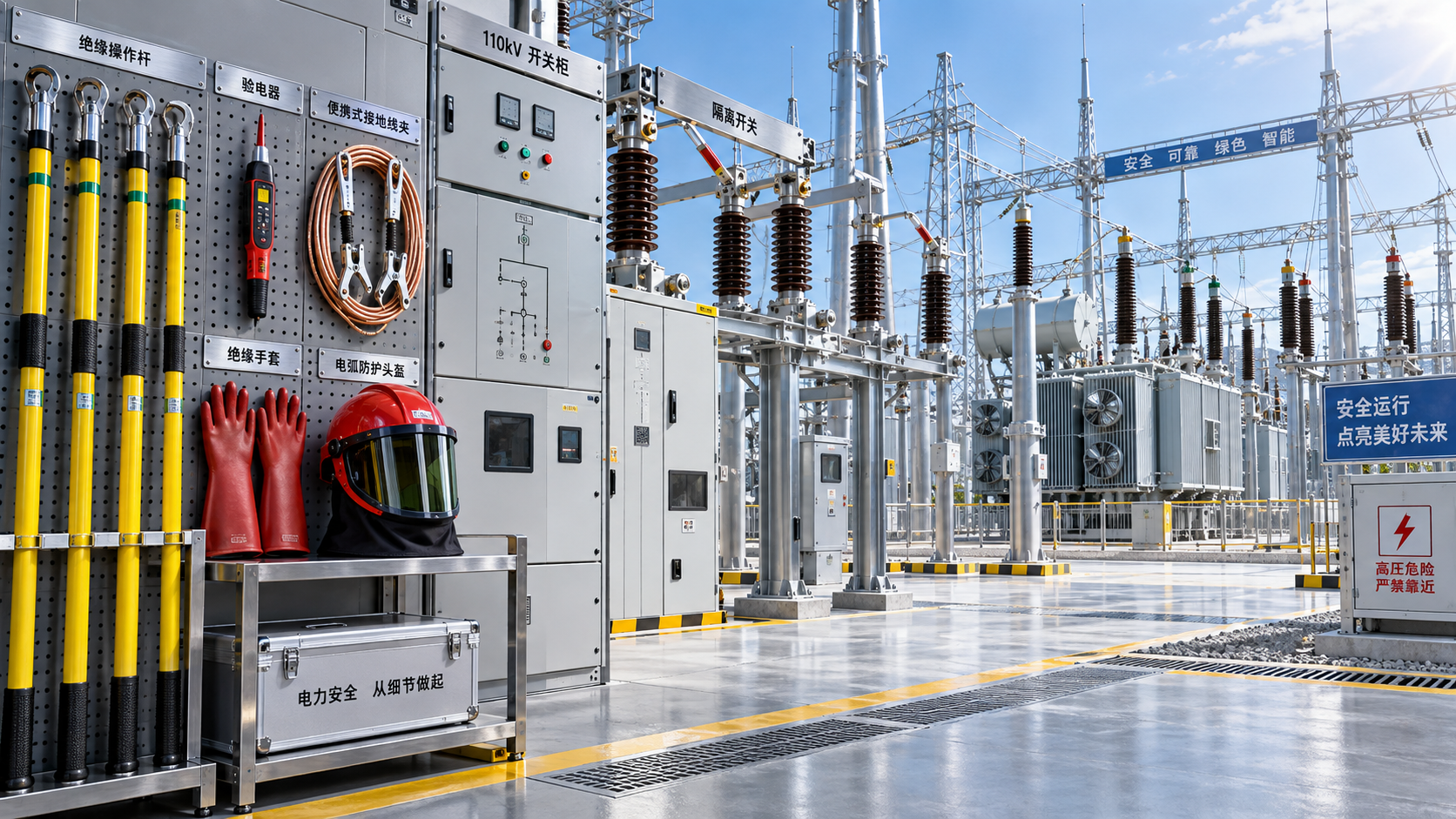
A useful specification starts with an inventory. Insulating gloves, operating rods, portable earthing equipment, voltage detectors, and arc-rated clothing do not all have identical storage needs. A single compartment with one temperature setting should not be assumed suitable for everything.
Check the following before issuing a purchase requirement:
- Equipment instructions: Obtain storage limits and handling guidance for each item, including restrictions on heat, light, chemicals, and battery storage.
- Actual room conditions: Assess seasonal humidity, temperature changes, water ingress, dust, and other contamination. One reading on a dry afternoon is weak evidence.
- Internal arrangement: Confirm usable rod length, glove storage arrangements, load capacity, and separation of heavy or sharp equipment from delicate insulating surfaces.
- Environmental controls: Define the required conditions and how they will be monitored. Do not accept “constant temperature” as a complete performance specification.
- Installation constraints: Check power supply, electrical protection, enclosure earthing where applicable, and compatibility with room access and working-space requirements.
There is no defensible universal humidity or temperature setting for every cabinet and every protective item. Use the equipment manufacturers’ instructions and applicable standards to establish suitable limits. Where requirements conflict, separate storage may be preferable to forcing all equipment into one enclosure.
Ask suppliers to explain how their proposed system maintains those conditions, including sensor location, control behaviour, and maintenance needs. A display reading near a heater does not necessarily describe conditions throughout a loaded cabinet. Likewise, moisture control that depends on consumables needs a replacement routine, not just an installation certificate.
A cabinet does not replace inspection or testing
Good storage preserves equipment; it does not prove equipment is fit for use. Inspections, functional checks, and electrical testing remain subject to the applicable rules and equipment instructions. A test date attached to a rod or glove does not remove the need to check for damage before use.
Storage arrangements should make status obvious. Equipment awaiting inspection or testing should not be mixed with service-ready items. Defective equipment needs a clear quarantine process so that another worker cannot take it during an urgent switching task. If cabinet access is controlled, authorized staff still need reliable access when the equipment is required.
An effective audit therefore looks beyond whether a cabinet is installed. It checks the equipment inventory, inspection and test records, manufacturer instructions, storage condition, and response to faults. A failed heater or humidity alarm needs an assigned owner and a defined response. Otherwise, the cabinet can become a reassuring-looking enclosure that no longer performs its intended function.
Use suppliers to resolve technical details—not legal applicability
A specialist manufacturer can help match storage arrangements to the protective equipment being used. Hebei Jinneng Power Technology Co., Ltd., founded in 2009 and operating under the JINPOWER brand, focuses on electrical safety equipment for power-sector applications. That specialization is relevant when discussing tool dimensions, storage layouts, handling instructions, and maintenance access.
However, a supplier’s recommendation should not substitute for a jurisdiction-specific compliance review. Request documentation for the proposed equipment and cabinet, and confirm which claims apply to the exact model. A general statement about international standards is not evidence that every product meets every local requirement.
Before approving a cabinet, establish three things: the applicable obligation, the conditions the stored equipment needs, and how the site will maintain and verify those conditions. If a utility specification explicitly requires a dedicated cabinet, follow it. If the rules require protected storage without naming a cabinet, document why the chosen arrangement is suitable. That is a stronger decision than either “every HV room legally needs one” or “the law does not mention it, so storage does not matter.”
Recommend
 Oct 25, 2026
Homemade Bird Repellent Spray: Recipe Limits and Outdoor Surface Risks
Searching for how to make homemade bird repellent spray? Discover recipe limits, outdoor surface risks, electrical safety tips, and safer deterrents before you spray.
- Oct 25, 2026
Natural Bird Deterrents for Rooftops: Choosing Nonchemical Options
Learn how to repel birds naturally with humane rooftop barriers and smarter maintenance. Compare nonchemical options to protect electrical equipment and keep roof access clear.
- Oct 24, 2026
Home Remedies for Repelling Birds: What to Try on Patios and Railings
Learn how to repel birds with home remedies for cleaner patios and railings. Discover humane DIY options, avoid harmful sprays, and keep deterrents clear of electrical equipment.