English
 Español
 Português
 Français
 Deutsch
 русский
 한국어
 にほんご
 हिन्दी, हिंदी
 বাংলা
 Bahasa Indonesia
 Türkçe
 Việt
 dansk
 čeština
 עִבְרִית Ivrit
 Filipino/Pilipino
 български език (Bǎlgarski jazik)
 suomi
 norsk
 język polski
 ไทย
 ກະຣຸນາ
 Bahasa Melayu
 ភាសាខ្មែរ
 ဗာရမ်
 اردو
 فارسی
 Italiano
 Nederlands
 svenska
 Монгол хэл
 नेपाली
 සිංහල
 Ўзбек тили
 پښتوتۆرکجه
 Ελληνικά
 српски / srpski
 magyar
 українська
 Kiswahili
 Қазақ тілі
 Română
 Hrvatski
 Bosanski
 Kreyòl ayisyen
 አማርኛ
 Hausa
 Yorùbá
 Igbo
How Can You Verify a Tool Cabinet Meets IEC Humidity Requirements?
Moisture rarely announces itself as a major problem in an electrical safety store. It may begin as a faint musty odor, a small patch of corrosion on a cabinet hinge, or a glove surface that feels different during a routine inspection. Yet for insulating gloves, hot sticks, voltage detectors, insulating mats, and other protective equipment, poor storage conditions can gradually undermine the confidence that workers need before entering a live-work area.
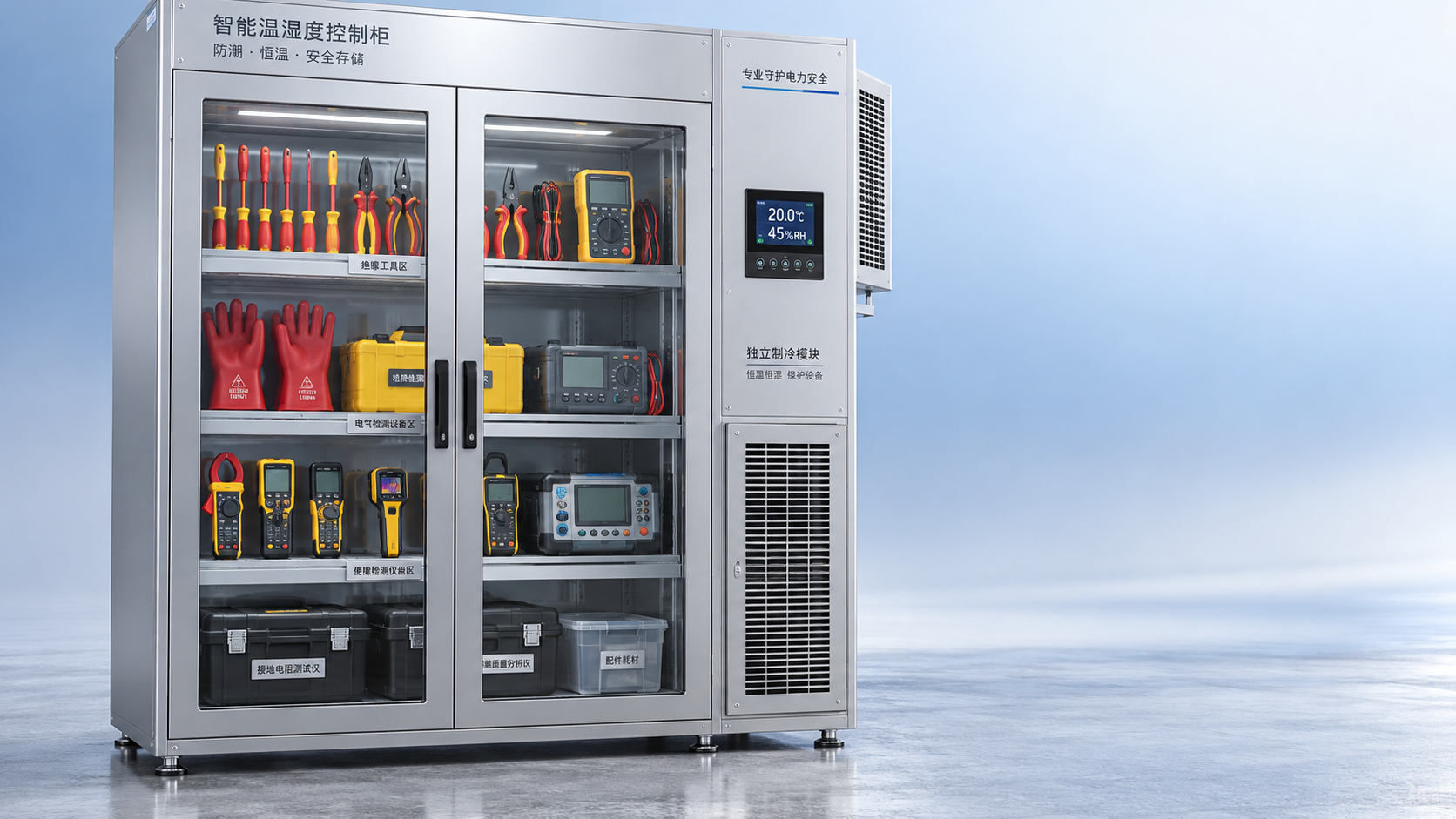
That is why verifying a tool cabinet against IEC-related humidity requirements should be treated as more than a cabinet-purchasing exercise. The real question is whether the cabinet, its installation environment, and its maintenance controls together preserve the condition of the equipment inside.
Safety managers also frequently raise a related standards question: Are IEC 60903 and IEEE 516 insulating glove standards interchangeable? The short answer is no. IEC 60903 addresses the requirements and testing framework for insulating gloves, while IEEE 516 is primarily a guide for maintenance methods and live-line work practices. Both may influence a safety program, but they do not replace one another. Understanding that distinction is important when setting up a compliant storage and inspection system.
Start by defining what “IEC humidity requirements” means for your cabinet
There is no single universal IEC humidity number that automatically applies to every tool cabinet used in the power industry. Requirements depend on what the cabinet stores, where it is installed, and which equipment standard or project specification governs the application.
A metal cabinet in an air-conditioned substation control room faces a different risk profile from one located in a coastal switching station, a wind farm maintenance container, or a humid industrial workshop. In each case, the cabinet itself may be only one part of the environmental control strategy.
When reviewing IEC references, procurement teams commonly encounter several relevant categories:
- IEC 60068 environmental testing standards, which include damp heat and cyclic humidity test methods used to evaluate equipment performance under controlled environmental stress.
- IEC 61439, which is relevant to low-voltage switchgear and controlgear assemblies and provides environmental considerations for assemblies, although it is not a blanket storage specification for every safety-tool cabinet.
- Product-specific standards, such as IEC 60903 for insulating gloves, which establish requirements for the protective item itself rather than a universal cabinet construction standard.
- Utility, contractor, or project specifications, which may set more precise limits for relative humidity, condensation prevention, ingress protection, corrosion resistance, and monitoring.
Before approving a cabinet, ask a practical question: Which standard, customer specification, or equipment manufacturer instruction is this cabinet expected to support? That answer prevents a common mistake—requesting “IEC compliant humidity storage” without identifying the actual test condition or acceptance criterion.
The critical distinction: humidity is not the same as condensation
A cabinet can be located in an area with an acceptable average relative humidity and still expose electrical protective tools to damaging moisture. The biggest concern is often condensation.
Condensation occurs when the cabinet surface or stored equipment falls below the dew point of the surrounding air. This can happen when a cabinet is placed against an exterior wall, installed near an intermittently operating HVAC outlet, opened frequently during humid weather, or left unheated overnight in a cold, damp location.
For insulating equipment, visible water is only part of the concern. Repeated moisture cycling can contribute to corrosion of metal accessories, deterioration of labels and records, contamination on insulating surfaces, fungal growth in unsuitable conditions, and reduced confidence in visual inspections. It may also create an environment in which dust and airborne pollutants adhere more easily to protective equipment.
A useful verification standard is therefore not simply “Can the cabinet withstand humidity?” but “Can the cabinet keep the stored items dry, clean, accessible, and protected from condensation throughout normal operating conditions?”
What to inspect in the cabinet design
A supplier datasheet can be a starting point, but a meaningful verification should look beyond broad claims such as “moisture-resistant” or “weatherproof.” Request technical evidence and inspect the features that affect actual storage performance.
Cabinet body, seams, and door closure
Check the cabinet material, surface treatment, welds or mechanical joints, door overlap, and gasket arrangement. Powder-coated steel, stainless steel, aluminum, or composite construction may each be suitable in the right setting, but material selection should match the local corrosion and humidity exposure.
The door is often the weakest point. Examine whether it closes evenly, whether the gasket remains continuous at corners, and whether the locking system provides consistent compression. A cabinet with a robust body but a poorly aligned door can allow humid air, dust, and insects to enter repeatedly.
Sealing should not be assessed only when the cabinet is new. Ask how gasket replacement is handled, whether hinges can be adjusted, and whether routine inspection of door compression is included in the maintenance plan.
Ventilation versus sealed storage
There is no universal answer to whether a tool cabinet should be ventilated or fully sealed. A cabinet in a clean, climate-controlled electrical room may benefit from limited air exchange. In a tropical, salty, dusty, or unconditioned environment, uncontrolled ventilation may simply introduce humid air.
Where ventilation is needed, it should be intentional: filtered vents, controlled airflow paths, or humidity-managed systems may be more appropriate than open louvers. Where a sealed design is selected, the cabinet still needs a plan for moisture that enters when doors are opened. Desiccant, low-wattage anti-condensation heaters, or controlled dehumidification can be considered, provided they do not expose insulating tools to unsuitable heat or alter manufacturer-recommended storage conditions.
Internal layout matters more than it seems
Even a well-sealed cabinet can create localized moisture problems if tools are packed tightly against cold metal surfaces or stored directly on the cabinet floor. Insulating gloves should not be crushed beneath other equipment. Hot sticks and insulating poles should be supported in a way that avoids bending, abrasion, and contact with contaminated surfaces.
Use shelves, racks, hangers, or dedicated holders that allow air movement around the equipment while keeping it away from potential water accumulation points. Store test records and inspection documents in protected compartments or digital systems rather than leaving paper records exposed to the same humidity risk.
How to verify performance instead of relying on a label
The strongest verification combines document review, physical inspection, environmental measurement, and a defined acceptance process. A cabinet does not need to be tested in a laboratory for every installation, but its claimed environmental performance should be traceable.
- Review the intended use. Identify indoor or outdoor installation, local climate, proximity to salt spray or chemicals, temperature variation, expected door-opening frequency, and the types of tools to be stored.
- Request applicable test documentation. If the supplier states that the enclosure has been evaluated under an IEC 60068 damp heat test or another environmental test, ask which exact test method, duration, severity, sample configuration, and pass criteria were used. “Tested to IEC” without these details is not enough.
- Confirm the enclosure rating separately. An IP rating can be relevant for protection against ingress of solids and water, but it does not by itself demonstrate resistance to internal condensation or prove appropriate storage conditions for insulating equipment.
- Inspect the delivered cabinet. Look for coating damage, exposed edges, incomplete seals, blocked drainage paths, warped doors, poorly fitted cable entries, and corrosion-prone hardware.
- Monitor the installation site. Place a calibrated temperature and relative-humidity data logger inside the cabinet and, where useful, nearby in the room. Monitoring across normal weather cycles and operating conditions provides more meaningful evidence than a one-time reading.
- Set response limits. Establish who reviews the readings, what conditions trigger an inspection, and what action is required if condensation, water ingress, or persistently high humidity is found.
For critical electrical safety equipment, it is wise to document this verification in the site’s safety-equipment register. The record can include cabinet identification, location, environmental design basis, inspection dates, data logger results, corrective actions, and the storage instructions associated with each tool category.
Questions to ask when a supplier cites IEC testing
Technical claims become clearer when they are translated into direct questions. Rather than asking only whether a cabinet is “IEC humidity compliant,” ask:
- Which IEC standard or test method was used?
- Was the test performed on the complete cabinet, including doors, gaskets, locks, vents, and cable entries?
- Did the test assess operation after exposure, corrosion resistance, insulation performance, or only visual condition?
- What temperature and humidity cycle was applied?
- Was condensation present during the test?
- Does the test result apply to the exact cabinet configuration being purchased?
- What storage environment does the supplier recommend for insulating gloves, rods, mats, and detectors?
These questions are especially valuable when comparing cabinets from different manufacturers. One may refer to an enclosure-level ingress test, while another refers to a damp heat test. Neither claim is necessarily inadequate, but they describe different risks and should not be treated as equivalent evidence.
Are IEC 60903 and IEEE 516 insulating glove standards interchangeable?
No. Although both are relevant in the world of electrical protective equipment, they serve different purposes.
IEC 60903 is a product standard for electrically insulating gloves. It addresses glove classification, material performance, dimensions, marking, testing, and related requirements. When selecting gloves for electrical work, IEC 60903 is directly relevant to whether the gloves are designed and evaluated as insulating protective equipment.
IEEE 516, by contrast, is a guide for maintenance methods on energized power lines. It addresses live-line work practices, methods, tools, planning, and safety considerations. It may guide how insulating gloves are used in a work method, but it is not a substitute product certification standard for gloves.
A glove marked or tested according to IEC 60903 should not be assumed to satisfy every procedural expectation in an IEEE 516-based work program. Similarly, a work procedure referencing IEEE 516 does not remove the need to select gloves that meet the applicable product standard, voltage class, inspection requirements, and local regulatory rules.
In some organizations, ASTM standards, regional regulations, utility rules, or customer specifications may also apply. The correct approach is to map each requirement to its purpose: product qualification, periodic electrical testing, storage, inspection, work method, or training. Treating standards as interchangeable can leave gaps precisely where safety programs need clarity.
Humidity control should support—not replace—inspection and testing
A dry, well-managed cabinet is an important protective layer, but it does not make stored equipment permanently safe. Insulating gloves still require the inspections, care, and electrical retesting specified by the applicable standard, regulations, employer procedures, and manufacturer instructions.
Before issue, users should look for cuts, cracks, swelling, sticky areas, discoloration, embedded contamination, ozone damage, or other visible changes. Gloves should be stored away from direct sunlight, sharp objects, oils, solvents, and unnecessary heat. Other insulating tools require similarly careful handling: cleanliness, proper support, secure storage, and protection from physical impact all matter alongside humidity management.
For utilities and industrial maintenance teams, the cabinet should become part of a disciplined equipment-control system rather than a forgotten storage box. Clear identification, organized compartments, inspection status labels, controlled access, and environmental review make it easier to spot problems before equipment reaches the field.
A practical decision rule for safety managers
If the cabinet will hold electrical protective equipment, approve it only when you can answer three questions with confidence: What environmental condition is it designed for? What evidence supports that claim? How will the site confirm that the internal environment remains suitable over time?
That approach is more reliable than searching for a generic “IEC humidity cabinet” label. It recognizes that standards, enclosure design, site climate, and operational discipline all work together.
Manufacturers and solution providers serving the power industry can support this process by providing clear material information, realistic environmental guidance, and storage configurations suited to electrical protective tools. At JINPOWER, the focus on electrical safety equipment includes the practical conditions surrounding its use—because reliable protection depends not only on the tool selected, but also on how carefully it is stored, inspected, and maintained between jobs.
Recommend
 Oct 25, 2026
Homemade Bird Repellent Spray: Recipe Limits and Outdoor Surface Risks
Searching for how to make homemade bird repellent spray? Discover recipe limits, outdoor surface risks, electrical safety tips, and safer deterrents before you spray.
- Oct 25, 2026
Natural Bird Deterrents for Rooftops: Choosing Nonchemical Options
Learn how to repel birds naturally with humane rooftop barriers and smarter maintenance. Compare nonchemical options to protect electrical equipment and keep roof access clear.
- Oct 24, 2026
Home Remedies for Repelling Birds: What to Try on Patios and Railings
Learn how to repel birds with home remedies for cleaner patios and railings. Discover humane DIY options, avoid harmful sprays, and keep deterrents clear of electrical equipment.