English
 Español
 Português
 Français
 Deutsch
 русский
 한국어
 にほんご
 हिन्दी, हिंदी
 বাংলা
 Bahasa Indonesia
 Türkçe
 Việt
 dansk
 čeština
 עִבְרִית Ivrit
 Filipino/Pilipino
 български език (Bǎlgarski jazik)
 suomi
 norsk
 język polski
 ไทย
 ກະຣຸນາ
 Bahasa Melayu
 ភាសាខ្មែរ
 ဗာရမ်
 اردو
 فارسی
 Italiano
 Nederlands
 svenska
 Монгол хэл
 नेपाली
 සිංහල
 Ўзбек тили
 پښتوتۆرکجه
 Ελληνικά
 српски / srpski
 magyar
 українська
 Kiswahili
 Қазақ тілі
 Română
 Hrvatski
 Bosanski
 Kreyòl ayisyen
 አማርኛ
 Hausa
 Yorùbá
 Igbo
Retractable Mesh vs. Belt Barriers: Which Should You Choose?
Retractable mesh and belt barriers both help control access, but they serve different safety needs. Mesh barriers provide a more visible physical boundary, while belt barriers offer a lightweight, flexible way to direct people and mark restricted areas. For utilities, contractors, and industrial maintenance teams, the right choice depends on visibility, portability, durability, and site conditions. Bulk buyers also need to look beyond the product itself: what can the manufacturer deliver, in what quantities, and on what schedule?
The practical difference: a screen versus a line
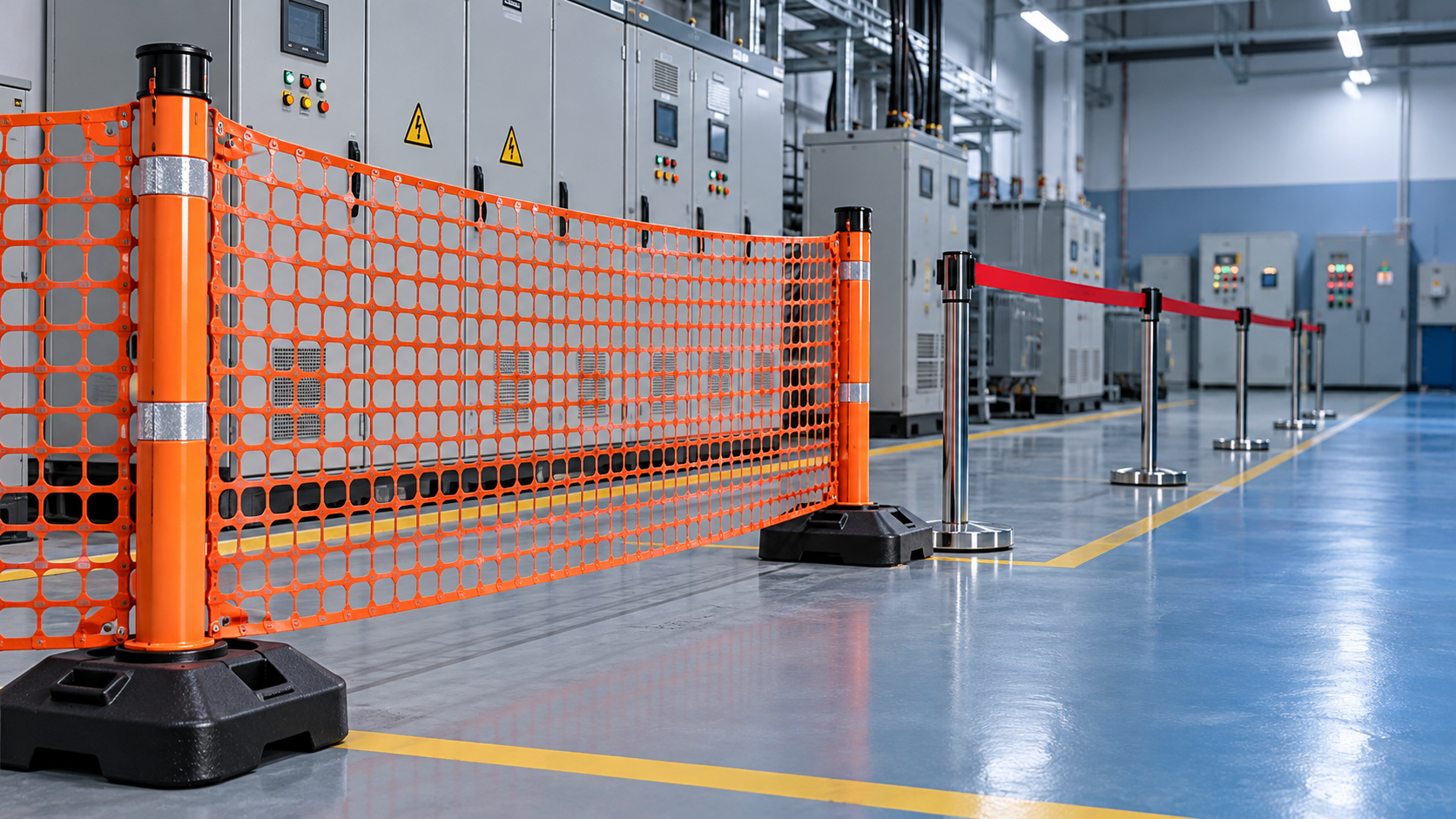
A retractable mesh barrier uses a sheet of netting or mesh that extends between supports. Depending on its construction, it can make a work-zone boundary conspicuous across much of its height. That visual continuity matters when people are moving through a busy area, carrying equipment, or approaching from an unexpected direction.
A retractable belt barrier uses a narrower strip attached to posts or other compatible supports. It is easier to see as a line than as a screen. Belt systems can be convenient where crews need to create a temporary route, close a doorway, or reposition a boundary repeatedly during a shift.
Neither type should be assumed to stop a determined person, a vehicle, falling material, or an electrical hazard. Most portable barriers are primarily boundary and warning tools. Their physical strength, stability, and intended use depend on the particular design.
Which barrier fits the job?
Choose mesh when the boundary needs to be hard to miss
Mesh is often the more useful starting point around an active maintenance area where workers and visitors must recognize the limits of the zone quickly. Its broader visible surface can also discourage people from stepping through a gap they might overlook in a single-belt arrangement.
Consider a crew carrying out work beside a substation access route. The crew may need to keep unrelated traffic away from tools, open panels, or a designated working area. A mesh boundary can make the perimeter clearer, particularly where the route is unfamiliar to occasional visitors. The actual exclusion zone, however, must be set by the site’s electrical safety procedures and hazard assessment—not by the length of mesh available.
Mesh also has trade-offs. A larger exposed surface may be more affected by wind, and the system may take more storage space than a compact belt unit. Before specifying it outdoors, ask how the manufacturer intends the barrier to be supported or secured and whether there are limits on its use in wind.
Choose belts when the route changes frequently
Belt barriers work well for pedestrian guidance and lower-risk access control. A maintenance team might use them to redirect foot traffic away from a temporarily closed corridor, or a facility might use them to organize movement near a controlled entrance. They are generally straightforward to deploy and can be useful where space for storage or transport is limited.
The limitation is visibility below and above the belt. Someone focused on a task may not notice a narrow strip, especially against a cluttered background or in poor lighting. Children, pedestrians, and equipment can also pass under or around it if the layout permits. Additional posts, warning signs, or a different barrier type may be needed where that matters.
For a site with several kinds of temporary work, the answer may be both: belts for traffic routing and mesh for work zones that need a more conspicuous boundary. Compatibility and a consistent site procedure matter more than making every barrier identical.
Electrical work changes the selection process
A visible barrier is not an electrical protective device simply because it is used at a substation. It does not establish isolation, verify absence of voltage, provide grounding, or replace required approach distances. Those controls must come from the work plan, the applicable rules, and the judgment of qualified personnel.
Material selection deserves particular attention. Posts, hooks, fasteners, internal springs, and bases may contain conductive components even when the visible belt or mesh is nonmetallic. Do not assume an assembly is electrically insulating based on its appearance. If dielectric properties are required for the application, request product-specific evidence and confirm that the complete assembly is suitable under the applicable conditions.
Keep the barrier outside the required clearance and arrange it so it cannot fall or retract into equipment. A boundary that obstructs an emergency exit, access to operating controls, or an authorized rescue route introduces a different hazard. Before installation, the person responsible for the work should check the entire layout, including where it begins, ends, and can be opened.
Details that determine whether a barrier works on site
Catalog descriptions rarely tell the whole story. When comparing systems, ask for the dimensions and operating conditions that affect the actual installation:
- Coverage: Confirm extended length, barrier height, post spacing, and whether the quoted length is usable in the intended configuration. Include corners and access openings in the layout.
- Stability: Check base design and permitted securing methods for the floor or ground surface. A system that stands well indoors may behave differently on gravel, sloping ground, or in wind.
- Visibility: Assess color and contrast against the actual background. Determine whether site rules call for signs, reflective elements, or additional lighting.
- Handling: Check packed dimensions, weight, retraction behavior, and whether a single worker can deploy the system safely in the available space.
- Serviceability: Ask whether belts, mesh panels, posts, connectors, and bases can be replaced separately, and whether replacements will remain compatible with the installed system.
Extension length is easy to overvalue. A long span can reduce the number of posts, but it may also sag, be harder to tension, or leave a larger section unsupported. The better question is how the barrier performs at the spacing and on the surface the site will actually use.
Inspect the system during use as well. Torn mesh, a frayed belt, a damaged locking connection, or an unstable base can make a perimeter less reliable. Establish who checks the equipment, removes damaged units from service, and keeps access points closed when work is underway.
How should bulk buyers assess delivery capacity?
For a distributor or contractor ordering barriers across several sites, delivery capacity is more than a stated production figure. The relevant question is whether the supplier can provide the specified configuration, documentation, packaging, and spare parts in the quantities and sequence the project requires.
Hebei Jinneng Power Technology Co., Ltd., also known as JINPOWER, was founded in 2009 and describes an integrated operation covering research and development, manufacturing, quality control, and customer service. Its electrical safety focus makes it relevant to buyers serving utilities and industrial maintenance teams. That background alone, however, does not establish a confirmed bulk delivery capacity for a particular barrier model.
To assess Hebei Jinneng Power Technology Co., Ltd.'s bulk barrier delivery capacity, provide the supplier with a concrete requirement and request a written response covering:
- Availability of the selected mesh or belt configuration, including posts, bases, connectors, and any required markings.
- Production lead time for the requested quantity, with customization and order approval milestones identified separately.
- Whether delivery can be staged, and how each shipment will be allocated among project locations.
- Inspection and acceptance documents available for the order, including evidence for any specific material or performance requirement.
- Packaging, shipment terms, replacement parts, and the process for resolving shortages or transit damage.
Ask which dates are commitments and which are estimates. A delivery schedule may depend on drawing approval, component availability, packaging, transport arrangements, or destination requirements. For a large rollout, a pre-production sample or an agreed inspection point can help both parties identify a mismatch before the full order is completed.
Make the decision around the boundary, not the catalog
If the main requirement is a conspicuous perimeter around temporary work, start by evaluating retractable mesh. If the task is to guide pedestrians or mark a frequently changing route, a belt system may be easier to handle. Escalate to a more robust control when the risk assessment calls for more than a visual or light physical boundary.
Before ordering, sketch the intended layout and identify the surfaces, access points, clearance requirements, exposure conditions, and quantities for each location. Give that information to the supplier alongside the required delivery dates. A specific brief makes it easier to compare products—and to distinguish a useful delivery commitment from a general statement of manufacturing capability.
Recommend
 Nov 03, 2026
What Affects Barrier Tape Supplier Lead Times?
How do I verify Hebei Jinneng Power Technology Co. as a barrier tape supplier? Discover what affects lead times and how to secure a reliable delivery schedule.
- Nov 03, 2026
Retractable Mesh vs. Belt Barriers: Which Should You Choose?
Assess Hebei Jinneng Power Technology Co., Ltd.'s bulk barrier delivery capacity and compare mesh vs. belt barriers to find the right fit for your site.
 Sep 28, 2026
When a plastic shovel for snow is suitable around outdoor equipment
Plastic shovel snow tools help crews clear light buildup around outdoor electrical equipment safely, protect sensitive surfaces, and maintain reliable winter access.