English
 Español
 Português
 Français
 Deutsch
 русский
 한국어
 にほんご
 हिन्दी, हिंदी
 বাংলা
 Bahasa Indonesia
 Türkçe
 Việt
 dansk
 čeština
 עִבְרִית Ivrit
 Filipino/Pilipino
 български език (Bǎlgarski jazik)
 suomi
 norsk
 język polski
 ไทย
 ກະຣຸນາ
 Bahasa Melayu
 ភាសាខ្មែរ
 ဗာရမ်
 اردو
 فارسی
 Italiano
 Nederlands
 svenska
 Монгол хэл
 नेपाली
 සිංහල
 Ўзбек тили
 پښتوتۆرکجه
 Ελληνικά
 српски / srpski
 magyar
 українська
 Kiswahili
 Қазақ тілі
 Română
 Hrvatski
 Bosanski
 Kreyòl ayisyen
 አማርኛ
 Hausa
 Yorùbá
 Igbo
Is Mesh More Visible Than a Single Belt Around a Work Area?
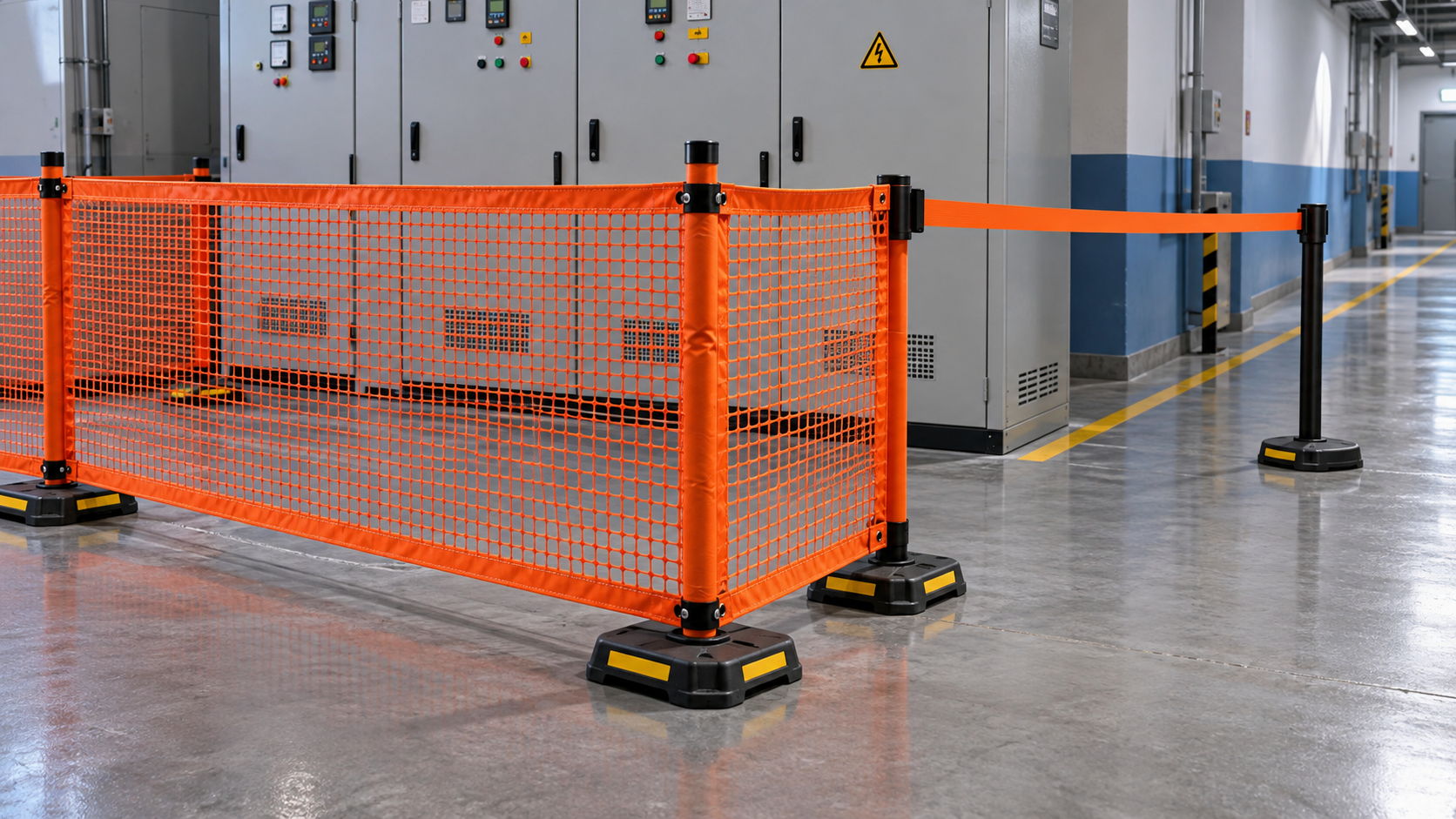
A mesh barrier is generally easier to notice than a single belt when it presents a larger, well-contrasted surface across the approach to a work area. That advantage is especially useful where someone might overlook a narrow horizontal line against equipment, fencing, or a busy maintenance background. However, a bright, taut belt can be more conspicuous than faded, open-weave mesh that blends into its surroundings.
The practical distinction is between seeing the boundary, understanding its meaning, and being prevented from crossing it. These are separate functions. Mesh can strengthen the visual presence of a perimeter, while a single belt can mark a simple boundary efficiently. Neither an ordinary mesh screen nor a retractable belt should be treated as electrical insulation, an arc-flash shield, or a protective guard merely because it surrounds electrical work.
Why a larger surface helps—and when it does not
A single belt creates a narrow horizontal signal. Mesh extends that signal vertically, making the boundary occupy more of a person’s field of view. Someone looking toward a task, doorway, or piece of equipment has more opportunity to notice a broad panel than a thin strip.
That does not mean a mesh panel’s full dimensions represent an equally visible surface. Its openings allow the background to remain visible. A fine, brightly colored mesh with substantial strands can present a distinct colored field; a very open mesh may appear as little more than scattered lines, particularly at a distance.
This distinction matters when comparing specifications. Overall panel height and length describe the area enclosed, but not how strongly the material stands out. Mesh opening size, strand width, color, border construction, and installation tension all influence the visual result. A broad contrasting top border may remain noticeable even where the mesh beneath it becomes difficult to distinguish.
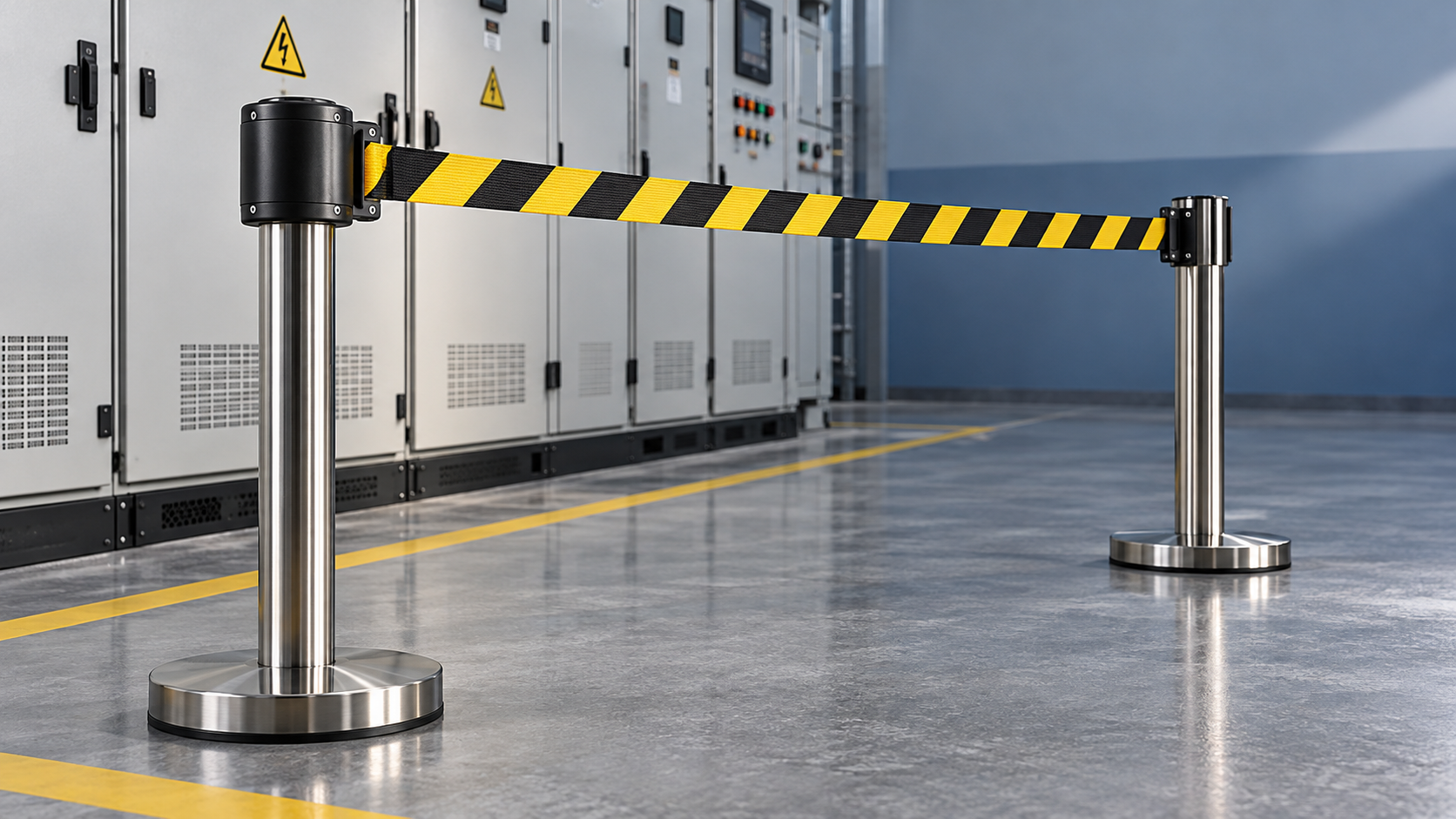
A belt has less surface area, but its continuous, opaque strip can create a clean line. Against a plain background, that line may be immediately recognizable. The useful comparison is therefore not simply “large mesh versus small belt,” but the visible contrast each installed system creates from the actual approach route.
The background can reverse the apparent advantage
Color should be assessed against the surroundings rather than selected from a catalog alone. Orange mesh may stand out against gray equipment but lose distinction beside orange construction materials. Green mesh can merge with vegetation or painted fencing. A yellow belt can be conspicuous against a dark wall yet less distinct against pale surfaces under strong lighting.
Electrical facilities introduce another complication: visual clutter. Cable runs, structural members, pipework, equipment labels, and existing fencing can compete with the barrier. Mesh superimposed on chain-link fencing may become difficult to separate from the background pattern. A continuous belt with contrasting markings can sometimes create a clearer boundary in that setting.
Conversely, a single belt running across a background of horizontal rails or cables can look like another part of the installation. A mesh panel that interrupts those lines may communicate the work-area edge more clearly.
The most useful check is to view the proposed barrier from where people will first encounter it—not just while standing beside the support post. Include approaches from adjacent aisles, building exits, and around equipment. A barrier that looks bright at close range may not become recognizable early enough for someone to change direction comfortably.
Lighting and approach angle matter as much as color
Daylight visibility does not establish night-time performance. Fluorescent colors can improve conspicuity under suitable daylight conditions, but fluorescence is not a substitute for illumination after dark. Retroreflective markings return light toward its source; their benefit depends on the relationship between the light, barrier, and observer. They do not make the whole perimeter self-illuminating.
Under vehicle headlights, a belt with suitable reflective features may be more noticeable than unmarked mesh. Under fixed work lights, a broad mesh panel may be easier to distinguish, provided it is illuminated and contrasts with the background. Backlighting can change either result by making colors harder to recognize and emphasizing silhouettes instead.
Approach angle creates a separate limitation. Both mesh and belts lose apparent surface area when viewed nearly edge-on. A long perimeter that is obvious from directly in front may be difficult to detect from a side aisle. Wider mesh does not eliminate this geometric problem.
At corners and access points, clearly marked posts, return sections, and correctly oriented signs can help establish the boundary. Where pedestrians and vehicles share access routes, check visibility from both pedestrian eye level and the relevant driving position. Equipment, parked vehicles, and stored materials can conceal a single belt or a substantial portion of a mesh panel.
Mesh communicates enclosure; a belt communicates a line
Visibility involves recognition as well as detection. People must understand that the object marks a restricted work area rather than a queue, storage boundary, or temporary housekeeping arrangement.
Mesh provides a stronger visual impression of enclosure because it occupies the space between supports. It can make a maintenance zone look distinct from the surrounding circulation area. A single belt leaves open space above and below it, so the perimeter relies more heavily on the uninterrupted line, signs, and local understanding of the barrier system.
This does not establish that mesh prevents entry. Lightweight mesh can be displaced or lifted, and a belt can be stepped over or passed underneath. Where unauthorized access must be physically prevented, the decision extends beyond these two visual demarcation options to an appropriately designed access-control or guarding system.
Signs should communicate the relevant restriction at likely entry points. A large mesh panel does not guarantee that a small attached warning is readable. Likewise, lettering on a belt may identify a restriction only at close range. Detecting the perimeter and reading the instruction require separate checks.
The installed shape determines whether the advantage lasts
A comparison made with new materials held flat can miss the main operational difference. Barriers must retain their intended position throughout the work.
Loose mesh can fold, bunch, or sag, reducing its visible area and creating unclear openings. Wind loads can pull on the panel and its supports. Mesh openings reduce wind resistance compared with a solid sheet, but they do not eliminate it. Panel dimensions, porosity, attachment points, post spacing, and base stability all matter.
A belt can also sag or twist. If its narrow edge faces the observer, much of its intended visual surface disappears. An excessive span can make the boundary less consistent, while a poorly positioned support can leave an apparent passage at a corner.
These differences affect purchasing decisions because the barrier is a system, not just a roll of material. Support compatibility, attachment security, intended span, and the ability to restore the perimeter after access are directly relevant to sustained visibility. A visually prominent material on unstable supports is not a reliable improvement.
Condition also changes the comparison. Dirt can reduce color contrast; exposure and abrasion can degrade appearance; damaged mesh edges or worn belt markings can make the boundary harder to interpret. Inspection should consider whether the installed perimeter remains conspicuous, rather than checking only whether the material is still present.
Electrical work requires a separate judgment about protection
In substations and electrical maintenance areas, a highly visible boundary can support access control, but its appearance says nothing about its electrical protective properties. Ordinary plastic mesh and fabric belts must not be assumed suitable for contact with energized equipment. Nonmetallic construction alone does not establish a dielectric rating or suitability for the intended electrical exposure.
The boundary position must follow the task-specific risk assessment, applicable rules, and site procedures. Choosing a taller or brighter barrier does not justify placing it closer to a hazard. Supports, attachments, and installation activities must also be considered, particularly where setting up or moving the barrier could bring people or objects into an unsafe position.
Mesh may also obscure lower-level equipment, floor conditions, or labels, depending on its density and placement. A belt preserves more of the sightline through the work area. That can be useful where visibility of equipment or approaching traffic is important, although it does not automatically outweigh the need for a more prominent perimeter.
If a specification calls for electrical insulation, arc protection, mechanical guarding, or impact resistance, those requirements need their own documented evidence. A claim such as “high-visibility safety barrier” does not establish any of those functions.
Choose by testing the actual boundary, not just the material
A practical comparison uses representative samples installed with the proposed supports, spans, and signs. Assess them under the lighting and access conditions expected during the job. A photograph taken directly in front of a sample is insufficient: camera exposure and image processing can alter apparent brightness, and the image may omit important approach angles.
The assessment should distinguish several questions:
- Detection: Is the barrier noticeable before someone reaches the point where they need to stop or change route?
- Recognition: Does it clearly identify a restricted work area rather than blend into existing equipment or fencing?
- Continuity: Are corners, openings, and transitions between sections unambiguous?
- Service condition: Does the boundary remain clear after normal access, movement, wind exposure, and expected soiling?
For a temporary indoor boundary with controlled access, clear sightlines, and frequent authorized passage, a well-positioned belt can provide effective visual demarcation without the handling demands of mesh. For a larger work zone where a narrow line is easily lost against the surroundings, mesh offers a stronger visual presence—provided its color, weave, supports, and placement preserve that advantage.
The deciding question is not whether mesh is inherently safer or brighter. It is whether the complete installed perimeter is detected and understood early enough under the conditions in which people will encounter it. Where neither option achieves that reliably, the remedy may be better lighting, different placement, clearer access points, or a more substantial barrier system—not simply more mesh.
Recommend
 Nov 01, 2026
Plastic vs. Steel Barrier Stands: Which Suits Substation Maintenance?
Are plastic barrier stands better than steel ones for substation maintenance? Compare electrical considerations, stability, and durability to choose the right system for your crew.
- Nov 01, 2026
Is Mesh More Visible Than a Single Belt Around a Work Area?
Is a mesh barrier easier to see than a single belt around a work area? Compare visibility, lighting, and site conditions to choose the right boundary for electrical maintenance.
- Oct 31, 2026
How Do You Evaluate Slow-Retracting Safety Barriers?
Evaluate slow retracting safety barriers with practical checks for controlled return, secure mounting, and durability. Discover how to choose the right barrier for electrical work zones.