English
 Español
 Português
 Français
 Deutsch
 русский
 한국어
 にほんご
 हिन्दी, हिंदी
 বাংলা
 Bahasa Indonesia
 Türkçe
 Việt
 dansk
 čeština
 עִבְרִית Ivrit
 Filipino/Pilipino
 български език (Bǎlgarski jazik)
 suomi
 norsk
 język polski
 ไทย
 ກະຣຸນາ
 Bahasa Melayu
 ភាសាខ្មែរ
 ဗာရမ်
 اردو
 فارسی
 Italiano
 Nederlands
 svenska
 Монгол хэл
 नेपाली
 සිංහල
 Ўзбек тили
 پښتوتۆرکجه
 Ελληνικά
 српски / srpski
 magyar
 українська
 Kiswahili
 Қазақ тілі
 Română
 Hrvatski
 Bosanski
 Kreyòl ayisyen
 አማርኛ
 Hausa
 Yorùbá
 Igbo
Is a Longer Retractable Barrier Belt Worth the Extra Cost?
A longer retractable barrier belt is worth the extra cost when its additional reach removes a post, closes a wider opening, or makes a frequently repeated setup quicker. The premium is harder to justify when most openings already fit a shorter belt, intermediate supports remain necessary, or outdoor conditions make the longer span difficult to manage.
The useful comparison is the cost of a complete, workable barrier arrangement. Extra belt length has value only when the installed barrier remains visible, stable, easy to release, and reliable during retraction. Around electrical equipment, it also needs a clearly defined role: marking restricted access. A retractable belt does not provide electrical insulation, establish a safe approach distance, or replace the protective measures required for the work.
Extra reach pays when it changes the layout
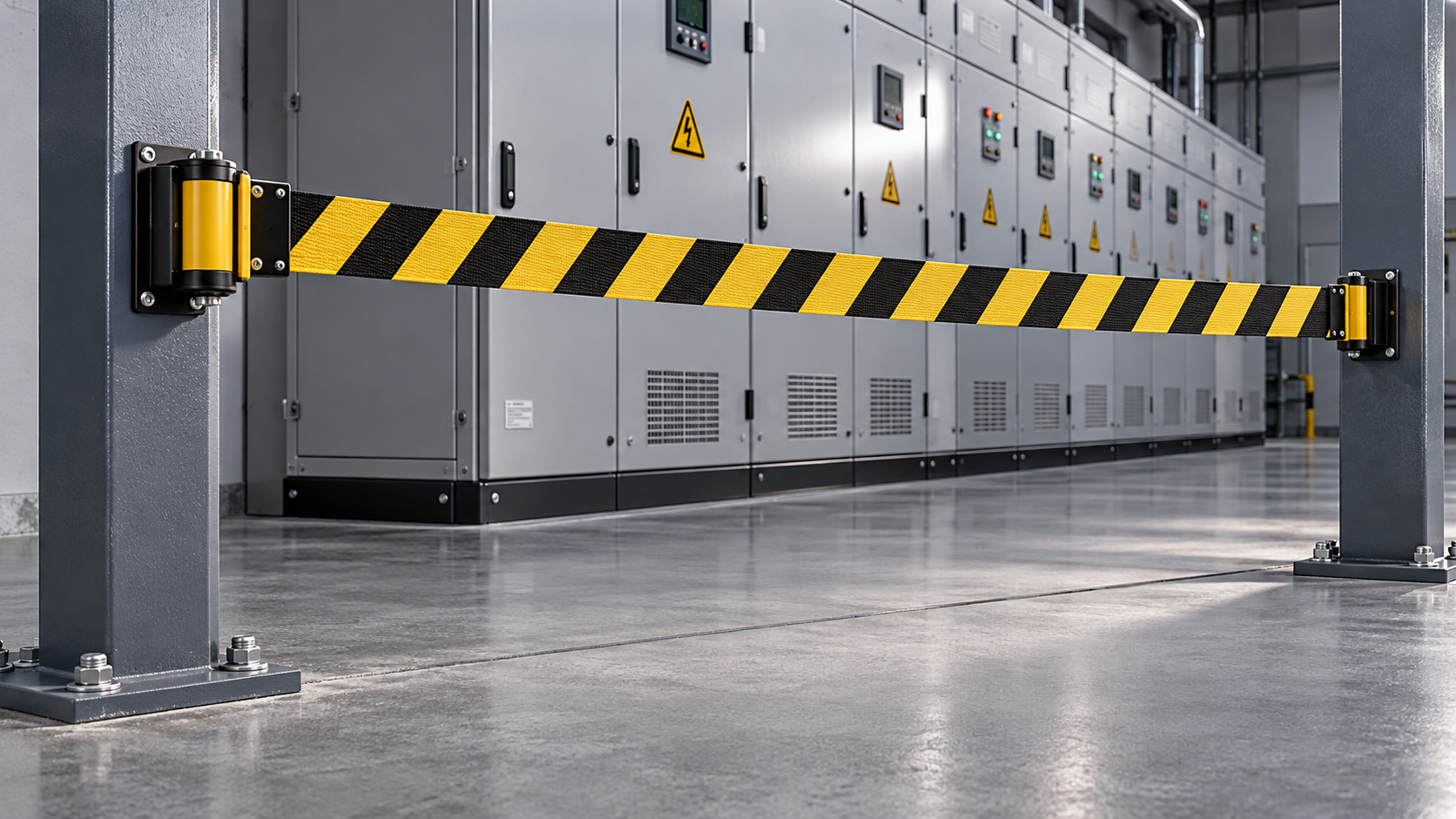
Consider a wide entrance that a shorter belt cannot span between suitable mounting points. A longer version could close that opening with one belt and one receiver. Using shorter belts would require an intermediate post or a different arrangement. In that situation, the longer belt offers a practical saving: fewer components to purchase, position, move, and store.
The same logic does not apply to every boundary. A barrier that turns around equipment still needs support at the corners. A longer belt cannot float around a change of direction, and routing it across an opening diagonally changes the restricted area. Additional reach saves equipment mainly on straight runs with appropriate endpoints.
Mounting positions also matter more than the opening’s nominal width. The actual span runs between the cassette outlet and the receiving connection. Offset bases, recessed mounting locations, and obstructions can increase that distance. Measure the intended belt path before comparing lengths, rather than relying on a doorway dimension or a site drawing alone.
Maximum extension is only one specification
An advertised belt length describes available reach. It does not, by itself, establish how well the belt performs across that distance. Webbing weight, spring tension, mounting height, endpoint rigidity, and exposure all affect the installed result. Two products with the same maximum extension can behave differently when stretched across the same opening.
At an otherwise unchanged tension, a longer unsupported span develops more sag under its own weight. Increasing tension reduces sag, but transfers greater force to the mounting points. A freestanding post must resist that pull without leaning, sliding, or becoming unstable. The base and cassette therefore need to be assessed together.
A visibly drooping belt is not automatically evidence of a weak spring. It could reflect an excessive span, unequal mounting heights, flexible supports, or damaged webbing. Replacing the cassette with a stronger mechanism will not correct every cause. It could instead expose a stability problem in the posts.
Compare performance at the intended working span, not just the maximum length printed in the specification. If a manufacturer states a recommended operating span, mounting requirement, or extension limit, use that information. Where only maximum reach is published, request clarification about suitability for the proposed arrangement rather than assuming that every installation up to that length performs equally well.
Visibility needs to survive the longer span
A longer belt does not necessarily create a clearer boundary. Sag can lower its midpoint behind stored materials or surrounding equipment. Twisting can turn a printed warning away from an approaching person. A narrow strip that is obvious at an entrance may be harder to distinguish across a busy industrial background.
Belt width, contrast, print orientation, and the surrounding lighting all deserve attention. Wider webbing offers a larger visible surface, but also presents more area to wind. Select those features together instead of treating width as a universal improvement. Where a written warning carries essential meaning, establish whether it remains readable from the likely approach directions.
Retraction quality can outweigh the extra metres
A long belt that takes repeated attempts to rewind can erase the convenience gained during deployment. The cassette must accommodate the full webbing length, guide it onto the spool, and control its return. Performance depends on the mechanism’s design and condition; a longer belt is not inherently smoother or rougher than a shorter one.
Useful evidence includes controlled return, consistent tracking into the housing, and a connector that seats without striking surrounding surfaces. Ask how the mechanism behaves near full extension and during the final part of retraction. A vague description such as “heavy duty” gives little information about these operating characteristics.
Retraction also affects handling. Releasing the end and allowing it to travel freely can cause whipping or impact. The connector should be guided back according to the manufacturer’s instructions. With a longer belt, the return path covers more space, making clear access between the receiver and cassette especially relevant.
A lock or brake deserves separate attention. A mechanism that holds the belt at an intermediate extension serves a different purpose from one that slows its return. Confirm what the feature actually does, how it releases, and whether it suits frequent opening. Similar product descriptions can conceal different operating arrangements.
Compare complete arrangements, including replacement parts
The price difference between two individual units is only the starting point. Compare the components required to close the same opening: cassettes, posts, bases, receivers, mounting hardware, and any intermediate supports. A longer unit that removes a post can be economical even with a higher purchase price. If the same supports remain necessary, the saving becomes less convincing.
A simple comparison is:
Additional cost of the longer arrangement − cost of genuinely avoided components − value of repeat setup savings + additional maintenance or replacement expense.
This is a decision framework rather than a promise of savings. Use actual quotations and observed setup times. Do not count a post as “avoided” if the long span still needs it for stability, visibility, or a change of direction. Likewise, count setup savings only for arrangements that will actually be deployed repeatedly.
Replacement design can change the ownership cost substantially. With a serviceable cassette, worn webbing or a failed return mechanism might be replaced without discarding the post. An integrated assembly may require replacement of a larger unit. Availability, compatibility, and replacement instructions matter more than an unsupported claim about service life.
Longer webbing also exposes more material to contact during each full deployment. Dirt dragged into the housing, abrasion against rough edges, and damage near the connector can affect operation. A long belt kept clear of surfaces may remain in better condition than a short one repeatedly pulled across concrete. Length alone is a poor predictor of durability.
Outdoor exposure can change the answer
Across an exposed opening, wind can make the webbing flutter, twist, or pull against the endpoints. A longer span presents more exposed belt area when width is unchanged. The effect depends on wind direction, local shelter, belt construction, and mounting arrangement. An indoor demonstration provides little evidence of performance beside an open yard or access road.
Adding weight to a base does not resolve every issue. It may improve resistance to movement while leaving the belt difficult to read or control. A shorter span with intermediate support can be more practical where movement is persistent, even though it adds components.
Outdoor suitability also involves resistance to sunlight and moisture, corrosion protection for hardware, and the cassette’s permitted exposure. These properties need product-specific confirmation. A longer belt with no stated outdoor suitability offers poor value for a location where it must remain deployed in changing weather.
Around electrical installations, material appearance is not evidence of electrical protection. Plastic housings and synthetic webbing must not be treated as rated insulating barriers. Position the arrangement according to the site’s access controls and electrical safety procedures; do not use the belt’s convenient reach to determine the boundary of a hazardous area.
A site trial should answer a specific question
Where the price premium is substantial or the span approaches the proposed unit’s limit, a demonstration at the intended location is useful. The question is whether the longer arrangement performs the task with fewer resources and acceptable handling. Simply proving that the connector reaches the receiver leaves most of the comparison unresolved.
Set the endpoints at their planned positions and heights. Observe the belt from the actual approach paths, including any direction where equipment or stored materials obstruct the view. Look for midpoint sag, twisting, base movement, and interference with normal access. If the arrangement is outdoors, assess it under representative conditions within the product’s stated operating limits.
Then open, close, and retract it using the normal working sequence. Pay attention to whether the receiver is convenient to reach, whether the connector releases predictably, and whether the returning belt tracks cleanly. A longer span that demands awkward handling at every opening can be a poor trade even when it removes a post.
Record the full setup and collection time for both arrangements, including moving bases and storing components. This exposes the difference between theoretical convenience and an actual reduction in work. It also reveals whether the larger cassette or heavier base introduces a handling burden elsewhere.
When the premium is justified
Paying more makes sense when the required span regularly exceeds the shorter option, the longer unit removes a real component or repeated task, and its installed performance meets the site’s needs. Those conditions connect the premium to a measurable benefit.
Choose the shorter arrangement when most openings fit comfortably within its reach, corners determine the number of supports, or a long unsupported run creates recurring visibility and stability problems. A mixed inventory can also be sensible: shorter units for routine openings and a smaller number of longer units for locations that genuinely require them.
The strongest reason to buy extra length is an identified span that it handles well. Unused reach has little value on its own.
Recommend
 Nov 02, 2026
Are Magnetic Barrier Mounts Suitable for Switchgear Enclosures?
Are magnetic barrier mounts suitable for electrical switchgear enclosures? Discover key checks for steel compatibility, holding strength, and placement to choose the right mounting solution.
- Nov 02, 2026
Is a Longer Retractable Barrier Belt Worth the Extra Cost?
Is a longer retractable belt worth the extra cost? Compare setup savings, stability, and retraction quality to find the best-value access barrier for your electrical equipment area.
- Nov 01, 2026
Plastic vs. Steel Barrier Stands: Which Suits Substation Maintenance?
Are plastic barrier stands better than steel ones for substation maintenance? Compare electrical considerations, stability, and durability to choose the right system for your crew.