English
 Español
 Português
 Français
 Deutsch
 русский
 한국어
한국어 にほんご
にほんご हिन्दी, हिंदी
 বাংলা
বাংলা Bahasa Indonesia
 Türkçe
 Việt
Việt dansk
dansk čeština
 עִבְרִית Ivrit
 Filipino/Pilipino
 български език (Bǎlgarski jazik)
 suomi
suomi norsk
norsk język polski
 ไทย
ไทย ກະຣຸນາ
 Bahasa Melayu
 ភាសាខ្មែរ
 ဗာရမ်
ဗာရမ် اردو
اردو فارسی
فارسی Italiano
 Nederlands
 svenska
 Монгол хэл
 नेपाली
 සිංහල
සිංහල Ўзбек тили
 پښتوتۆرکجه
 Ελληνικά
 српски / srpski
 magyar
 українська
 Kiswahili
 Қазақ тілі
 Română
 Hrvatski
 Bosanski
 Kreyòl ayisyen
 አማርኛ
አማርኛ Hausa
Hausa Yorùbá
 Igbo
IgboTool Cabinets With Dehumidifiers: What Should Buyers Compare Before Ordering?
The cabinet is only valuable if its moisture control matches the tools inside it
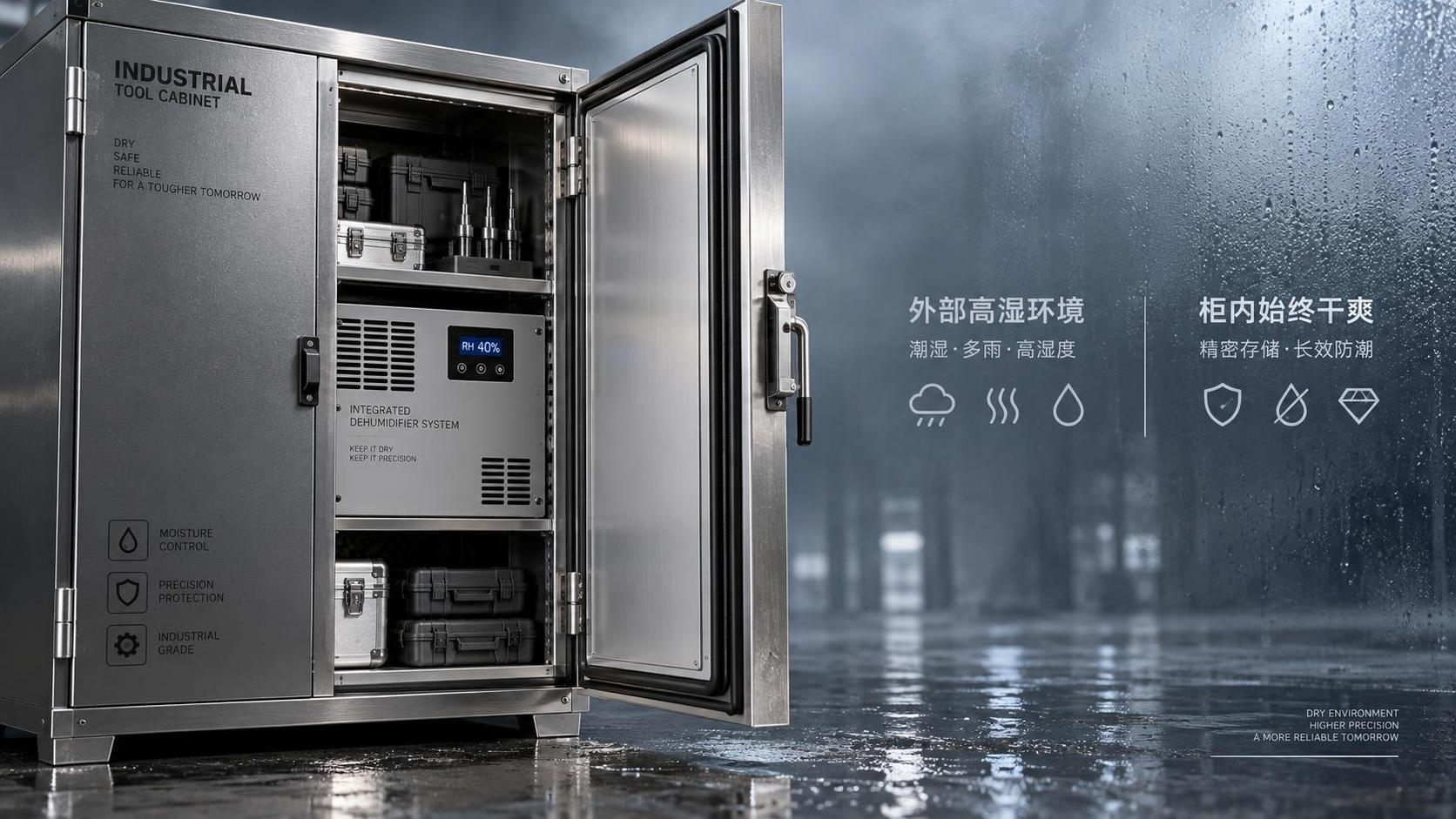
A tool cabinet with dehumidifier should not be compared as a standard steel cabinet with an added electrical accessory. In electrical maintenance environments, the purchasing decision concerns whether the complete storage system can preserve the condition, traceability, and ready availability of insulated tools over its service life. A cabinet that merely warms the internal air, has poor door sealing, or cannot recover after frequent opening may offer little protection in a humid substation room or a maintenance depot with changing ambient conditions.
The first comparison point is therefore not cabinet price or external dimensions. It is the relationship between the cabinet’s humidity-control method, the site environment, the stored equipment, and the way operators access the cabinet. This relationship determines energy use, maintenance burden, useful internal capacity, and the risk of tools being returned to service in unsuitable condition.
For insulated rods, gloves, insulating boots, voltage detectors, grounding equipment, protective clothing, and related electrical safety items, storage cannot replace periodic inspection and testing. It can, however, reduce avoidable exposure to moisture, dust, deformation, poor organization, and accidental damage between uses. That is where the commercial case for a controlled cabinet is strongest.
Compare humidity performance as a system, not as a feature list
“Dehumidifier included” is not a meaningful specification on its own. Suppliers may use different approaches: a heating element to reduce relative humidity, a refrigeration-based dehumidifier, a desiccant-based unit, or a combination of heating, ventilation, and sealed storage. Each option behaves differently under low ambient temperature, high outside humidity, frequent door opening, and varying internal loads.
A heating solution may be practical where the cabinet remains in an enclosed electrical room and modest temperature elevation is acceptable for the stored items. It works by raising air temperature and lowering relative humidity, but it does not remove water from the cabinet in the same way as a dehumidification unit. If damp air is repeatedly introduced through open doors or leaks, heating alone can be an incomplete solution. Buyers should ask whether the proposed configuration is intended to prevent condensation, maintain a controlled relative-humidity range, or actively remove moisture from the air. These are different performance objectives.
The supplier should be able to define the control arrangement in operational terms:
- the humidity or temperature setpoint range and whether it is adjustable;
- the sensor location inside the cabinet and its calibration or replacement arrangements;
- how the system responds after doors are opened;
- the expected operating condition, including ambient temperature and humidity limits;
- whether the cabinet needs a drain, water container, external ventilation, or periodic desiccant replacement;
- what alarm, display, or fault indication is provided when humidity control is unavailable.
Recovery performance deserves particular attention. A cabinet located in a transmission maintenance unit may be opened several times during shift preparation, while one in a controlled substation room may stay closed for long periods. A quoted humidity level measured with doors closed and no internal load does not describe either use case adequately. Request a clear statement of performance conditions rather than relying on an isolated display reading or a generic “moisture-proof” claim.
Also verify whether the tools themselves impose storage restrictions. Some rubber insulating products, electronic instruments, batteries, adhesives, and protective garments may have different temperature or ventilation requirements. A cabinet should not be specified at a temperature that benefits moisture control while accelerating deterioration of another stored item. The correct requirement is compatible environmental control for the actual inventory, not the lowest possible humidity reading.
Internal capacity is a layout question before it is a volume question
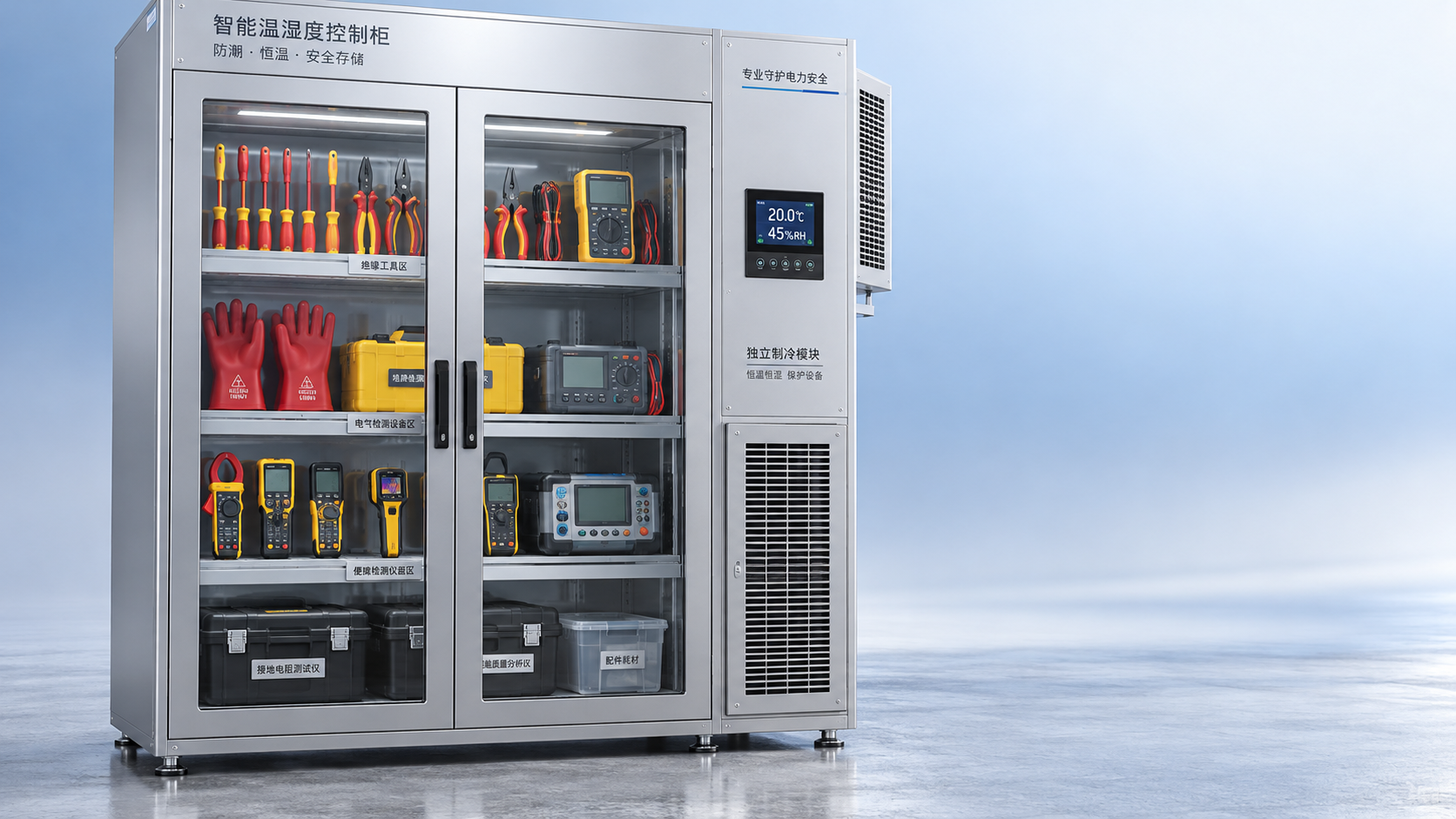
External dimensions and nominal cabinet volume are easy to compare, but they do not show whether the cabinet can accommodate the tool mix safely. Long insulating poles, rescue hooks, portable grounding sets, insulated ladders, arc-rated clothing, gloves, boots, and test devices each require different storage conditions. A cabinet designed around shelves alone can waste space or create handling hazards when long and heavy items must be lifted over other equipment.
Procurement specifications should identify the stored articles by type, approximate dimensions, weight, quantity, and access frequency. The supplier can then propose a credible arrangement of shelves, hanging rails, rod holders, drawers, partitions, and labeled zones. The goal is not maximum packing density. It is to prevent tools from bending, falling, being stacked on sensitive equipment, or becoming difficult to inspect before use.
For large tools, assess the usable height and depth after accounting for the dehumidification module, air channels, shelving brackets, and door clearance. A wide cabinet may still be unsuitable if a long insulating rod must be stored diagonally or if the door opening is restricted by adjacent switchgear. Delivery-site measurements should include passageways, lifts, doorways, plinths, and the final installation position—not only the available wall space.
Load-bearing capacity must be documented at more than cabinet level. Ask for the allowable distributed load of each shelf, the load limit of drawers and pull-out frames, and the anchoring requirement for the complete unit. Heavy electrical safety equipment can create a high center of gravity, particularly where tools are stored in upper sections. Anti-tip provisions and floor or wall fixing points should be considered part of the cabinet requirement, not optional extras decided after installation.
Where a higher-capacity arrangement is needed for substations, distribution rooms, or maintenance centers, a configuration such as a Heavy-duty electrical safety equipment cabinet may be relevant if its internal zoning, structural load rating, ventilation route, and moisture-control option are specified against the actual inventory. “Heavy-duty” should be supported by construction and load data, rather than accepted as a descriptive label.
Cabinet construction affects both durability and humidity stability
Thin sheet metal, poorly aligned doors, exposed fasteners, and weak hinges can undermine a technically capable dehumidification unit. Air leakage increases the moisture load. Door distortion can prevent proper closing. Corrosion around seams and the cabinet base can become a long-term maintenance issue in utility buildings, coastal locations, or rooms exposed to damp concrete floors.
Compare the following construction details:
- steel grade, sheet thickness, reinforcement around shelves and door frames, and weld quality;
- surface treatment and coating system, especially at cut edges, joints, the base, and locations prone to abrasion;
- door gasket design, locking points, hinge durability, and the ability to replace worn seals;
- raised base, adjustable feet, or other measures that prevent direct contact with wet floors;
- cable-entry design and sealing where the cabinet requires a mains connection;
- the separation between electrical components and stored tools, including protection against accidental contact.
Ventilation requires careful interpretation. A ventilated cabinet can reduce stagnant air and may be useful for particular stored equipment. But unrestricted ventilation conflicts with maintaining a low and stable internal humidity level. The buyer should ask how airflow is controlled: whether vents are adjustable, whether they form part of a closed-loop system, and whether the specified humidity performance assumes vents open or closed. A cabinet cannot be judged by treating “ventilated” and “dehumidified” as automatically complementary features.
Finish quality also has a practical procurement consequence. Scratches and corrosion inside the cabinet can contaminate stored protective equipment or make periodic cleaning harder. Smooth, accessible internal surfaces and removable or adjustable storage components can reduce the effort required to keep the cabinet orderly and inspectable.
Electrical safety requirements need to cover the cabinet itself
A powered cabinet introduces electrical installation questions that are sometimes overlooked because the stored products are electrical safety tools. Confirm rated voltage, frequency, connected load, plug type, cable length, earthing arrangement, overcurrent protection, and the required ingress protection for the installation environment. If the cabinet will be supplied across borders, these details must be aligned with the destination market and the site’s electrical system before production begins.
Control components should be accessible for service without requiring tools to be removed or exposing personnel to live parts. Ask whether the cabinet includes independent over-temperature protection where heating is used, and what happens after a power interruption. Some sites may require an alarm or a visible status indication because a failed humidity-control function could otherwise remain unnoticed for an extended period.
Claims of compliance should be separated into three categories: regulations applying to the cabinet as an electrical product, site-specific rules governing installation, and standards governing the safety tools stored inside. A cabinet does not make an insulating tool compliant, nor does an insulating-tool standard automatically certify a storage cabinet. Procurement documents should request the relevant declarations, test records, electrical component documentation, and destination-market markings that actually apply to the supplied configuration. Broad claims such as “international standard” are insufficient without identifying the applicable requirement and scope.
The lower purchase price can create the higher operating cost
The cost comparison should include more than the cabinet invoice value. A low-cost cabinet can become expensive if it consumes unnecessary power, requires frequent replacement of consumables, lacks available spare parts, or does not prevent damage to tools that must be replaced or withdrawn from service.
Energy cost depends on the control method, cabinet volume, insulation, door leakage, setpoint, local climate, and access pattern. Instead of accepting a vague statement that a unit is “energy saving,” request rated power, normal operating power where available, controller logic, and the conditions under which those figures were obtained. A continuously energized heating element and a humidity-controlled system that cycles only when needed may have very different annual consumption, but the better option depends on the moisture load and required storage conditions.
Maintenance obligations should be priced before ordering. These can include cleaning air filters, emptying condensate, checking drains, replacing desiccant, calibrating or replacing humidity sensors, inspecting door seals, and sourcing control modules or heating elements. The quotation should state which parts are consumable, their expected replacement basis, warranty coverage, and whether replacement components will remain available after the initial warranty period.
A useful total-cost comparison includes the cabinet price, freight and installation, electrical connection work, expected energy consumption, routine maintenance, spare parts, and the expected cost of unmanaged tool deterioration or disorganized storage. It is rarely necessary to assign a speculative monetary value to every risk. The exercise is still valuable because it exposes whether one proposal transfers significant ongoing work and uncertainty to the operating site.
Ordering documents should turn expectations into inspectable requirements
Ambiguous purchase orders are a common source of disputes. “Tool cabinet with dehumidifier,” “moisture-proof,” and “suitable for electrical tools” leave too much room for differing interpretations. The technical schedule should define the intended location, ambient conditions, inventory list, required internal layout, humidity-control method, power supply, surface finish, anchoring method, access control, labeling, and documents required at delivery.
Before shipment, request dimensional drawings, internal layout drawings, wiring diagrams where applicable, component lists for the humidity-control system, load ratings, and operating and maintenance instructions in the required language. If the cabinet will be integrated into a larger safety-tool management system, confirm how asset labels, inspection-status tags, and category markings will be applied. Good storage supports disciplined inspection routines; it should not obscure inspection dates or mix serviceable and quarantined equipment.
Acceptance checks should be practical: verify external and internal dimensions, door operation, shelf and drawer configuration, anchoring points, electrical supply details, controller operation, alarm indications where specified, and the supplied documentation. For a multi-unit order, consistency of layout matters. A cabinet that differs from the approved sample in shelf spacing, socket location, or tool holders can disrupt established storage practice even if its overall dimensions are correct.
The best purchase decision is not necessarily the cabinet with the most features. It is the one whose moisture-control performance, physical layout, electrical design, serviceability, and documentation are matched to the actual tools and installation environment. When those conditions are written into the order rather than assumed from a catalogue description, the cabinet becomes a controllable protection asset rather than another item of facility furniture.
Recommend
 Oct 25, 2026
Homemade Bird Repellent Spray: Recipe Limits and Outdoor Surface Risks
Searching for how to make homemade bird repellent spray? Discover recipe limits, outdoor surface risks, electrical safety tips, and safer deterrents before you spray.
- Oct 25, 2026
Natural Bird Deterrents for Rooftops: Choosing Nonchemical Options
Learn how to repel birds naturally with humane rooftop barriers and smarter maintenance. Compare nonchemical options to protect electrical equipment and keep roof access clear.
- Oct 24, 2026
Home Remedies for Repelling Birds: What to Try on Patios and Railings
Learn how to repel birds with home remedies for cleaner patios and railings. Discover humane DIY options, avoid harmful sprays, and keep deterrents clear of electrical equipment.