English
 Español
 Português
 Français
 Deutsch
 русский
 한국어
 にほんご
 हिन्दी, हिंदी
 বাংলা
 Bahasa Indonesia
 Türkçe
 Việt
 dansk
 čeština
 עִבְרִית Ivrit
 Filipino/Pilipino
 български език (Bǎlgarski jazik)
 suomi
 norsk
 język polski
 ไทย
 ກະຣຸນາ
 Bahasa Melayu
 ភាសាខ្មែរ
 ဗာရမ်
 اردو
 فارسی
 Italiano
 Nederlands
 svenska
 Монгол хэл
 नेपाली
 සිංහල
 Ўзбек тили
 پښتوتۆرکجه
 Ελληνικά
 српски / srpski
 magyar
 українська
 Kiswahili
 Қазақ тілі
 Română
 Hrvatski
 Bosanski
 Kreyòl ayisyen
 አማርኛ
 Hausa
 Yorùbá
 Igbo
Wall-Mounted vs. Freestanding Barriers: Which Should You Choose?
Wall-Mounted vs. Freestanding Barriers: Which Should You Choose?
A barrier that works well across a switchroom doorway can become a nuisance around an open maintenance area. The difference is not simply appearance or available floor space. It is whether the boundary stays in the right place, remains visible, and allows people to work without creating another obstruction.
When comparing wall mounted vs freestanding barriers, the practical starting point is straightforward: wall-mounted systems usually suit repeatable boundaries at fixed locations; freestanding systems suit temporary work zones and changing layouts. Electrical facilities often need both. The harder decisions involve mounting conditions, escape routes, stability, and what the barrier is actually expected to prevent.
Start with the boundary’s purpose—not the mounting style
“Safety barrier” can describe very different products: a retractable warning belt, a post-and-chain arrangement, a rigid portable panel, or an engineered protective enclosure. They are not interchangeable. This comparison concerns pedestrian warning and access-control barriers, rather than vehicle restraints or purpose-designed electrical guarding.
A belt across a doorway may tell someone that entry is restricted. It does not necessarily stop a determined person, contain an arc-flash event, or protect against contact with energized equipment. Likewise, a plastic post is not evidence of electrical insulation. Any claimed protective function needs supporting product documentation and suitability for the intended application.
Before choosing a format, establish whether you need a visible reminder, controlled pedestrian access, or a physical guard. Where the risk assessment requires guarding, locked access, isolation, or other electrical protective measures, a warning barrier cannot substitute for them. Required approach distances and work boundaries must come from the applicable safety procedures and site assessment—not the reach of the belt.
Where wall-mounted barriers earn their place
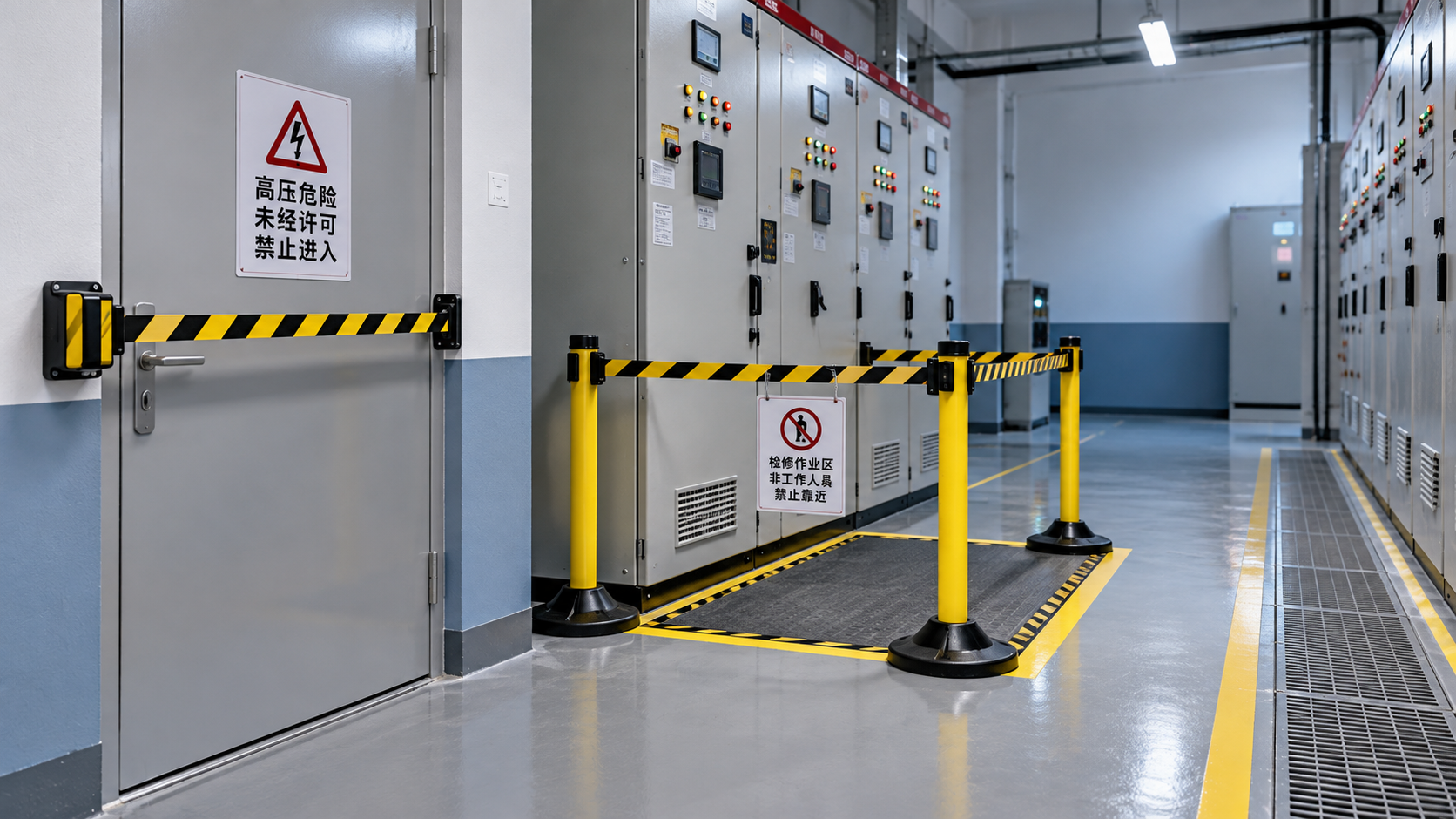
Wall-mounted barriers make sense when the same opening needs to be restricted repeatedly. Typical locations include an entrance to a maintenance room, a service corridor, or a defined pedestrian access point near electrical equipment. A retractable unit can remain at the location, ready to connect to an approved receiver when needed.
The useful advantage is not just a tidier floor. It removes the need to find, carry, and position portable posts each time that opening is closed. In a narrow corridor, eliminating floor bases may also reduce conflicts with tool carts and routine foot traffic, provided the barrier itself is appropriately located.
There is a trade-off: the installation fixes the geometry. If equipment is moved or the work boundary changes, yesterday’s convenient mounting point may no longer mark the correct limit. Extending the belt diagonally to reach a new location can create an unclear boundary or cross an access route that should remain open.
The mounting surface can decide the issue
A wall-mounted unit needs a suitable substrate, compatible fixings, and permission to install them. A sound masonry wall is a different proposition from lightweight partitioning or an equipment enclosure. The receiver needs assessment too; a secure reel housing does not compensate for a poorly fixed receiving bracket.
Do not treat switchgear panels, electrical cabinets, or fire-rated construction as convenient drilling surfaces. Unapproved alterations can affect enclosure integrity or other specified performance, and concealed services may be present. Obtain the necessary authorization and check installation requirements before work starts. Magnetic or adhesive mounting also needs explicit suitability checks; neither should be assumed secure merely because it avoids drilling.
Where freestanding barriers are the better tool
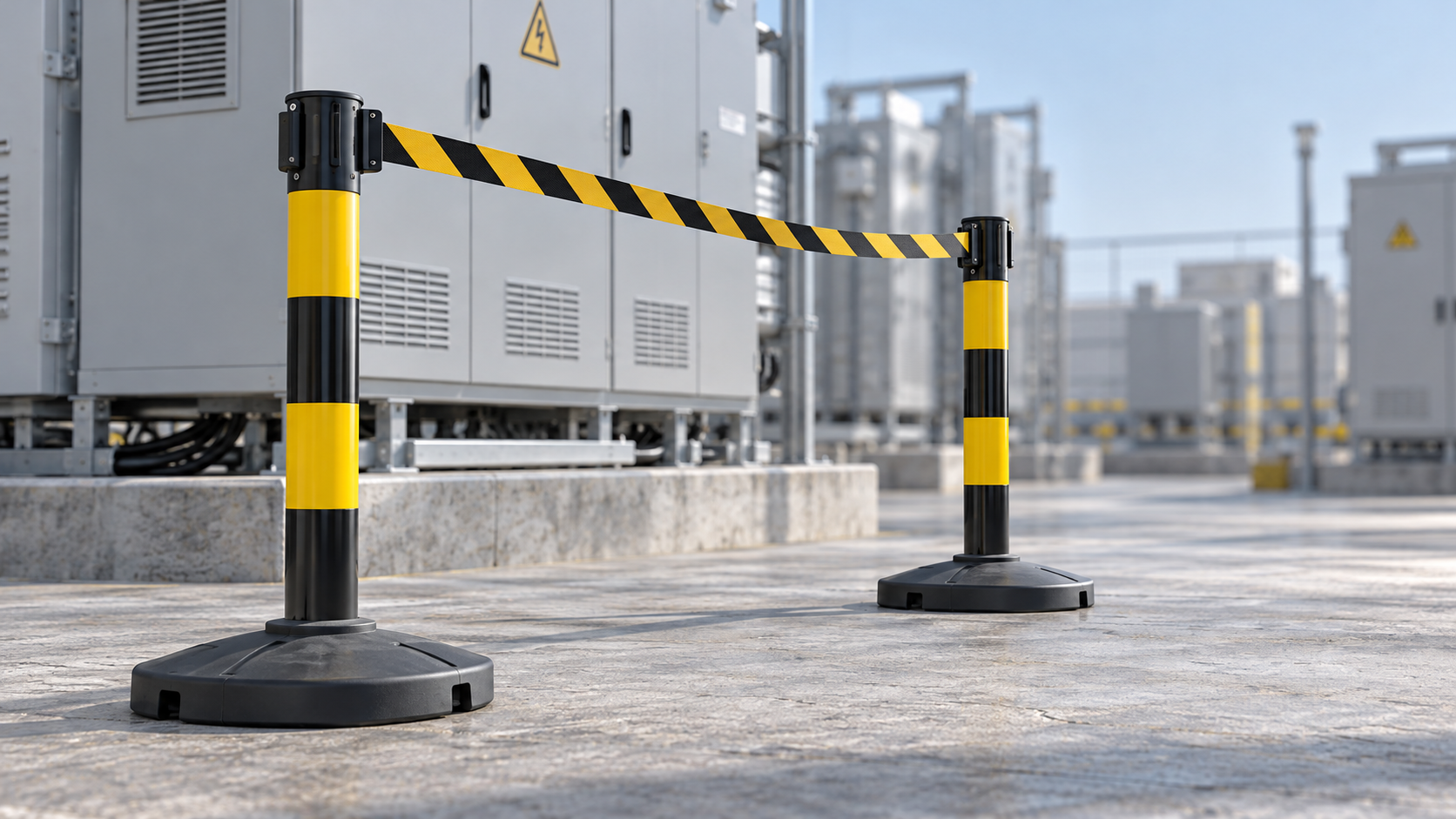
Portable barriers become more useful when the work moves. During an industrial shutdown, today’s restricted area might surround a motor control center; tomorrow’s might sit beside a transformer service area. At a renewable energy site, maintenance locations may be too dispersed for permanent mounting points to be practical.
Freestanding posts or panels let the crew form corners, identify a temporary entry point, and follow a work zone’s shape. They can also be deployed without modifying the building. That flexibility matters in rented premises, unfinished facilities, and areas where installation approval would take longer than the maintenance task itself.
But portable does not automatically mean quick. Someone must transport the equipment, lay it out correctly, and return it to storage. A setup requiring several posts can consume more handling effort than expected, especially where stairs, gravel, or long walking distances are involved. Check the assembled weight and handling arrangements, not just the weight of one component.
The common weakness is displacement. A post moved to let a trolley through may not be returned to its original position. The boundary then changes without anyone formally changing the work plan. Clearly assigned responsibility for placement and checks helps keep a portable system dependable.
Stability is a site condition, not a visual impression
A broad base may look stable on a showroom floor but behave differently on uneven paving or a sloping access road. Belt tension, accidental contact, and wind can all influence performance. Adding a sign or solid panel may increase wind loading, so an outdoor setup needs evaluation as a complete assembly.
Ask for the manufacturer’s intended-use limits and approved stabilization options. Do not improvise by hanging tools from posts or adding unapproved ballast. If the system cannot remain stable under expected conditions, choose a more suitable barrier rather than relying on frequent repositioning.
Compare the whole working arrangement
The biggest selection mistakes happen when buyers compare the hardware in isolation. A barrier has to work alongside doors, equipment, people, and emergency arrangements.
- Equipment access: Check cabinet-door swings, withdrawable equipment movement, and service positions. A boundary that fits with everything closed may fail once maintenance begins.
- Clear routes: Assess the entire footprint, including portable bases and receiving brackets. Neither design should obstruct required escape routes or necessary access to emergency equipment.
- Visibility: Consider the approach from both directions, lighting, and visual clutter. A warning message facing the work area is little help to someone entering from the corridor.
- Authorized entry: Decide where workers will enter and how the boundary will be restored afterward. Repeatedly stepping over belts is a sign that the arrangement needs changing.
- Storage: Portable equipment needs an accessible storage location. A wall-mounted system needs a safe retracted position that does not interfere with nearby operations.
Also check the actual barrier span. A reel’s stated maximum extension is not a recommended electrical safety distance, nor does it prove that the same arrangement will work at every installation. Confirm the permitted span and configuration with the supplier, then position the system around the independently established work boundary.
Indoor and outdoor service change the buying questions
For indoor installations, inspect retraction control, latch operation, fixing quality, and the visibility of the warning material. A belt that sticks, a damaged receiver, or a post that rocks can undermine otherwise sensible placement. Maintenance should cover these functional details, not just whether the equipment looks clean.
Outdoor use adds exposure to sunlight, moisture, dust, corrosion, and temperature changes. Request documented environmental suitability for the complete system, including fasteners and connectors. “Heavy-duty” is not a measurable outdoor performance specification. A portable system used occasionally outside still needs to suit the conditions it will encounter.
Electrical environments also require care with material claims. Conductive components may affect where a barrier can safely be positioned, but choosing nonmetallic parts alone does not establish dielectric protection. Where electrical insulating performance is required, it must be verified for the intended application through appropriate specifications and test evidence.
Purchase price is only part of the cost
Wall-mounted systems can involve installation approval, fixings, and labor. They become easier to justify where a boundary is used frequently and remains in the same place. Freestanding systems avoid permanent installation but require handling, storage, and enough components to cover the intended layout.
Neither option is universally cheaper. Compare the installed or fully deployed arrangement, including corners, receivers, signage, and replacement parts. Ask whether worn belts, damaged connectors, or individual bases can be replaced without discarding the complete unit. For facilities maintaining several systems, component compatibility can matter more than a small difference in initial price.
JINPOWER, the electrical safety equipment business of Hebei Jinneng Power Technology Co., Ltd., was founded in 2009 and focuses on protective tools for power-industry applications. For a specialist supplier in this field, the useful conversation starts with the work area and required protective function—not simply a choice between a wall bracket and a portable base. Buyers should bring layout information, exposure conditions, and site restrictions to that discussion.
Make the choice at the actual work location
Choose wall-mounted barriers when the restriction point is fixed, suitable mounting locations are available, and repeated deployment would otherwise mean moving portable equipment. Choose freestanding barriers when the boundary must move, turn corners, or operate without permanent fixings.
A mixed arrangement can be sensible: fixed units at recurring access points, with portable equipment reserved for temporary maintenance areas. The two systems need compatible warning messages and clear placement rules, even if their hardware differs.
Before ordering, walk the proposed layout with operations and safety personnel. Open the equipment doors, check the access route, and identify where authorized workers will cross the boundary. If the arrangement only works when nobody moves equipment or needs to pass through, it is not ready for the job.
Recommend
 Oct 29, 2026
How Do You Assess Wind Resistance in Outdoor Barrier Stands?
Assess outdoor barrier stand wind resistance with practical tips on bases, ballast, anchors, and gust exposure. Learn how to compare supplier claims and choose the right setup for your site.
- Oct 29, 2026
Wall-Mounted vs. Freestanding Barriers: Which Should You Choose?
Compare wall mounted vs freestanding barriers for electrical facilities. Explore mounting, stability, access, and costs to choose the right setup for your worksite.
- Oct 29, 2026
Why Bird Repellent Tape Fails Around Warehouses—and What to Adjust
Why does de bird repellent tape fail around warehouses? Discover practical placement fixes, ways to reduce bird attractants, and electrical safety tips for smarter bird control.