English
 Español
 Português
 Français
 Deutsch
 русский
 한국어
 にほんご
 हिन्दी, हिंदी
 বাংলা
 Bahasa Indonesia
 Türkçe
 Việt
 dansk
 čeština
 עִבְרִית Ivrit
 Filipino/Pilipino
 български език (Bǎlgarski jazik)
 suomi
 norsk
 język polski
 ไทย
 ກະຣຸນາ
 Bahasa Melayu
 ភាសាខ្មែរ
 ဗာရမ်
 اردو
 فارسی
 Italiano
 Nederlands
 svenska
 Монгол хэл
 नेपाली
 සිංහල
 Ўзбек тили
 پښتوتۆرکجه
 Ελληνικά
 српски / srpski
 magyar
 українська
 Kiswahili
 Қазақ тілі
 Română
 Hrvatski
 Bosanski
 Kreyòl ayisyen
 አማርኛ
 Hausa
 Yorùbá
 Igbo
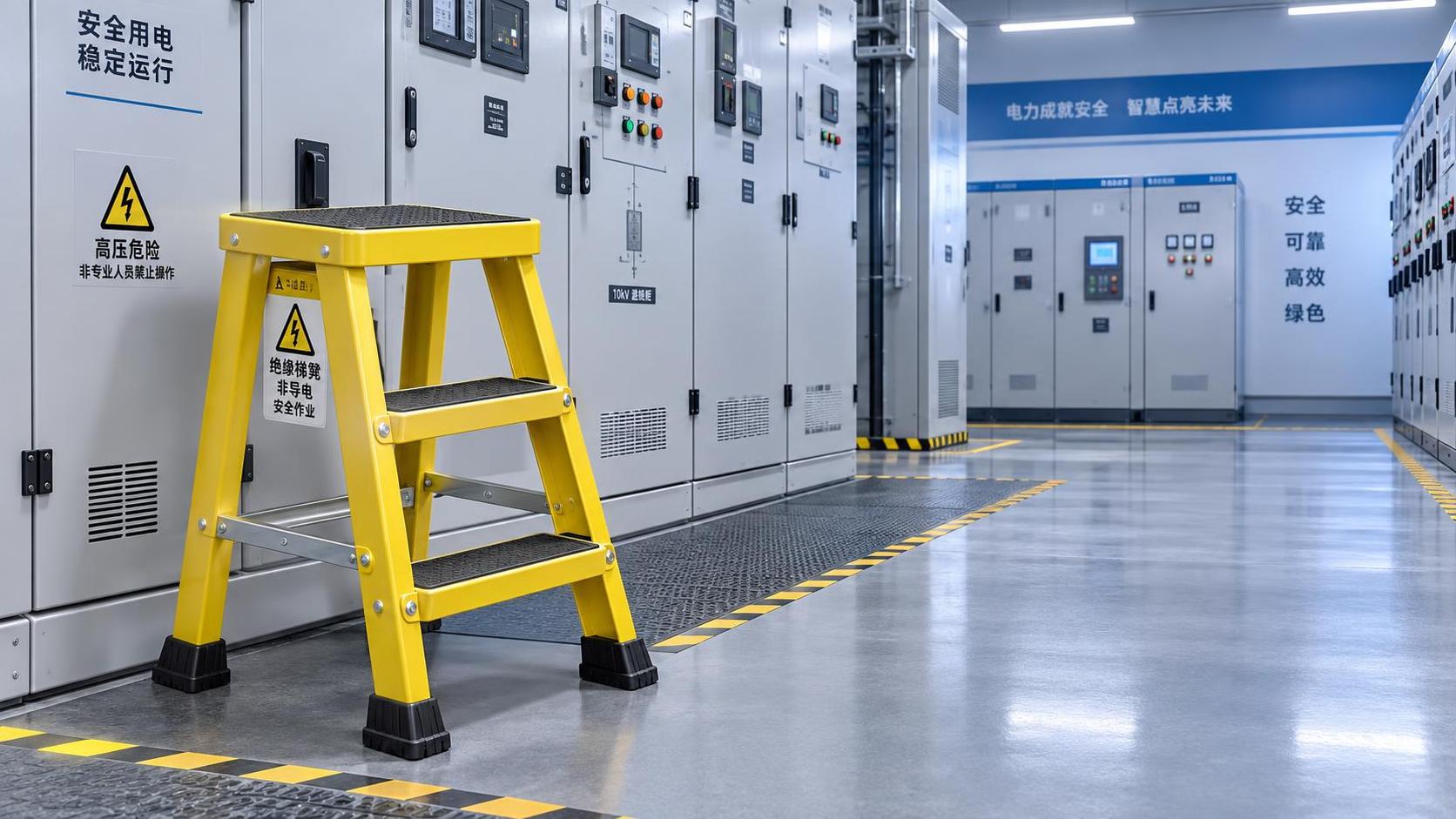
Insulating Ladder Stools for Switchrooms: Selecting Height and Dielectric Performance
An insulating ladder stool in a switchroom should not be selected as a simple height-access accessory. Its working height, dielectric design, structural stability, and condition in service all affect whether it provides meaningful protection or merely introduces a false sense of security.
The central selection question is not “Which stool reaches the panel?” It is: can a worker reach the intended work zone while maintaining a stable posture, remaining within the site’s electrical safety controls, and avoiding an unintended conductive path to earth? A stool that is too low drives overreaching; one that is too high can force work close to exposed live parts, reduce balance, or place the worker above a permitted access boundary. Dielectric performance must be evaluated as an assembled, maintained system rather than inferred from the presence of fiberglass alone.
Define the actual switchroom task before selecting a height
“Switchroom work” covers very different activities. Reading labels, operating a local control, inspecting an enclosure top, servicing low-voltage auxiliary circuits, or performing work near exposed conductors impose different access and safety requirements. A ladder stool appropriate for external inspection of a de-energized cubicle may be unsuitable for work inside an energized lineup.
Height should therefore be defined from the task envelope, not from the nominal height of the equipment. The relevant dimensions are:
- the finished floor level, including any insulating mat, grating, cable trench cover, or raised access floor;
- the platform standing height, rather than the overall product height;
- the vertical and horizontal location of the work point;
- the worker’s permitted hand position and body position during the task;
- the distance to adjacent energized or potentially energized parts;
- the space needed to open doors, withdraw drawers, operate handles, or use approved insulated tools.
A practical selection starts by identifying the lowest platform height that allows the task to be completed without standing on the top step, leaning sideways, climbing onto an enclosure, or lifting both feet into an unstable position. The worker should be able to keep both feet fully supported, maintain a normal body position, and avoid using the switchgear itself for balance.
This is particularly important around panel-mounted equipment. A stool may allow access to an upper terminal compartment, but that does not mean the compartment is an acceptable working location. Clearance requirements, arc-flash boundaries, lockout/tagout conditions, manufacturer instructions, and site procedures govern whether work may occur there at all. An Insulating Ladder Stool does not alter those boundaries.
Why nominal height alone is an incomplete specification
Suppliers may describe a stool by total height, number of steps, platform height, or working height. These are not interchangeable. For technical comparison, the standing surface elevation and usable platform dimensions matter more than a catalogue label.
A narrow top step may technically provide the required elevation but can be unsuitable for tasks requiring two-handed operation, sustained visual inspection, or controlled tool use. A true platform stool with a broad standing surface and a guard arrangement may support better posture, but its larger footprint can create access conflicts in narrow switchroom aisles.
For repetitive work at several elevations, it is often safer to standardize two or three clearly differentiated standing heights than to force one tall unit into every task. A lower platform generally gives better stability and keeps the worker farther from upper equipment zones. The higher option should be justified by a measured reach need, not chosen for versatility alone.
Dielectric performance is more than the base material
Fiberglass-reinforced plastic is widely used in electrically insulating access equipment because it can combine mechanical strength with electrical resistance. Yet “fiberglass construction” is not a complete dielectric specification. The electrical behavior of a finished stool depends on the resin system, fiber architecture, surface finish, contamination condition, moisture absorption, joints, fittings, and the route by which current could travel through the assembly.
In switchrooms, the key risk is often not direct contact with a single energized part. The concern may be a worker simultaneously approaching an energized component and a grounded enclosure, structural steel member, floor, cable tray, or other conductive object. The stool can help interrupt the path through the worker to earth, but only if its insulating path remains effective under the actual conditions of use.
Technical review should distinguish among three claims that are frequently treated as equivalent but are not:
- Non-conductive material claim: a statement that major structural parts are made from insulating composite material.
- Electrical test claim: evidence that the complete product or a defined part has passed a specified dielectric test.
- Live-working suitability claim: a declared intended use under a recognized live-working standard, with stated voltage class, test conditions, limitations, and maintenance requirements.
The first claim may be useful for general electrical environments, but it does not establish the second or third. A product can contain fiberglass rails while having conductive hinges, reinforcing bars, fasteners, foot assemblies, or contamination-prone interfaces that affect the effective insulating path. Conversely, a product designed and tested for electrical use may still be prohibited by a site procedure for a particular energized-work task.
Use the right standard framework, and verify its scope
There is no single global standard that automatically validates every item marketed as an insulating step stool. The applicable requirement depends on the product’s geometry, intended use, voltage environment, and jurisdiction.
For ladders of insulating material intended for live working, IEC 61478 is an important reference standard. It addresses insulating ladders used in live-working applications and should be considered where the equipment is genuinely intended to provide electrical insulation during such work. In European low-voltage contexts, EN 50528 may also be relevant for insulating ladders used on low-voltage installations. In North American specifications, fiberglass ladder requirements may be considered alongside relevant ANSI ladder standards, such as ANSI A14.5 for portable reinforced plastic ladders, but a general ladder standard should not be misread as proof of a specific live-working dielectric rating.
These references are useful only when the product actually falls within their scope. A compact folding stool, podium-style platform, mobile work platform, or custom switchroom access unit may not be covered in the same way as a conventional ladder. A certificate for a material sample, rail section, or related ladder model is also not equivalent to certification of the supplied configuration.
Documentation should identify the exact model, dimensions, construction, test standard or test method, issue date, and any declared voltage limitation. It should also state whether the electrical test applied to the complete assembled product and whether it was performed under dry, wet, clean, or conditioned circumstances. A bare statement such as “tested to 30 kV” is not enough without the test arrangement, test duration, electrode placement, leakage-current criteria where applicable, and the meaning of that value in relation to intended service.
Dry dielectric strength does not resolve contamination risk
A clean, dry composite surface can have high electrical resistance. Conditions in service are less controlled. Conductive dust, carbon deposits, salt contamination, oil film, water, cleaning residues, and damaged coatings can create surface leakage paths. In industrial switchrooms, contamination may come from ventilation routes, nearby process areas, battery rooms, cable-entry points, or maintenance activities rather than from outdoor exposure alone.
Surface tracking is a particular concern for polymeric insulating equipment. Repeated electrical stress in the presence of moisture and contamination can progressively damage the surface, reducing insulation performance. Deep scratches, exposed fibers, cracking, whitening of stressed composite, blistering, resin erosion, or burn marks are not merely cosmetic defects.
Design details deserve close review:
- sealed or protected composite ends reduce moisture ingress;
- smooth, cleanable surfaces are easier to inspect than heavily textured or dirt-trapping profiles;
- drainage and geometry should avoid retaining water or conductive debris around joints;
- metal fasteners should be recessed, isolated, or arranged so they cannot form a bridging path across the intended insulation zone;
- rubber feet, anti-slip treads, and hinge components should be evaluated as part of the whole current path and stability system.
Where a switchroom is normally dry and access equipment is used only for de-energized maintenance, a non-conductive composite stool may be an appropriate risk-control measure. Where the intended activity is near exposed energized parts, the electrical rating, certification scope, inspection regime, and approved work method need far more scrutiny. The product’s label should never replace the electrical risk assessment.
Mechanical safety and dielectric safety cannot be separated
Electrical insulation does not compensate for poor stability. Falls are a major failure mode for short access equipment because users may underestimate the hazard of a low platform. The stool should have a declared duty rating that covers the worker, clothing, tools, and reasonably foreseeable carried items. The evaluation should clarify whether the stated load is a static capacity, a ladder duty rating, or a working load with defined test conditions.
Load capacity also needs to be considered with the center of gravity. A worker reaching above shoulder level, pulling on a stiff mechanism, or applying torque with a tool introduces horizontal and overturning forces not represented by body mass alone. A broad footprint, positive spreader locks, robust hinge design, level floor contact, and slip-resistant feet are central to safe performance.
Switchroom floors create their own complications. Cable trench covers may flex or sit unevenly. Grating can reduce foot contact. Raised-floor panels may have local load limits. Loose insulating mats can shift under a stool unless specifically arranged and approved for that use. The access unit should stand on a firm, level, clean surface; it should not be positioned on temporary boards, boxes, pallets, stacked mats, or another stool to obtain additional height.
Mobile units require additional caution. Locking casters do not automatically make a rolling platform suitable for work near electrical equipment. If mobility is necessary, the design must have a defined stabilized working configuration, and the site procedure must address movement, brake engagement, floor condition, and clearance from energized apparatus.
Questions that expose weak specifications
Many procurement specifications focus on height, load rating, and fiberglass rails, leaving the decisive technical questions unanswered. A more reliable review asks for evidence rather than broad product descriptions:
- What is the exact approved standing height, and is the top surface intended to be stood on?
- What standard governs the product, and does that standard apply to this stool or platform configuration?
- Is the declared voltage value a working classification, a type-test voltage, or simply a material-test result?
- Was dielectric testing performed on the fully assembled unit, including hinges, feet, treads, and handrails?
- What are the environmental limitations for moisture, contamination, ultraviolet exposure, chemical contact, and storage?
- Which defects require removal from service, and does the manufacturer provide inspection and cleaning instructions?
- Are replacement feet, treads, locks, and other safety-critical parts controlled so field substitutions do not change the design?
Traceability matters because visually similar products can differ in resin formulation, wall thickness, fastener arrangement, and test basis. Each unit should carry durable identification sufficient to connect it to its rated load, intended use, inspection status, and supplier documentation.
Inspection determines whether insulation remains credible
An insulating ladder stool should be visually checked before use and formally inspected at intervals established by the facility’s electrical safety program and the manufacturer’s instructions. Inspection should cover cleanliness, structural damage, loose or corroded fittings, hinge function, spreader locks, anti-slip feet, platform condition, labels, and signs of electrical or thermal damage.
Cleaning is not a trivial housekeeping issue. A surface contaminated with conductive dust or oily residue cannot be assumed to retain its original dielectric behavior. Cleaning agents should be compatible with the composite resin and anti-slip components. Abrasive methods, unauthorized paint coatings, drilling, field-installed metal brackets, and improvised repairs can compromise both electrical and mechanical performance.
Any unit showing cracks, exposed reinforcement, tracking marks, severe abrasion, damaged feet, distorted geometry, or uncertain test history should be removed from use until assessed under the organization’s control process. A stool that remains structurally usable may still no longer be suitable as insulating access equipment.
A defensible selection outcome
The strongest selection is usually the shortest stable platform that permits the defined task without overreach, has a documented duty rating and secure footing, and carries dielectric evidence appropriate to the actual electrical exposure. Its standard compliance must match the product category and intended use, not merely resemble the requirements for a related ladder product.
For ordinary de-energized switchroom maintenance, the emphasis may be on non-conductive construction, robust mechanical design, cleanliness, and controlled use. For tasks performed under energized-work authorization or near exposed live parts, the threshold is higher: the access equipment, work method, protective equipment, approach limits, and facility procedures must function together. Height and dielectric performance are therefore not separate purchasing specifications. They are linked controls within the same electrical safety decision.
Recommend
 Sep 20, 2026
Best Tool Cabinet with Dehumidifier for Coastal High-Salt Environments: Why JINPOWER Leads
Explore JINPOWER’s intelligent tool cabinet with dehumidifier for coastal high-salt environments. Semiconductor dehumidification, anti-corrosion construction, and BanNiu control help protect electrical safety tools.
- Sep 17, 2026
Clear Plastic Snow Shovels: Visibility Benefits and Limits in Commercial Use
Clear plastic snow shovel guide for commercial sites: explore visibility benefits, cold-weather durability, edge options, and electrical safety limits.
- Sep 18, 2026
Plastic Snow Shovels for Facility Crews: When Polymer Blades Outperform Metal
Plastic shovel snow solutions for facility crews: compare polymer vs. metal blades, protect sensitive surfaces, and improve winter access safety.