English
 Español
 Português
 Français
 Deutsch
 русский
 한국어
 にほんご
 हिन्दी, हिंदी
 বাংলা
 Bahasa Indonesia
 Türkçe
 Việt
 dansk
 čeština
 עִבְרִית Ivrit
 Filipino/Pilipino
 български език (Bǎlgarski jazik)
 suomi
 norsk
 język polski
 ไทย
 ກະຣຸນາ
 Bahasa Melayu
 ភាសាខ្មែរ
 ဗာရမ်
 اردو
 فارسی
 Italiano
 Nederlands
 svenska
 Монгол хэл
 नेपाली
 සිංහල
 Ўзбек тили
 پښتوتۆرکجه
 Ελληνικά
 српски / srpski
 magyar
 українська
 Kiswahili
 Қазақ тілі
 Română
 Hrvatski
 Bosanski
 Kreyòl ayisyen
 አማርኛ
 Hausa
 Yorùbá
 Igbo
What Utility Safety Equipment Is Needed for Routine Maintenance?
Routine utility maintenance does not require every piece of electrical safety equipment on every job. It requires a documented, task-matched set of protective tools that remains effective after transport, storage, inspection, and repeated field use. The essential distinction is between equipment that protects a worker from an expected electrical hazard and equipment that merely makes the work more convenient.
For work near energized or potentially energized conductors, the baseline normally includes voltage verification equipment, insulating protective equipment, arc-flash PPE where the hazard assessment requires it, temporary protective grounding for de-energized work, lockout/tagout devices, and rescue provisions. The precise combination changes with system voltage, available fault energy, switching conditions, weather, access constraints, and whether the task is performed on overhead lines, in a substation, in a pad-mounted enclosure, or inside industrial distribution equipment.
What is the minimum safety equipment for routine electrical utility maintenance?
A practical maintenance kit begins with the tools needed to establish and maintain an electrically safe work condition. Before any maintenance is treated as de-energized, the crew must be able to isolate the source, prevent re-energization, verify absence of voltage using an appropriate tester, and apply protective grounds when the work method and applicable procedure require them.
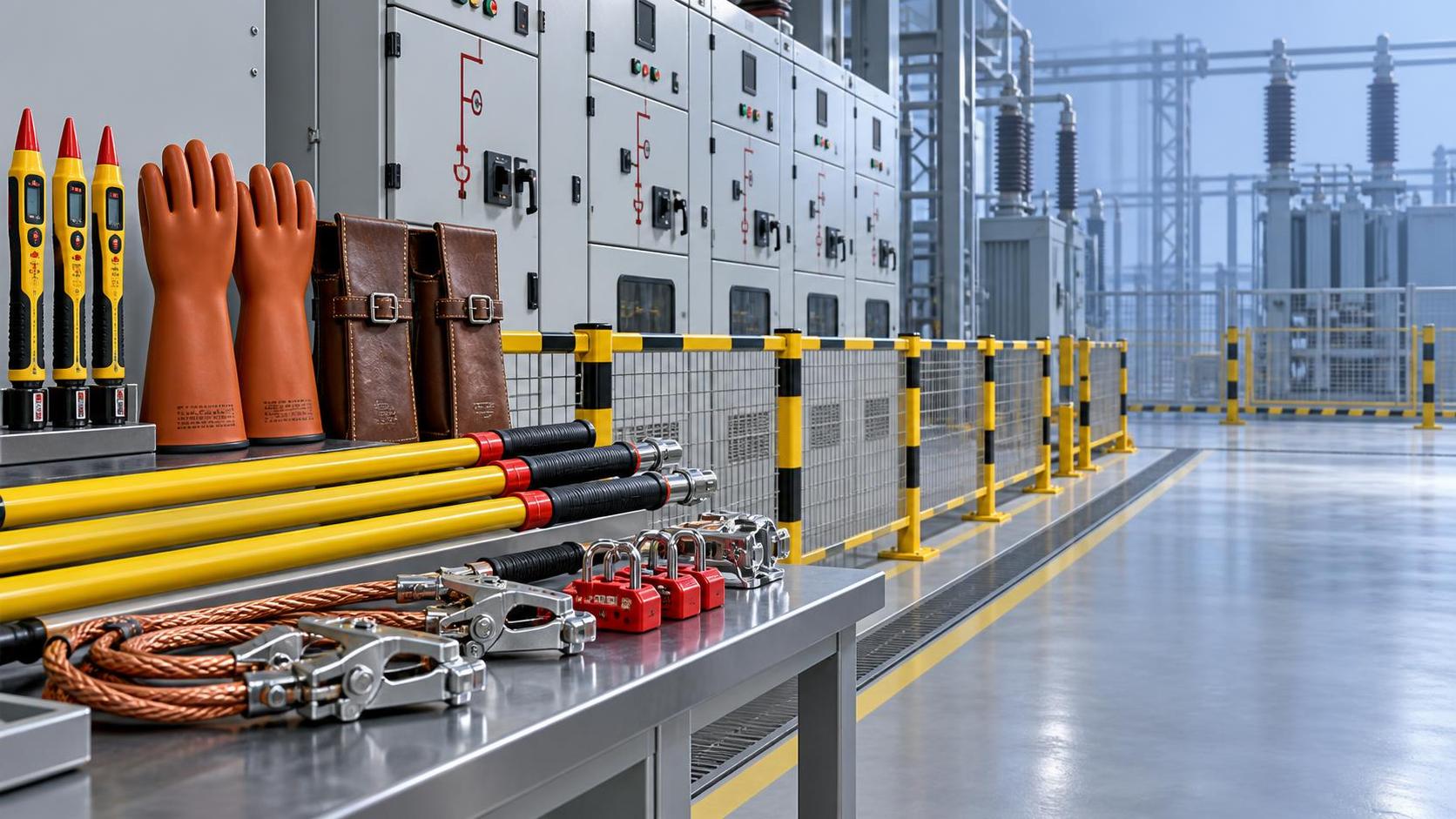
The core equipment generally falls into six groups:
- Voltage detection and testing: approved voltage detectors, phasing equipment where relevant, and test points or proving devices suitable for confirming the detector is functional.
- Insulating personal protection: voltage-rated rubber insulating gloves, leather protectors, insulating sleeves when exposure can extend above the glove cuff, and dielectric footwear where specified by the work program.
- Insulating live-line tools: hot sticks, switch sticks, shotgun sticks, clamp sticks, and other insulated tools matched to the system voltage and task.
- Isolation and control devices: lockout/tagout locks, tags, hasps, lock boxes, switching barriers, danger signs, and control-room communication arrangements.
- Temporary grounding equipment: grounding cables, clamps, cluster bars, grounding points, and application tools designed for the prospective fault duty and installation configuration.
- Arc-flash and general PPE: head, eye, face, body, hand, hearing, and foot protection selected from the incident-energy or PPE-category requirements of the site’s electrical safety program.
That list is not a universal packing checklist. A worker changing a damaged warning sign outside a fenced substation does not need the same equipment as a crew opening a medium-voltage switch compartment or servicing a transformer connection. The equipment requirement follows the exposure, not the job title.
Why voltage detectors are more than a basic testing tool
Voltage detectors are central to routine maintenance because assumptions about isolation are a frequent source of serious risk. A disconnect may be open but incorrectly identified. A feeder may be back-fed by distributed generation, an alternate supply, a capacitor bank, an induction source, or stored energy. A circuit that appears inactive can still have hazardous voltage present.
The detector must be rated for the expected voltage range and compatible with the conductor geometry and work method. A non-contact detector intended for low-voltage troubleshooting is not automatically appropriate for verifying absence of voltage on utility distribution equipment. Likewise, a detector used through an insulating stick must be designed and installed for that arrangement.
Reliable verification also requires a disciplined test sequence. The device should be checked on a known energized source or approved proving unit before use, used to test the circuit, and checked again afterward. This “live-dead-live” principle helps identify a failed detector or depleted battery that could otherwise create a false indication of safety.
Workers should also understand the detector’s limits. Induced voltage, shielded cables, capacitive coupling, poor contact, moisture, and incorrect range selection can affect readings. A voltage detector supports a work procedure; it does not replace correct circuit identification, switching control, or the requirement to apply grounds where required.
Which insulating equipment is needed?
Rubber insulating gloves are often the most visible item in electrical maintenance, but their selection is frequently oversimplified. Glove class must provide adequate protection for the maximum voltage exposure, while the glove length, dexterity, cuff interface, and compatibility with leather protectors must fit the actual task. Wearing a higher-class glove is not always a practical solution if reduced dexterity introduces handling errors or prevents reliable tool use.
Gloves require more than a purchase specification. They need controlled storage away from heat, sunlight, ozone-producing equipment, oils, sharp objects, and compression damage. Before each use, the wearer should inspect the gloves for cuts, cracking, punctures, embedded contamination, swelling, or other visible deterioration, and perform the air test where required by procedure. Electrical retesting intervals should follow the applicable standard, regulation, and employer program; visual inspection alone does not confirm dielectric integrity.
Insulating sleeves become important where the forearm or upper arm can enter the exposure zone, such as work in tight switchgear compartments, on congested structures, or near adjacent energized parts. Dielectric overshoes, insulating blankets, line hose, and equipment covers may also be necessary when workers must prevent accidental contact with nearby energized components rather than simply protect themselves from the component being serviced.
These items should be treated as a coordinated insulation system. A glove does not compensate for an unprotected forearm, and a blanket does not create a safe work condition if it can shift, tear, or be installed on the wrong component.
When are hot sticks and other live-line tools necessary?
Insulating sticks are required whenever the task demands separation between the worker and an energized or potentially energized component. They are commonly used for operating disconnects, applying or removing temporary grounds, installing covers, handling fuse devices, retrieving objects, or performing voltage tests from a safer distance.
The correct tool depends on the operation. A switch stick designed to operate a disconnect is not automatically suitable for applying a grounding clamp. A shotgun stick may provide controlled handling of certain attachments, while a telescopic stick may offer reach but introduce different handling and cleanliness concerns. Tool selection must account for voltage rating, length, mechanical loading, attachment interface, and minimum approach distance.
Field condition matters as much as the nameplate rating. Fiberglass insulating tools can lose performance when contaminated by salt, moisture, dust, grease, or carbon tracking. Routine maintenance programs should include cleaning, inspection of the surface and ferrules, examination for cracks or delamination, and electrical testing at intervals established by the governing safety program. A dirty or damaged hot stick should not be treated as an insulating barrier.
Do all maintenance tasks require arc-flash PPE?
Not all tasks require the same arc-flash PPE, but arc-flash exposure should never be decided by habit. The needed protection depends on the likelihood of an arc and the estimated incident energy or PPE category established by the site’s electrical safety assessment. Operating equipment, opening enclosures, racking devices, troubleshooting energized circuits, and performing voltage testing can create different exposure conditions.
Arc-rated clothing, face shields or hoods, balaclavas, safety glasses, hearing protection, gloves, and footwear must be selected as a system. A face shield without the required chin and neck coverage may leave critical areas exposed. Non-arc-rated outer garments, contaminated clothing, melting synthetic layers, or unsuitable rainwear can undermine the intended protection.
Arc-flash PPE also has a defined role: it reduces injury severity if an arc occurs. It does not make energized maintenance routine or inherently safe. De-energizing remains the preferred control whenever it is feasible and does not introduce a greater hazard. PPE should be the final layer after equipment condition, isolation, work planning, barriers, and approach boundaries have been addressed.
Why temporary grounding is essential after isolation
For many utility tasks, de-energized does not mean harmless. Conductors can become energized unexpectedly through switching errors, accidental backfeed, induced voltage from nearby circuits, or restoration activity. Temporary protective grounds create a controlled low-impedance path intended to protect workers if the circuit is inadvertently energized.
Grounding sets must be engineered for the installation, not selected only by cable length or clamp appearance. Relevant factors include available fault current, fault-clearing time, conductor size, grounding-point configuration, clamp compatibility, and the mechanical condition of the cable and ferrules. A grounding set that cannot withstand the available fault duty may fail at the moment it is needed most.
Application order is equally important. Procedures commonly require connecting the grounding end first and removing it last, using an insulating tool where needed. The exact arrangement, including whether grounds are installed on both sides of the work area, depends on the system and work rule. Grounds should never be applied until absence of voltage has been verified using the approved method.
What rescue and emergency equipment should be available?
Routine maintenance planning should include the possibility that a worker may be incapacitated by electric shock, arc-flash injury, fall, heat stress, or confined-space conditions. A rescue kit is not a substitute for trained response, but the absence of suitable equipment can delay life-saving action.
The required provisions may include an insulated rescue hook, first-aid supplies, an automated external defibrillator where the site program provides one, emergency communications, fire extinguishers suitable for the identified hazards, fall-rescue equipment, and confined-space retrieval systems where applicable. An insulated rescue hook is intended to separate a person from an energized source without placing the rescuer in direct contact; it is not a general-purpose pulling tool.
Rescue readiness must be specific to the site. A crew working from elevated platforms needs a practical suspension-relief and retrieval plan. Work in a vault may require atmospheric monitoring, ventilation, communications, and retrieval equipment. Simply storing emergency gear in a vehicle does not solve an access problem if the work location is remote, elevated, locked, or separated from the vehicle by a long right-of-way.
How should equipment change by maintenance location?
Substations and switchyards often require robust voltage detection, grounding sets, insulating sticks, arc-flash PPE, barriers, and clear switching-control documentation. Adjacent energized bays, step-and-touch potential, induced voltage, and complex operating authority are important considerations.
Overhead distribution work places greater emphasis on live-line tools, line hose, protective covers, fall protection, weather assessment, traffic control, and communication around recloser or automatic restoration functions. Nearby circuits and shared structures can create exposures that are not obvious from the circuit being repaired.
Underground and pad-mounted equipment may require cable identification tools, voltage testing appropriate for shielded cable systems, grounding arrangements, confined-space controls, gas detection, and water-management precautions. Moisture and contamination can affect both access safety and equipment condition.
Low-voltage service and industrial auxiliary systems still require lockout/tagout, absence-of-voltage verification, appropriate insulated hand tools, and arc-flash assessment. Lower nominal voltage does not eliminate arc-flash or shock hazards, particularly where available fault current is high.
What procurement mistakes create safety gaps?
The most costly mistake is buying equipment as isolated items rather than as parts of a verified work system. A voltage detector, hot stick, grounding clamp, glove, and storage bag may each appear compliant on paper but still be incompatible in use. Examples include grounding clamps that do not fit installed hardware, detector attachments that do not match the stick head, gloves that cannot be used with required protectors, or arc-rated garments that conflict with fall-arrest harness arrangements.
Documentation matters. Equipment should have clear ratings, traceable identification, inspection instructions, test requirements, and service-life guidance. For internationally sourced equipment, purchasers should confirm which standards and test methods apply to the specific product and whether those requirements align with the jurisdiction and utility procedures where the equipment will be used. A generic statement that an item is “certified” is not enough without identifying the relevant standard, scope, and product configuration.
Storage and replenishment should be included in the purchasing decision. Rubber goods need protective containers. Hot sticks need racks or bags that avoid surface damage. Grounding sets need inspection points and replacement criteria. Consumables such as lockout tags, batteries, seals, and cleaning materials need to be available when work is scheduled, not after a crew reaches the site.
What should be checked before routine maintenance begins?
The most useful pre-job question is not “Do we have PPE?” but “What could energize, injure, trap, or delay this crew during this specific task?” The answer should drive equipment selection.
- Confirm the equipment identity, voltage level, energy sources, switching status, and possible backfeed paths.
- Review the required isolation, lockout/tagout, test-for-absence-of-voltage, and grounding sequence.
- Verify that testers, insulating tools, gloves, grounds, and PPE are within inspection and test requirements and free from visible damage.
- Check that ratings match the task, including voltage, fault duty, incident-energy requirements, reach, and clamp or attachment compatibility.
- Establish barriers, approach limits, communication methods, weather controls, traffic controls, and emergency response arrangements.
The utility safety equipment actually needed for routine maintenance is therefore not a static catalog list. It is the set of verified protective measures that enables a crew to isolate energy, prove the condition of the equipment, control unexpected energization, prevent inadvertent contact, limit arc-flash exposure, and respond effectively if something goes wrong. When those functions are covered by equipment that is properly rated, inspected, stored, and used within a sound work procedure, routine maintenance becomes more controlled rather than merely more equipped.
Next:No more content
Recommend
 Sep 16, 2026
What Utility Safety Equipment Is Needed for Routine Maintenance?
What utility safety equipment do I actually need for routine maintenance? Explore essential testers, PPE, grounding, lockout/tagout, and rescue gear for safer utility work.
- Sep 12, 2026
When is an insulating ladder stool required for electrical work?
Insulating Ladder Stool guidance for electrical work: discover when elevated tasks near energized equipment require safer, stable insulated access.
- Jun 30, 2026
For Routine Electrical Utility Work, What Safety Gear Matters Most?
What utility safety equipment do I actually need for routine maintenance? Discover the essential gear for utility crews, from insulating gloves to grounding tools, and choose safer, compliant solutions.