
 English
 Español
 Português
 Français
 Deutsch
 русский
 한국어
한국어 にほんご
にほんご हिन्दी, हिंदी
 বাংলা
বাংলা Bahasa Indonesia
 Türkçe
 Việt
Việt dansk
dansk čeština
 עִבְרִית Ivrit
 Filipino/Pilipino
 български език (Bǎlgarski jazik)
 suomi
suomi norsk
norsk język polski
 ไทย
ไทย ກະຣຸນາ
 Bahasa Melayu
 ភាសាខ្មែរ
 ဗာရမ်
ဗာရမ် اردو
اردو فارسی
فارسی Italiano
 Nederlands
 svenska
 Монгол хэл
 नेपाली
 සිංහල
සිංහල Ўзбек тили
 پښتوتۆرکجه
 Ελληνικά
 српски / srpski
 magyar
 українська
 Kiswahili
 Қазақ тілі
 Română
 Hrvatski
 Bosanski
 Kreyòl ayisyen
 አማርኛ
አማርኛ Hausa
Hausa Yorùbá
 Igbo
Igbo‹
›
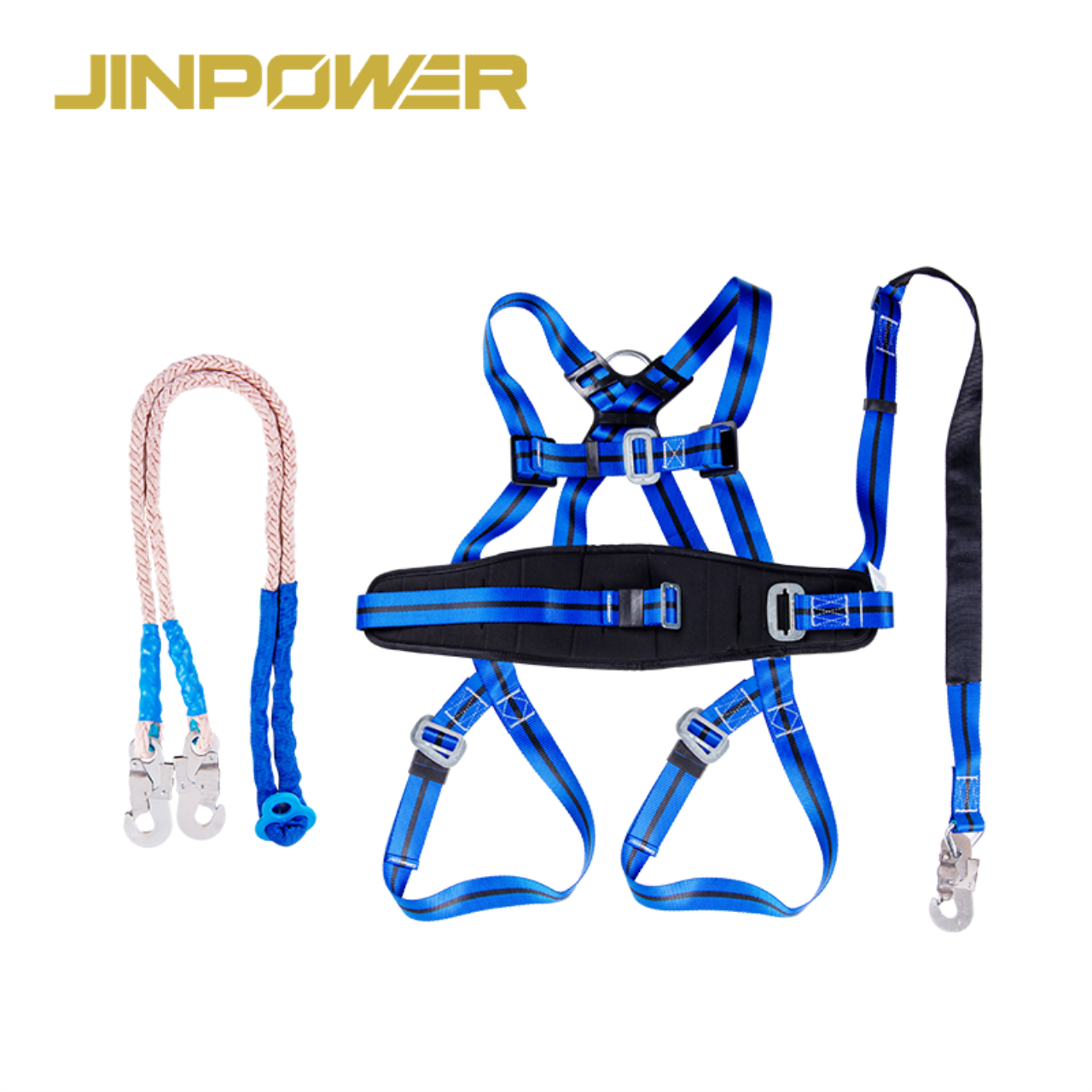
Full Body Safety Harness for Utility and Industrial Work at Height
JINPOWER supplies full body safety harnesses for electrical utilities, transmission and distribution projects, substations, tower and pole work, industrial maintenance and other work-at-height applications.
A full body harness supports the worker across the shoulders, torso and legs and provides attachment points for a compatible fall arrest system. When correctly selected and fitted, it helps distribute fall-arrest forces across the body and keep the worker connected to the protection system.
For professional buyers, selecting a harness involves more than choosing a size. The required protection function, attachment points, connecting device, worker fit, working environment, applicable standard and rescue plan should all be considered before purchase.
All Products
Stay Connected
If you have any questions, please contact us and we will contact you as soon as possible.
Prduct Introdution
Product Highlights:
- Full-body support for fall protection applications
- Multiple attachment configurations available by model
- High-strength webbing construction
- Compatible with suitable lanyards, energy absorbers and SRLs
- Suitable for utility, tower, substation and industrial applications
What Is a Full Body Safety Harness?
A full body safety harness is the body-support component of a personal fall protection system. It is designed to secure the worker around the torso, shoulders and legs and provide suitable attachment points for connecting to the fall protection system.
Unlike a simple waist belt, a full body harness is intended to distribute fall-arrest forces across a larger area of the body. This makes it the appropriate body-support solution when a worker is exposed to a potential free fall.
The exact harness configuration should match the task. Tower climbing, pole positioning, substation access, industrial maintenance and rescue operations may require different attachment points and connecting equipment.
Full Body Harness vs Safety Belt: Fall Arrest or Work Positioning?
Full body harnesses and safety belts are often used in the same industries, but they perform different safety functions. They should not be treated as interchangeable products.
For work-positioning applications, see ourSafety Beltproduct options. Where fall arrest is required, the positioning system should not be treated as a substitute for an appropriate full body fall arrest system.
Full Body Harness as Part of a Personal Fall Arrest System
A full body harness does not work as a complete fall arrest system by itself. It must be connected to a suitable anchorage through an approved connecting device.
Anchorage → SRL or Energy-Absorbing Lanyard → Connector → Full Body Harness → Worker
The harness, connectors, anchorage and connecting device must be compatible and suitable for the same work situation. Mixing components without checking compatibility can create an unsafe system even when each individual product appears suitable.
For applications requiring automatic lifeline extension and rapid locking, see ourSelf-Retracting Lifelinesolutions.
Understanding Full Body Harness Attachment Points
Attachment points are one of the most important differences between harness configurations. Buyers should select them according to the required protection function rather than simply asking for the maximum number of D-rings.
Dorsal D-Ring
The dorsal attachment point is located on the back of the harness and is commonly used as the primary fall-arrest connection point.
It may connect to an SRL, energy-absorbing lanyard or other compatible fall-arrest component according to the approved system configuration.
Sternal or Front Attachment
A front attachment point may be used for specific climbing, ladder, rope-access or controlled fall-protection applications when the harness and complete system are designed for that use.
Do not assume that every front attachment point is approved as a primary fall-arrest point. The intended use must be confirmed from the specific harness design and instructions.
Side or Hip D-Rings
Side attachment points are commonly associated with work positioning. They can allow a pole, tower or structure worker to maintain a supported working position while keeping both hands available for the task.
Positioning attachment points should not automatically be treated as primary fall-arrest points.
Shoulder or Rescue Attachments
Some harness configurations include shoulder or other dedicated attachment points for rescue and retrieval applications.
Where these points are required, buyers should confirm that the specific harness is designed and approved for the planned rescue method.
How to Select a Full Body Safety Harness
A good harness specification starts with the work task. The following points help utilities, EPC contractors, distributors and industrial procurement teams define the correct configuration.
1. Define the Required Protection Function
Start by identifying what the harness must do:
- Fall arrest
- Work positioning
- Climbing support
- Rescue or retrieval
- A combination of functions
This determines the attachment points and connecting equipment that should be considered.
2. Select the Required Attachment Points
A basic fall-arrest configuration may focus on a dorsal attachment, while tower or pole work may also require work-positioning points. Rescue applications may require additional approved attachment locations.
Do not specify additional D-rings unless they have a clear function in the planned work procedure.
3. Decide How the Harness Will Connect to the Anchorage
Typical connecting devices include:
- Self-retracting lifeline
- Single-leg energy-absorbing lanyard
- Twin-leg energy-absorbing lanyard
- Positioning strap or pole strap
- Other application-specific connectors
The connecting device affects mobility, fall clearance, anchorage requirements and the way workers move between structures.
4. Confirm Worker Fit and Size
A full body harness must fit the worker correctly. A loose or poorly adjusted harness can change body position during a fall and reduce the effectiveness of the system.
Buyers should review:
- Available harness size range
- Shoulder adjustment
- Chest strap adjustment
- Leg strap adjustment
- Fit for workers wearing seasonal clothing or other PPE
5. Consider the Electrical Work Environment
For transmission lines, substations and other electrical environments, fall protection is only one part of the hazard assessment.
Buyers should also consider electrical approach distances, exposed conductive hardware, site electrical PPE requirements and whether any special hardware configuration is required by the work procedure.
Do not assume that a standard metal-hardware harness provides electrical insulation unless the specific product has been designed and tested for that purpose.
6. Consider Comfort for Long-Duration Work
Tower technicians, utility workers and industrial maintenance personnel may wear a harness for long periods. Comfort therefore becomes a practical purchasing factor rather than only a user preference.
Useful points to review include:
- Strap adjustment range
- Load distribution
- Padding where applicable
- Webbing management
- Ease of putting on and removing the harness
- Compatibility with other required PPE
Full Body Safety Harness Applications in Utility and Industrial Work
Transmission and Distribution Line Work
Transmission and distribution workers may need fall protection while accessing towers, poles, structures and elevated equipment. Harness configuration should match the climbing system, anchorage arrangement and required work-positioning method.
Tower and Pole Climbing
Tower and pole work often combines fall arrest with work positioning. A suitable harness may therefore require a primary fall-arrest attachment together with positioning points and compatible connecting devices.
Substation and Power Facility Maintenance
Harnesses can support work-at-height protection during maintenance of gantries, transformers, structures, cable systems and other elevated equipment in substations and power facilities.
The fall protection system must also be selected in coordination with electrical isolation, grounding, approach boundaries and other site safety procedures.
Wind and Renewable Energy O&M
Renewable-energy maintenance can require technicians to climb structures, access elevated platforms or work in restricted spaces. Harness attachment points and rescue planning should match the specific access method.
Industrial Plant Maintenance
Typical industrial applications include elevated platforms, steel structures, machinery access, maintenance walkways and other locations where workers are exposed to fall hazards.
Rescue and Emergency Operations
Where rescue or retrieval forms part of the work plan, the harness configuration should be reviewed together with the rescue equipment, attachment points and recovery procedure.
Harness Configuration for Tower and Pole Work
Tower and pole applications normally require more than a basic one-point harness. Workers may need both continuous fall protection while moving and stable work positioning once they reach the task location.
A project specification may therefore consider:
- Dorsal attachment for the primary fall-arrest system
- Side attachment points for approved work positioning
- Twin-leg lanyard where continuous connection during transitions is required
- Compatible pole or positioning strap
- Suitable anchorage arrangement
- Rescue plan for a suspended or injured worker
The final configuration must follow the actual tower structure, climbing method and project safety procedure.
Fall Arrest and Work Positioning Are Not the Same
Fall Arrest
A fall arrest system is designed to stop a worker after a fall has begun. The system must manage the fall distance, arrest forces and clearance below the worker.
Work Positioning
A work-positioning system supports a worker in a controlled position so that both hands can be used for the task. This is common during pole and tower work.
Where a fall hazard remains, work positioning should not automatically be considered a replacement for a separate fall-arrest system.
Full Body Harness with SRL or Energy-Absorbing Lanyard?
Both SRLs and energy-absorbing lanyards can connect a full body harness to the fall protection system. The correct choice depends on work geometry, anchorage, mobility and available fall clearance.
For more detailed SRL selection guidance, see ourSelf-Retracting Lifelineproduct page.
Basic Harness Fit Check Before Working at Height
Correct fitting is essential before connecting the harness to the fall protection system.
A basic fit check should include:
- Inspect the harness before putting it on.
- Make sure all straps are untangled and correctly oriented.
- Put the shoulder straps over the body as intended.
- Connect and adjust the leg straps.
- Adjust the chest strap to the correct position.
- Adjust shoulder and torso straps for a secure fit.
- Check that the dorsal attachment is correctly positioned.
- Verify that buckles are fully engaged and excess webbing is managed.
Workers should follow the instructions supplied with the specific harness and the workplace training procedure. This page is not a substitute for fall-protection training.
Full Body Harness Inspection Before Each Use
A harness is safety-critical PPE. Before use, inspect the complete product rather than checking only the D-ring or buckle.
Check the Webbing
- Cuts or tears
- Heavy abrasion
- Burns or heat damage
- Chemical contamination
- Unusual stiffness or discoloration
- Damaged edges
Check the Stitching
Look for broken, loose, pulled or heavily worn stitching, especially around structural attachment points and load-bearing areas.
Check D-Rings and Hardware
- Cracks
- Deformation
- Corrosion
- Sharp edges or burrs
- Abnormal wear
Check Buckles and Adjusters
Make sure buckles engage correctly and adjustment hardware holds the webbing securely without abnormal movement.
Check Labels and Identification
Critical product identification, model information and inspection-related labels should remain readable.
A damaged or questionable harness should be removed from service and evaluated according to the applicable workplace and manufacturer procedure.
Can a Full Body Harness Be Reused After a Fall?
A harness that has been subjected to a fall-arrest load should not automatically be returned to service.
After a fall event:
- Remove the harness from normal service
- Identify and segregate the equipment
- Record the incident where required
- Evaluate the harness according to the manufacturer and workplace procedure
- Replace the harness if required
The absence of visible damage does not by itself prove that fall-arrest PPE is suitable for continued use.
When Should a Full Body Harness Be Removed from Service?
A harness should be removed from service when its condition, history or identification no longer supports safe use.
Common reasons include:
- It has been involved in a fall event and requires removal under the applicable procedure
- Webbing is cut, torn, burned or badly abraded
- Structural stitching is damaged
- Hardware is cracked, bent or heavily corroded
- The harness has suffered significant chemical or heat damage
- Critical labels or identification are no longer readable
- It fails a required inspection
- It reaches a manufacturer-defined retirement or service-life limit where applicable
Do not create a universal service-life rule for all harnesses. Inspection frequency and retirement criteria should follow the specific product instructions, applicable standard and site procedure.
Standards and Compliance for Full Body Safety Harnesses
Fall-protection requirements vary by destination market and project. Professional buyers should confirm the applicable product standard and workplace regulation before approving a harness.
ANSI / ASSP Z359.11
ANSI/ASSP Z359.11 is commonly referenced in North American procurement for full body harness design, performance, qualification, marking, instructions and use requirements.
If this standard is required, buyers should confirm that the specific harness model has the corresponding documentation rather than assuming compliance from product appearance.
OSHA Workplace Requirements
OSHA requirements relate to how personal fall protection systems are selected, connected, inspected and used in the workplace.
It is more accurate to verify whether the complete fall-protection system meets the applicable OSHA workplace requirements than to describe a harness as “OSHA certified.”
Other Market or Project Standards
Other markets may specify EN or project-specific requirements. The required standard should be stated clearly in the RFQ so the correct harness configuration and documentation can be reviewed before quotation.
Testing and Documentation for Buyer Approval
For utility, EPC and distributor procurement, supplier approval should include both the physical product and the supporting documentation.
Depending on the specific product and order requirement, buyers may request:
- Product technical data sheet
- User instruction manual
- Applicable product test report
- Conformity or certification information where applicable
- Size chart
- Model identification
- Lot, serial or manufacturing identification where applicable
- Inspection guidance
- Product marking information
Required documents should be confirmed before order placement, especially for tender projects and regulated markets.
What JINPOWER Checks Before Shipment
For fall-protection PPE, visual appearance alone is not enough. Product configuration, hardware, webbing and identification should match the confirmed purchase specification.
According to the confirmed product requirements, shipment inspection can include:
- Harness model and configuration verification
- Webbing appearance inspection
- Structural stitching inspection
- D-ring and hardware inspection
- Buckle and adjustment function check
- Size and attachment-point confirmation
- Product label and identification check
- Packaging and documentation matching
For project purchases, specific acceptance requirements should be confirmed during the RFQ or order stage so the inspection scope matches the buyer's needs.
OEM and Project-Based Harness Supply
JINPOWER supports electrical safety distributors, EPC contractors, utility suppliers and industrial procurement programs with project-based fall protection supply.
Depending on the selected harness model and technical requirements, customization can be discussed for:
- Harness configuration
- Required attachment points
- Size requirements
- Webbing color
- Lanyard or connecting-device configuration
- Product labels
- Packaging requirements
The final configuration should be confirmed from the actual work application rather than selecting options only for appearance or price.
Why Source Full Body Safety Harnesses from JINPOWER?
Focused on Utility and Electrical Safety Applications
JINPOWER supplies fall-protection products as part of a broader electrical safety product portfolio for utilities, electrical contractors and industrial customers.
System-Based Product Selection
For professional inquiries, we review the harness together with the planned connecting device, work-positioning requirement and application rather than treating it as an isolated PPE item.
Support for Distributor and Project Procurement
We support repeat supply, project inquiries and product-portfolio requirements from electrical safety distributors, EPC companies and industrial buyers.
Broader Electrical PPE Supply
Full body harnesses can be sourced together with otherPPE for Electrical Safetyproducts for utility and industrial safety programs.
What to Include in Your Full Body Safety Harness RFQ
A clear RFQ helps both buyer and supplier confirm the harness configuration before quotation.
Frequently Asked Questions About Full Body Safety Harnesses
What is a full body safety harness used for?
A full body safety harness is used as the body-support component of a personal fall protection system. It connects the worker to a suitable fall-arrest or positioning system during work at height.
What is the difference between a full body harness and a safety belt?
A full body harness supports the shoulders, torso and legs and can form part of a fall-arrest system. A safety or positioning belt mainly supports the worker around the waist for positioning or restraint and should not be treated as a direct replacement for a full body fall-arrest harness.
What is the dorsal D-ring used for?
The dorsal D-ring is commonly the primary fall-arrest attachment point on a full body harness. It may connect to an SRL, energy-absorbing lanyard or another approved fall-arrest component.
Should I use an SRL or a lanyard with a full body harness?
Both can be suitable. Selection depends on worker movement, anchorage position, fall clearance, edge conditions and the work procedure. An SRL is often useful where more continuous movement is required, while a lanyard may suit defined anchorage tasks and controlled transitions.
How should a full body harness be inspected?
Inspect the webbing, stitching, D-rings, buckles, adjusters and labels before use. Look for cuts, abrasion, heat or chemical damage, corrosion, deformation and any other condition that could affect safe performance.
Can a safety harness be reused after a fall?
Do not automatically return a harness to service after it has been subjected to a fall-arrest load. Remove it from service and follow the applicable manufacturer and workplace evaluation procedure.
Can JINPOWER supply harnesses for tower and pole work?
JINPOWER supports utility and work-at-height applications. For tower or pole projects, provide the required fall-arrest, work-positioning, connecting-device and attachment-point requirements so the appropriate configuration can be reviewed.
Request Full Body Safety Harness Details
If you are sourcing full body safety harnesses for transmission projects, utilities, substations, towers, industrial facilities or distribution, send JINPOWER your application and technical requirements.
For a more accurate technical review and quotation, please provide:
- Application and working environment
- Required protection function
- Required attachment points
- SRL, lanyard or positioning-device requirement
- Worker size requirements
- Applicable standard or destination market
- Order quantity
- Required test or conformity documents
- Customization requirements
JINPOWER will review the information and recommend a suitable Full Body Safety Harness configuration for your project or procurement program.
Inquiry