English
 Español
 Português
 Français
 Deutsch
 русский
 한국어
한국어 にほんご
にほんご हिन्दी, हिंदी
 বাংলা
বাংলা Bahasa Indonesia
 Türkçe
 Việt
Việt dansk
dansk čeština
 עִבְרִית Ivrit
 Filipino/Pilipino
 български език (Bǎlgarski jazik)
 suomi
suomi norsk
norsk język polski
 ไทย
ไทย ກະຣຸນາ
 Bahasa Melayu
 ភាសាខ្មែរ
 ဗာရမ်
ဗာရမ် اردو
اردو فارسی
فارسی Italiano
 Nederlands
 svenska
 Монгол хэл
 नेपाली
 සිංහල
සිංහල Ўзбек тили
 پښتوتۆرکجه
 Ελληνικά
 српски / srpski
 magyar
 українська
 Kiswahili
 Қазақ тілі
 Română
 Hrvatski
 Bosanski
 Kreyòl ayisyen
 አማርኛ
አማርኛ Hausa
Hausa Yorùbá
 Igbo
IgboSubstation Safety Tool Cabinet Buying Checklist for Multi-Bay Electrical Projects
Choosing a substation safety tool cabinet for a multi-bay electrical project is rarely a simple storage decision. For procurement teams, the cabinet sits at the intersection of safety control, maintenance workflow, inspection discipline, and asset life. A poor specification can create clutter, slow switching operations, increase the risk of tool misuse, and drive replacement costs much earlier than expected. A well-specified cabinet, by contrast, helps standardize field behavior across bays, shifts, and contractors.
The key point is that multi-bay projects change the buying logic. In a single-bay installation, storage mistakes may stay localized. In a multi-bay substation, the same cabinet design may be replicated across different voltage areas, work teams, and operating routines. That means procurement is not just comparing dimensions and price. It is deciding how safety tools will be organized, protected, identified, and audited over years of service.
What buyers are usually trying to solve
When someone searches for a substation safety tool cabinet in this context, they are usually not asking what a cabinet is. They are trying to answer more practical questions: How many cabinets are actually needed per bay or work zone? What internal layout prevents tool mixing? Which material stands up better in humid, dusty, or coastal environments? How much should be standardized across the project, and where should site-specific customization be allowed?
These are valid concerns because electrical safety tools are not generic consumables. Insulating gloves, insulating boots, grounding leads, operating rods, voltage detectors, discharge tools, rescue hooks, arc-protection accessories, and lockout devices all have different storage needs. Some are bulky. Some are sensitive to moisture, UV, compression, or contamination. Some require clear segregation by voltage class, test cycle, or operating area. A cabinet that looks adequate on paper can still fail operationally if it does not support these realities.
Start with the project layout, not the cabinet catalog
The first mistake in purchasing is selecting from a supplier catalog before defining the storage logic of the site. In a multi-bay project, cabinet sizing should follow the operating map of the substation. Procurement should ask how tools move during routine inspection, switching, planned outages, emergency response, and contractor access. The answer affects whether you need centralized storage, bay-level storage, or a hybrid approach.
In practice, buyers should clarify at least four points before comparing suppliers:
- How many bays will be active in the current phase and in the final phase?
- Will each bay require dedicated tool sets, or will some tools be shared by zone?
- Which items must remain immediately accessible, and which can be kept under controlled access?
- Who is responsible for inspection and replenishment: the owner, EPC contractor, O&M team, or subcontracted service provider?
Without these answers, even a technically sound cabinet can become a mismatch. Overbuying internal compartments creates wasted space and higher cost. Under-planning creates overflow, mixed storage, and inconsistent field practice.
Material choice is about environment, not appearance
Procurement teams often compare steel and non-metallic cabinet options mainly on price and finish. That is too narrow. The real question is how the cabinet will perform under the environmental stresses of the substation. Indoor control building storage, semi-open operating platforms, and auxiliary rooms near cable routes can all expose the cabinet to dust, humidity, temperature swings, and cleaning chemicals.
Steel cabinets are often chosen for strength and structural stability, but coating quality matters more than brochure claims. In corrosive or humid environments, weak surface treatment tends to show up first at hinges, welds, edges, and base sections. Stainless options may improve corrosion resistance, but buyers should still verify grade and fabrication consistency rather than assume all stainless cabinets perform equally.
Non-metallic or composite structures may be considered in some applications where corrosion is a persistent issue, but they should be reviewed for load-bearing performance, fire behavior, aging characteristics, and cleaning compatibility. In other words, cabinet material should be selected as an environmental control decision, not as a cosmetic one.
Internal layout is where safety value is won or lost
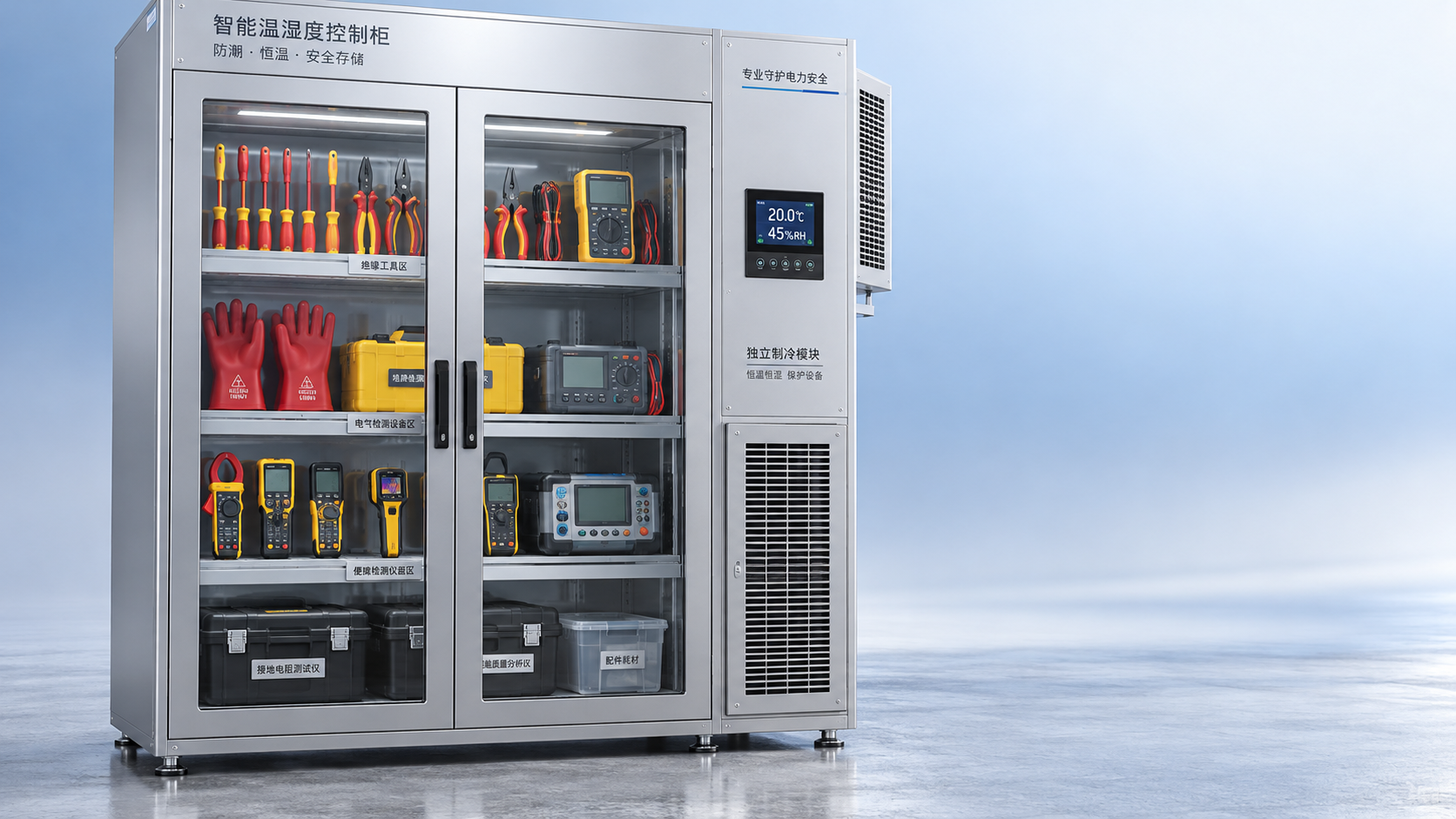
For multi-bay projects, the internal organization of the cabinet often matters more than external dimensions. Procurement should examine how compartments, rails, hooks, trays, shelving, labels, and lockable sections support actual tool categories. A large empty cabinet may look flexible, but in service it often turns into mixed storage.
Look for a layout that supports visual control. Workers should be able to identify missing items quickly and return them to the correct position without interpretation. This becomes especially important when different crews rotate through the same area or when outages compress schedules.
A practical checklist includes:
- Dedicated hanging or support positions for long tools such as operating rods and rescue hooks
- Separated sections for insulating gloves, boots, and face protection to avoid compression or contamination
- Storage space for grounding sets and test devices without tangling or impact damage
- Clear labeling zones by tool type, voltage class, bay number, or work area
- Lockable compartments for controlled-access devices or spare items
- Enough clearance for removal and re-placement while wearing PPE
This is also where accessory planning matters. In substations that handle capacitor banks, high-voltage cables, GIS, or test equipment, teams may need dedicated space for discharge tools. For example, a Resistive diachsrge rod may be stored with other controlled high-voltage safety devices when procedures require the safe release of residual charge before maintenance. That is not a reason to redesign the whole cabinet around a single item, but it is a reminder that storage planning should reflect the actual isolation and discharge sequence used on site.
Standardization saves more than unit cost
Procurement teams understandably focus on price breaks from larger-volume orders. But in multi-bay projects, standardization delivers a broader benefit: it reduces training variability, lowers identification errors, simplifies inspections, and makes replacement planning easier. If every cabinet in similar service areas follows the same internal logic, crews spend less time searching and less time adapting.
That said, full standardization is not always the right answer. A common mistake is forcing the same cabinet configuration into every bay regardless of equipment differences. A better approach is usually a standard platform with controlled variations. For example, maintain the same cabinet body, labeling method, locking approach, and corrosion protection across the project, while adjusting internal accessories for bay-specific tool kits.
This balance helps procurement control both cost and operational fit. It also reduces the chance that a later replenishment order becomes a one-off custom exercise.
Compliance should be checked at the storage-system level
Buyers often ask whether the cabinet itself is “certified,” but that question can be misleading. In many cases, the more important issue is whether the cabinet supports compliance with the site’s electrical safety management system, inspection practice, and applicable standards for stored tools and workplace safety. Exact requirements vary by market and project specification, so claims should be checked carefully against local obligations and customer documentation.
Useful procurement questions include:
- Does the cabinet design help maintain cleanliness and condition of insulating tools?
- Can labels, inspection tags, and identification marks be applied clearly and durably?
- Are there sharp edges, poor grounding considerations, unstable bases, or hardware details that create secondary risks?
- Does the design support housekeeping, periodic inspection, and documented control of safety equipment?
If a supplier references standards, treat that as a starting point for review, not the end of it. Certification language in this category is sometimes used loosely, and project teams should confirm what is genuinely tested, what is self-declared, and what remains 【待核实】.
Durability is not just a materials question
Many cabinets fail early not because the shell corrodes, but because moving parts degrade under daily use. Door alignment, hinge durability, lock quality, shelf rigidity, mounting strength, and base stability all affect service life. In high-use substations, repeated opening and closing by multiple teams can expose weak construction quickly.
Procurement should ask for details that often get ignored in quotations:
It is also worth asking whether the supplier can provide consistency across batches. For projects with phased delivery, the first cabinet and the last cabinet should function the same way. Small production changes can create operational frustration when accessories no longer match earlier units.
Delivery and installation constraints affect total cost
For procurement, the visible cabinet price is only part of the cost. Multi-bay projects often face tight installation windows, staged commissioning, and coordination with civil, electrical, and safety teams. A cabinet that is difficult to transport, place, assemble, or anchor can create avoidable site labor costs.
Before ordering, confirm:
- Whether cabinets are delivered assembled or knock-down
- Whether door width, corridor clearance, and lifting conditions suit the site
- Whether mounting hardware or anchoring details are included
- Whether labeling is factory-applied or completed on site
- Whether phased delivery is possible without specification drift
These details matter because procurement delays around “minor” storage equipment are rarely treated as minor during commissioning. If safety tools arrive before proper storage is installed, temporary arrangements tend to become semi-permanent, and that undermines the original control objective.
Do not evaluate cost on unit price alone
The cheapest cabinet in the quotation set may become the most expensive over the project lifecycle. Procurement should consider the full cost of ownership: expected service life, maintenance burden, replacement frequency, damage to stored tools, inspection efficiency, and the operational cost of poor organization.
For example, if a lower-cost cabinet leads to overcrowding or poor segregation, teams may misplace items, damage insulated equipment, or spend more time during routine checks. Those losses rarely appear in the initial purchase comparison, but they are real. In substations, the financial impact of one avoidable safety incident or one maintenance delay can exceed the savings from selecting a weak storage solution.
This is also why buyers should be cautious about over-specifying. Heavy customization, premium finishes, or unnecessary internal complexity can push up cost without delivering practical value. The right buying posture is disciplined rather than maximalist: pay for the features that improve safety control, durability, and workflow, and be skeptical of extras that do not affect field performance.
What to ask suppliers before final selection
Once the shortlist is down to two or three options, procurement should move beyond brochures and request concrete answers. The goal is to uncover whether the supplier understands substation use conditions or is simply offering a general industrial cabinet.
- What substation or utility use cases has this cabinet configuration served before?
- Can the internal layout be matched to a defined electrical safety tool list?
- What are the cabinet body material and surface treatment details?
- Which parts are most commonly replaced in service?
- How is corrosion resistance or durability evaluated 【待核实】?
- Can future expansion orders match the original dimensions and accessories?
- What is the lead time for standard and customized versions?
- How are cabinets packed to prevent transit deformation?
For buyers sourcing from specialized manufacturers, this is where supplier background becomes relevant. A company focused on electrical protective tools and substation safety equipment is usually better positioned to understand storage compatibility, inspection habits, and field constraints than a generic sheet-metal vendor. That does not guarantee suitability on its own, but it does improve the quality of the conversation and the odds of a cabinet that works in practice.
In some cases, suppliers that already support electrical protective tools may also help procurement think through related storage categories, including controlled discharge devices for capacitor banks, cables, GIS, or test equipment. That kind of application-level discussion is more useful than broad claims about “one cabinet for all needs.”
The practical buying view
For multi-bay electrical projects, a substation safety tool cabinet should be treated as part of the site’s safety operating system, not as a commodity enclosure. The best purchasing decisions usually come from a simple sequence: map the workflow, define the tool sets, set the environmental requirements, standardize where repetition adds value, and challenge suppliers on lifecycle details rather than just price.
That approach gives procurement teams something more useful than a lower quotation. It gives them a cabinet plan that remains workable after handover, under daily use, and across the full operating life of the substation.
Recommend
 Oct 25, 2026
Homemade Bird Repellent Spray: Recipe Limits and Outdoor Surface Risks
Searching for how to make homemade bird repellent spray? Discover recipe limits, outdoor surface risks, electrical safety tips, and safer deterrents before you spray.
- Oct 25, 2026
Natural Bird Deterrents for Rooftops: Choosing Nonchemical Options
Learn how to repel birds naturally with humane rooftop barriers and smarter maintenance. Compare nonchemical options to protect electrical equipment and keep roof access clear.
- Oct 24, 2026
Home Remedies for Repelling Birds: What to Try on Patios and Railings
Learn how to repel birds with home remedies for cleaner patios and railings. Discover humane DIY options, avoid harmful sprays, and keep deterrents clear of electrical equipment.