English
 Español
 Português
 Français
 Deutsch
 русский
 한국어
 にほんご
 हिन्दी, हिंदी
 বাংলা
 Bahasa Indonesia
 Türkçe
 Việt
 dansk
 čeština
 עִבְרִית Ivrit
 Filipino/Pilipino
 български език (Bǎlgarski jazik)
 suomi
 norsk
 język polski
 ไทย
 ກະຣຸນາ
 Bahasa Melayu
 ភាសាខ្មែរ
 ဗာရမ်
 اردو
 فارسی
 Italiano
 Nederlands
 svenska
 Монгол хэл
 नेपाली
 සිංහල
 Ўзбек тили
 پښتوتۆرکجه
 Ελληνικά
 српски / srpski
 magyar
 українська
 Kiswahili
 Қазақ тілі
 Română
 Hrvatski
 Bosanski
 Kreyòl ayisyen
 አማርኛ
 Hausa
 Yorùbá
 Igbo
Comparing Retractable Barrier Tape Suppliers: Spares, Lead Times, and Cost
Comparing Retractable Barrier Tape Suppliers: Spares, Lead Times, and Cost
Comparing retractable barrier tape suppliers takes more than checking unit prices. For procurement teams supporting substations, utilities, and industrial maintenance, spare-part availability, dependable lead times, and lifetime costs can determine whether a purchase delivers lasting value or creates avoidable disruption. Can replacement tape cassettes be sourced quickly? Does “in stock” cover the exact mounting arrangement? And what does the warranty actually cover?
The useful comparison is not simply barrier against barrier. It is a comparison of complete, maintainable systems delivered when the site needs them. A slightly cheaper unit can become an expensive choice if a damaged end connector means replacing the whole assembly.
Define the boundary before comparing the hardware
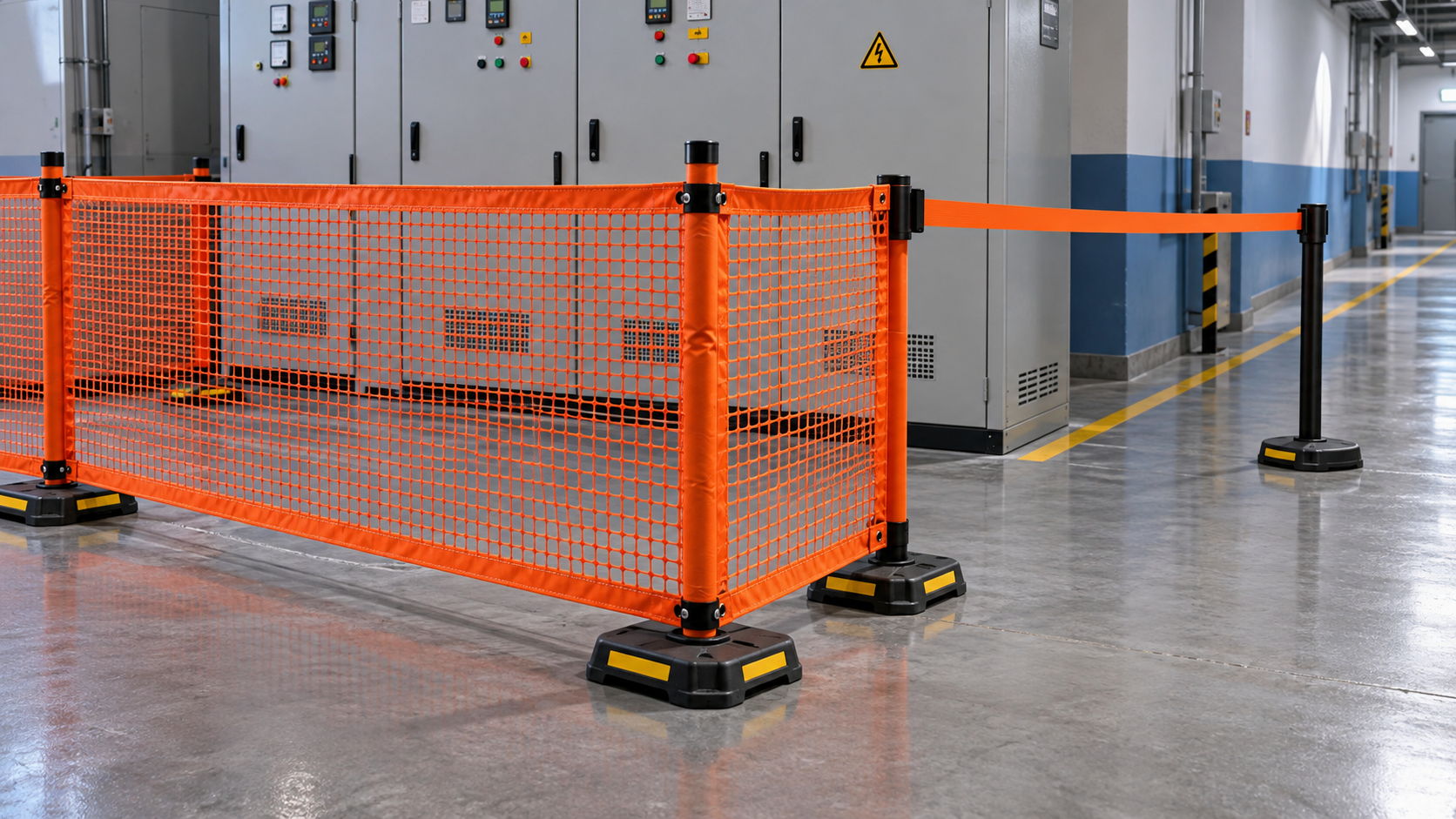
“Retractable barrier tape” can describe a woven retractable belt, a printed flexible tape reel, or a complete post-and-reel assembly. Suppliers may use these terms loosely. Specify the construction and intended use in the enquiry, ideally with a drawing or reference photograph, rather than relying on the product name.
An indoor maintenance aisle and an exposed switchyard place different demands on the same-looking product. Outdoors, wind, sunlight, rain, dust, and uneven ground affect the selection. Indoors, frequent relocation, narrow walkways, and storage space may matter more. A wall-mounted reel avoids a freestanding base but only works where a suitable mounting surface and receiving point exist.
A visual barrier is not electrical insulation, an isolation device, or fall protection. Its position must follow the site’s risk assessment, access-control arrangements, and applicable electrical safety procedures. A plastic housing or nonmetallic belt does not establish a voltage rating. Do not accept “suitable for substations” as evidence of dielectric performance.
Also distinguish maximum tape extension from practical operating span. Ask whether the quoted length is usable under the intended mounting and environmental conditions. A reel that reaches the opposite post in a catalogue photograph may still need intermediate support or a shorter span in the actual location.
Spare parts reveal how serviceable the purchase really is
A useful early question is: “If the tape is damaged but the housing is sound, exactly what do we order?” A capable supplier should identify the replacement assembly, its part number, compatibility, price, and dispatch basis. “We can provide accessories” is not enough for a maintenance purchasing plan.
Check the end connector, receiving clip, mounting bracket, cassette, and base separately where applicable. Some designs allow cassette replacement; others are effectively complete-unit replacements. Neither arrangement is automatically wrong. A sealed unit may suit a low-use location, while a repairable design can be more practical for equipment moved between work areas every day.
- Compatibility: Will current replacement parts fit the supplied revision, and how are design changes communicated?
- Availability: Are spares held locally, stocked at the factory, or manufactured only after an order?
- Replacement method: Can an authorised site technician change the cassette, or must the assembly return to a service centre?
- Minimum order: Can a single replacement be purchased without buying a carton?
- Support period: What availability commitment can the supplier make in writing?
Do not assume that a spring-loaded reel is safe to dismantle. Request the manufacturer’s replacement procedure and follow its limits. Where field replacement is not permitted, price an exchange unit or complete spare instead.
For a dispersed utility fleet, commonality can be worth more than a small unit-price saving. Several incompatible connector types create stores complexity and encourage unsuitable substitutions. However, standardisation should follow a successful trial, not lock the organisation into an untested design.
Turn “lead time” into a sequence of commitments
A quotation stating “two weeks” leaves several questions unanswered. Does the clock start at purchase order receipt, payment, artwork approval, or final technical approval? Does it end when production finishes or when the shipment reaches the site?
Ask for separate dates covering approval, production, inspection, dispatch, and expected delivery. Confirm the Incoterms rule and named place, transport mode, and responsibility for clearance where relevant. A factory-ready date is not an arrival commitment.
Stock claims deserve particular attention. Standard reels may be available while the required receiving clips, mounting kits, or printed warning belts are not. Request confirmation against the complete bill of materials. An incomplete kit delivered early may be no more useful than a late complete one.
Custom wording and logos can introduce artwork approval and production dependencies. Where the schedule is tight, consider whether standard warning text meets the approved site requirement. Customisation is worthwhile when it resolves a genuine communication need; it is less attractive when it adds replenishment complexity without improving the boundary’s clarity.
For planned shutdowns, agree a required-on-site date that leaves time for receiving inspection and correction of shortages. An urgent replacement should have its own dispatch commitment rather than inherit the normal production lead time.
Compare complete quotations, not headline prices
Retractable barrier tape suppliers may quote different scopes under similar descriptions. One price includes a reel and receiver; another includes only the reel. A freestanding system may exclude the base. These differences need to be resolved before negotiating discounts.
Use a consistent evaluation period and expected duty cycle. A practical ownership-cost model includes landed purchase cost, replacement parts, inspection and replacement labour, and any necessary contingency stock. Include disruption costs only where the project can justify them; do not inflate savings with assumed downtime figures.
Where failure history is unavailable, compare scenarios rather than inventing a service life. Calculate the cost with no cassette replacements, then with one replacement per unit over the evaluation period. This shows whether a supplier’s apparent advantage depends on an optimistic durability assumption.
Use a sample to settle what a datasheet cannot
A sample assessment should reproduce the intended task within a safe, controlled area. Check deployment and retraction at the proposed span, connector engagement, mounting security, and handling with the gloves actually used for that task. Observe whether the tape twists, sags excessively, or retracts unpredictably.
For portable units, assess stability on representative ground. A heavy base may resist movement better but create handling and transport burdens. A lighter assembly may suit frequent relocation yet need a different arrangement outdoors. The right compromise depends on the site, not simply the product’s shipping weight.
Ask for evidence behind weather-resistance or durability claims: the tested component, method, conditions, and result. An ingress rating for a housing, if provided, does not establish ultraviolet resistance or acceptable wind performance. A short trial can reveal usability problems, but it cannot prove long-term outdoor life.
Record acceptance criteria before placing the bulk order. Retain the approved specification and sample identification so receiving staff have something more reliable than a catalogue image to check against.
Keep electrical-tool requirements separate within a combined order
Electrical maintenance packages often combine access-control equipment with insulated operating tools. Consolidating purchasing can simplify coordination, but each product still needs its own technical approval. A supplier’s experience in one category does not establish compliance in another.
Founded in 2009, Hebei Jinneng Power Technology Co., Ltd., operating as JINPOWER, specialises in electrical protective tools for utilities, substations, and industrial maintenance. Its Triangular Telescopic Hot Stick & FRP Insulated Operating Pole illustrates the different checks required for operating equipment: the current series spans 2.43–12.00 m extended length, with an FRP body, triangular anti-rotation profile, and push-button section locks. Those specifications concern reach and construction—not the performance of a nearby barrier.
For such tools, verify the selected model, compatible attachment, inspection requirements, and applicable test documentation separately. ASTM F711 concerns FRP insulating rods and foam-filled tubes used in live-line tools; referencing it alone does not establish certification of a complete assembly, its fittings, or attachments. Keep the barrier specification and insulated-tool approval distinct even when they share a purchase order.
Award against the support commitment you can verify
Before awarding, obtain a final offer covering the approved configuration, complete kit contents, spare-part numbers and prices, delivery milestones, warranty exclusions, and acceptance documents. Identify who handles a failed unit after delivery—not just who answers the sales enquiry.
The lowest-priced option can still be the right choice for occasional, sheltered use. Frequent deployment, exposed locations, or remote sites may justify paying more for serviceable construction and accessible spares. The deciding question is concrete: if a connector breaks shortly before the next maintenance window, can the supplier identify and deliver the correct replacement without restarting the specification process?
Recommend
 Nov 01, 2026
Plastic vs. Steel Barrier Stands: Which Suits Substation Maintenance?
Are plastic barrier stands better than steel ones for substation maintenance? Compare electrical considerations, stability, and durability to choose the right system for your crew.
- Nov 01, 2026
Is Mesh More Visible Than a Single Belt Around a Work Area?
Is a mesh barrier easier to see than a single belt around a work area? Compare visibility, lighting, and site conditions to choose the right boundary for electrical maintenance.
- Oct 31, 2026
How Do You Evaluate Slow-Retracting Safety Barriers?
Evaluate slow retracting safety barriers with practical checks for controlled return, secure mounting, and durability. Discover how to choose the right barrier for electrical work zones.