English
 Español
 Português
 Français
 Deutsch
 русский
 한국어
 にほんご
 हिन्दी, हिंदी
 বাংলা
 Bahasa Indonesia
 Türkçe
 Việt
 dansk
 čeština
 עִבְרִית Ivrit
 Filipino/Pilipino
 български език (Bǎlgarski jazik)
 suomi
 norsk
 język polski
 ไทย
 ກະຣຸນາ
 Bahasa Melayu
 ភាសាខ្មែរ
 ဗာရမ်
 اردو
 فارسی
 Italiano
 Nederlands
 svenska
 Монгол хэл
 नेपाली
 සිංහල
 Ўзбек тили
 پښتوتۆرکجه
 Ελληνικά
 српски / srpski
 magyar
 українська
 Kiswahili
 Қазақ тілі
 Română
 Hrvatski
 Bosanski
 Kreyòl ayisyen
 አማርኛ
 Hausa
 Yorùbá
 Igbo
How Can You Verify UV Resistance in Retractable Barrier Belts?
You can verify UV resistance in retractable barrier belts by checking whether the finished webbing has undergone documented weathering exposure, then comparing its strength and usability before and after that exposure. A credible report identifies the belt tested, describes the exposure conditions, and provides measured results. A “UV resistant” label, a fabric specification, or a photograph of an unfaded belt provides much less evidence.
For outdoor substations, utility work areas, and maintenance zones, the strongest assessment combines laboratory weathering with checks on the complete retractable assembly. The belt must remain readable and mechanically serviceable under the expected conditions. Even well-supported UV resistance does not establish electrical insulation, an arc rating, or suitability as a protective guard.
Compare the evidence behind the claim
Suppliers may use the same description for products supported by very different evidence. Before comparing prices or exposure hours, establish what each supplier has actually tested.
- A material statement: The supplier identifies a polymer, coating, or UV stabilizer. This explains a design choice but does not demonstrate how the finished belt performs after weathering.
- A colorfastness result: Testing measures fading or color change. This helps assess visibility and appearance, but provides no direct measurement of retained strength.
- A weathering report with mechanical results: Identified webbing undergoes a defined exposure, followed by strength testing against unexposed samples. This provides stronger evidence of resistance to degradation.
- Weathering and assembly evaluation: The assessment also examines printing, attachments, and retraction after exposure. This gives a broader picture of whether the product remains usable.
Each level answers a different question. A colorfastness report can support a claim about warning visibility, while tensile results address resistance to breaking under the specified test conditions. Neither, by itself, establishes that a weathered belt will retract smoothly or that its end connector will remain secure.
Start by asking for the underlying report rather than a certificate or brochure summary. Check that it identifies the relevant product and gives enough detail to understand the procedure and results. An independent laboratory can add confidence, particularly when the work falls within its accredited scope, but independence does not compensate for testing the wrong material or measuring the wrong property.
Understand what the weathering method actually represents
Accelerated weathering exposes samples to controlled conditions intended to investigate deterioration. Different methods use different light sources and exposure cycles, so the test name and operating conditions matter as much as the duration.
Fluorescent UV methods, such as those addressed by ASTM G154, use fluorescent lamps and can include moisture exposure. Xenon-arc methods, such as those addressed by ASTM G155, use filtered xenon light to represent a broader portion of sunlight. Neither designation is a universal pass mark for retractable belts. These practices describe exposure approaches; the applicable procedure and acceptance criteria still need to be specified.
Fluorescent UV exposure can help investigate degradation driven by particular ultraviolet wavelengths. Xenon-arc exposure can be useful when changes in pigments, printing, and materials under a broader solar spectrum are relevant. The more appropriate choice depends on the material, expected failure mechanism, and intended environment. A report using one approach is not automatically superior to a report using the other.
For a useful comparison, review the lamp or filter specification, irradiance, exposure cycle, temperature conditions, moisture stages, and duration. Where a report gives radiant exposure, check its wavelength basis and units before comparing it with another result. These details determine what the samples experienced inside the equipment.
A belt exposed for more hours has not necessarily endured a more demanding test. Different light sources, temperatures, and wetting cycles can produce different degradation patterns. Even two reports citing the same standard may use different permitted conditions.
Ask suppliers to explain claims that a chamber exposure equals a stated number of outdoor years. Such a relationship needs supporting correlation for the relevant material and environment. Sunlight intensity, climate, orientation, shade, and time spent extended all influence field exposure. Without suitable correlation, laboratory hours are useful for comparing defined tests, but cannot establish a replacement interval on their own.
Compare retained strength alongside actual breaking force
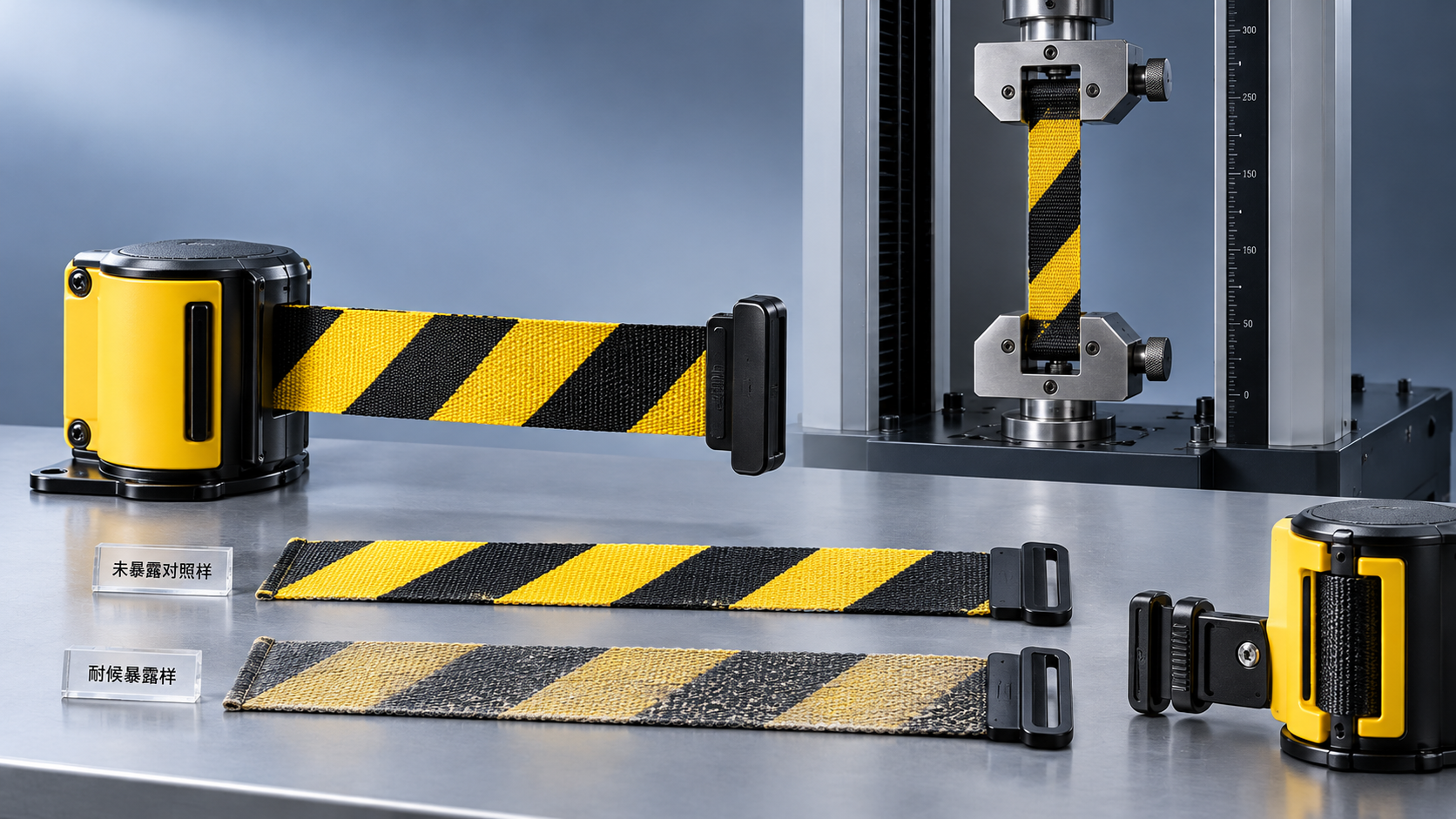
For UV resistant retractable barrier belts, retained tensile strength is a useful measure of whether exposure has weakened the webbing. It compares the strength of exposed samples with that of equivalent unexposed samples tested using the same method.
Retained tensile strength (%) = exposed-sample tensile strength ÷ unexposed-sample tensile strength × 100.
Request both the retention percentage and the measured breaking force. A belt can retain a high proportion of a low starting strength, while another belt may lose a greater proportion and still have a higher remaining breaking force. Percentage retention describes degradation; the remaining force helps assess whether the aged material still meets the purchaser’s mechanical requirement.
The test procedure also affects the comparison. Sample width, gripping arrangement, gauge length, conditioning, and test speed can influence results. Values obtained from different procedures should not be treated as directly interchangeable. Ask the laboratory to identify a tensile method suitable for the webbing construction and apply it consistently to the exposed and control samples.
Check the number of specimens, the spread of results, and where failure occurred. A single reported average can conceal variation, while failure at a grip may need different interpretation from failure in the sample’s working section. Reports should provide enough information to distinguish material behavior from testing problems.
There is no defensible universal retention threshold for every retractable barrier application. Acceptance criteria should reflect the belt’s intended function, foreseeable handling loads, and consequences of failure. Agree on both retained performance and minimum remaining strength before commissioning a comparison, rather than selecting a threshold after seeing the results.
Strength testing also needs a clear boundary. Evidence that webbing resists breaking does not qualify a retractable barrier for fall protection, personnel restraint, or vehicle impact. Those functions involve requirements beyond the UV durability of an access-control belt.
Fading and mechanical deterioration need separate judgments
Color change is easy to notice, which makes it an attractive shortcut for judging weathering. It is an unreliable substitute for strength measurements. Pigments, printed inks, coatings, and load-bearing fibers can deteriorate at different rates. A belt may retain a strong color while losing mechanical performance, or fade while retaining substantial strength.
For electrical work zones, readability remains a functional requirement. Warning text that becomes difficult to read or a pattern that loses contrast can reduce the belt’s usefulness even when its tensile results remain acceptable. Evaluate color and printing alongside mechanical performance, with acceptance criteria appropriate to the viewing conditions.
After exposure, examine the webbing for cracking, surface powdering, fraying, stiffness, and changes in flexibility. Assess printed areas and edges, where deterioration may affect handling or visibility. Photographs help document these changes when lighting and presentation are consistent, but photographs alone cannot quantify retained strength.
Do not assume that results for one color or print design cover an entire range. Pigments and finishes can affect weathering behavior. The supplier should identify which variants were tested and explain the basis for extending those findings to other versions.
Confirm that the tested sample represents the supplied belt
A detailed report has limited purchasing value if its sample cannot be linked to the product being ordered. Check the manufacturer’s product reference, webbing construction, width, color, printing, and relevant finish against the proposed supply.
Testing unfinished fabric may be useful during development, but printing, coating, and fabrication can change the final product’s behavior. Likewise, a report for a thicker webbing or different material formulation does not automatically support a thinner replacement. Where formulation details are confidential, traceable product identification can still establish what was tested.
Ask how material substitutions and production changes are controlled. The practical concern is whether later deliveries remain represented by the evidence used for approval. Changes to yarn, dye, coating, or printing should trigger a review of whether the original results still apply.
Exposure geometry deserves attention too. A short sample mounted flat in a chamber receives a different pattern of exposure from webbing partly protected inside a cassette. In service, repeatedly extending the same length can leave some sections more exposed than others. A laboratory comparison should document which surfaces were exposed and how samples were mounted.
For a consequential purchase, it can be useful to submit samples from the proposed supply for comparison under one agreed protocol. This reduces uncertainty caused by unrelated reports, provided the sampling process and product identity remain traceable.
Check the assembly under the intended operating conditions
The belt is only one part of a retractable barrier. An outdoor assessment should also consider the housing, belt outlet, attachment, and retraction mechanism. UV-resistant webbing cannot compensate for a brittle connector or a housing that no longer supports normal operation.
After relevant exposure, check whether the belt extends, locks, and retracts as intended. Look for edge abrasion at the outlet, distortion, attachment damage, and changes in retraction behavior. If only the webbing underwent laboratory exposure, describe the evidence accordingly; it does not establish the durability of the whole assembly.
Site conditions determine what additional evaluation is useful. A belt deployed briefly during maintenance has a different exposure profile from one left extended throughout the year. Heat, rain, dust, salt, and cleaning products may create deterioration that a UV-focused test does not adequately represent.
A documented outdoor trial can complement laboratory testing, especially when comparing shortlisted products under the same local conditions. Record deployment time, orientation, inspection findings, and functional changes. Such a trial can reveal handling and assembly problems, although a short trial cannot establish long-term life or replace mechanical measurements.
Keep electrical qualification separate throughout this process. UV durability does not establish dielectric performance or authorize a barrier to be used within electrical clearances. Select its location and function through the site’s electrical safety procedures.
A practical purchase specification should therefore identify the finished belt, define the weathering exposure, require comparable pre- and post-exposure measurements, and state acceptable limits for strength, readability, and operation. When comparing offers, favor evidence that answers those requirements directly. A longer exposure claim is of little help if the report never shows what condition the belt was in afterward.
Recommend
 Oct 30, 2026
How Do You Specify Custom Warning Text for Barrier Belts?
Specify custom warning text barrier belts with confidence. Discover how to choose clear messages, print layouts, and approval criteria for electrical work areas. Get the practical guide.
- Oct 30, 2026
How Can You Verify UV Resistance in Retractable Barrier Belts?
UV resistant retractable barrier belts: learn how to verify weathering reports, retained strength, and assembly performance to compare suppliers and choose with confidence.
- Oct 29, 2026
How Do You Assess Wind Resistance in Outdoor Barrier Stands?
Assess outdoor barrier stand wind resistance with practical tips on bases, ballast, anchors, and gust exposure. Learn how to compare supplier claims and choose the right setup for your site.