English
 Español
 Português
 Français
 Deutsch
 русский
 한국어
 にほんご
 हिन्दी, हिंदी
 বাংলা
 Bahasa Indonesia
 Türkçe
 Việt
 dansk
 čeština
 עִבְרִית Ivrit
 Filipino/Pilipino
 български език (Bǎlgarski jazik)
 suomi
 norsk
 język polski
 ไทย
 ກະຣຸນາ
 Bahasa Melayu
 ភាសាខ្មែរ
 ဗာရမ်
 اردو
 فارسی
 Italiano
 Nederlands
 svenska
 Монгол хэл
 नेपाली
 සිංහල
 Ўзбек тили
 پښتوتۆرکجه
 Ελληνικά
 српски / srpski
 magyar
 українська
 Kiswahili
 Қазақ тілі
 Română
 Hrvatski
 Bosanski
 Kreyòl ayisyen
 አማርኛ
 Hausa
 Yorùbá
 Igbo
Planning Retractable Tape Barrier Systems for Warehouse Maintenance Zones
A maintenance team opens an electrical cabinet beside a busy warehouse aisle. Picking continues nearby, a forklift approaches the junction, and someone needs access to the charging area behind the work. A boundary that looked adequate during a quiet walkthrough can become confusing within minutes.
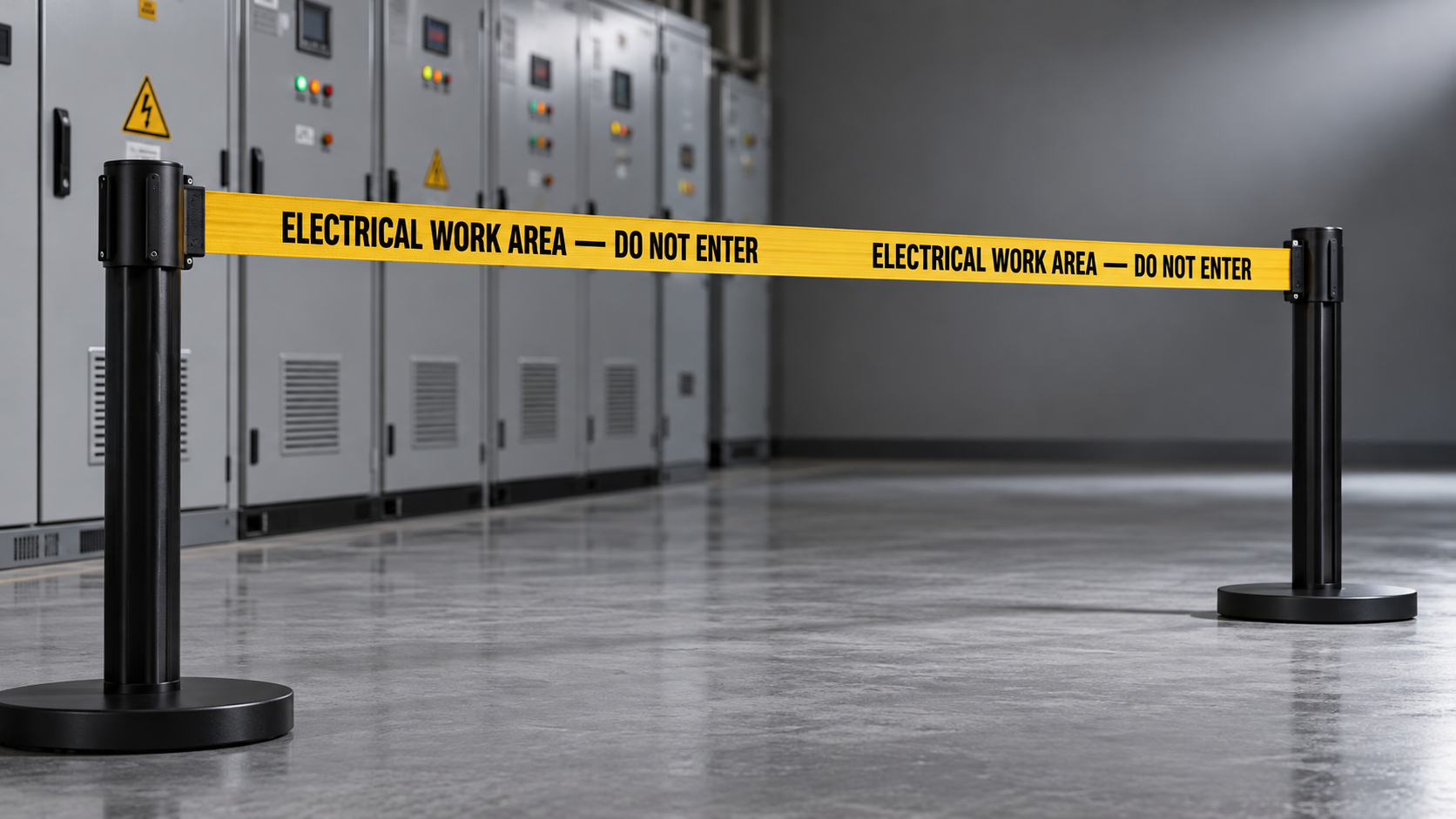
Planning retractable tape barrier systems means accounting for these movements before work begins. Project managers need a layout that makes restricted areas obvious, keeps authorized access manageable, and gives warehouse operations a workable alternative route. Drawing on JINPOWER’s focus on electrical safety equipment, this guide examines how visual barriers fit into maintenance planning—and where stronger protective measures are necessary.
Decide what the boundary must prevent
Before selecting posts or measuring tape lengths, define the purpose of the exclusion zone. Is it intended to discourage pedestrians from approaching routine servicing, control entry around electrical maintenance, or keep people below overhead work? Each situation requires a different boundary, and some cannot be managed with retractable tape alone.
A retractable tape barrier is a visual access-control measure, not a vehicle restraint, electrical protective barrier, or fall-protection system. It does not stop a forklift, contain an electrical fault, or reliably prevent a person from entering a hazardous area. Where the risk assessment requires physical separation, use appropriate rigid barriers, traffic controls, guarding, or other engineered measures.
This distinction also improves procurement. A long tape span is not necessarily a better solution if the real problem is uncontrolled vehicle access.
Walk the site with operations—not just the maintenance team
A floor plan shows aisle widths and equipment positions. It rarely shows where empty pallets accumulate at shift change or which shortcut people take when dispatch becomes busy. Walk the proposed zone with the warehouse supervisor, maintenance lead, and relevant safety personnel.
Observe the area under representative operating conditions. Check forklift turning movements, pedestrian crossings, loading activity, and doors that open into the proposed boundary. Look beyond the immediate task: a diversion can move pedestrians away from one hazard and into another.
Record the features that must remain accessible:
- Emergency exits, escape routes, and fire equipment.
- Required access to electrical equipment and emergency controls.
- Authorized maintenance entry and any planned rescue route.
- Pedestrian routes that remain separated from moving vehicles.
- Space for tools, replacement components, removed covers, and waste.
Then map the actual work sequence. Opening a cabinet door, withdrawing a component, or positioning a mobile platform may require more space than the equipment footprint suggests. Include these movements inside the controlled area rather than expecting workers to extend the boundary after the task has started.
Set electrical work boundaries before placing the posts
For electrical servicing, barrier placement should follow the electrical safety assessment—not determine it. Qualified personnel must establish the precautions appropriate to the equipment, task, and applicable requirements. These may include isolation, lockout/tagout, verification of absence of voltage, and controls for stored energy or nearby energized parts.
Do not use a convenient aisle edge as a substitute for an assessed electrical boundary. Shock protection boundaries and arc-flash boundaries, where applicable, depend on the electrical conditions and work being performed. Tape color, post spacing, or a standard kit does not establish a safe distance.
Plan enough room for workers to maintain required clearances without stepping into warehouse traffic. If the necessary controlled area occupies an aisle, the answer may be a temporary aisle closure or a different maintenance window—not a smaller work zone.
Never assume that a barrier component is electrically insulating. Metal posts, wall brackets, magnetic mounts, and even apparently nonmetallic assemblies require suitability checks. Do not attach a reel to electrical equipment, open protective enclosures for mounting, or introduce conductive components near exposed energized parts without appropriate authorization and assessment.
Select retractable tape barrier systems for the layout you actually have
Once the boundary is established, compare configurations against the site conditions. Maximum tape length is only one consideration; mounting security, visibility, base stability, and ease of controlled access often matter more.
Portable posts for changing work areas
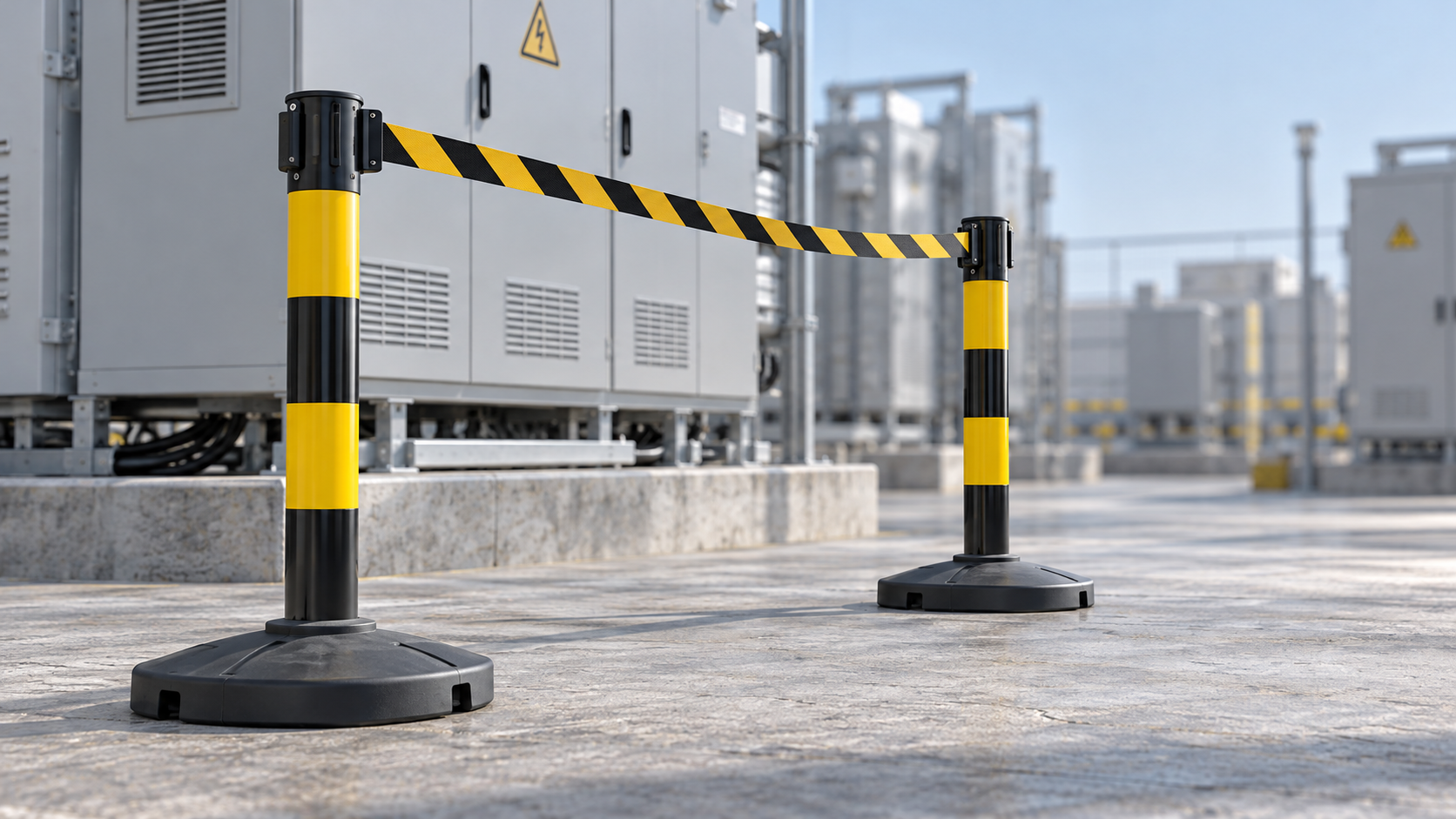
Freestanding posts suit maintenance zones that move between aisles or equipment locations. Check whether the base is appropriate for the floor, expected tape extension, and foreseeable incidental contact. Uneven surfaces, floor joints, and debris can undermine stability.
Place bases where they will not create new trip hazards or encroach on the usable width of a diversion route. A base that looks compact in a product photograph may be awkward beside a pedestrian crossing or narrow doorway.
Fixed reels for recurring maintenance points
Wall-mounted reels can reduce setup time where the same equipment is serviced regularly. They also avoid some floor-level obstructions. However, both the mounting surface and receiving point need verification, and the installation must not obstruct doors, controls, inspection points, or required equipment access.
Magnetic or other removable mounts should be used only on suitable, approved surfaces and within the manufacturer’s instructions. A convenient attachment point is not necessarily a secure one.
Tape spans, warnings, and retraction behavior
Choose spans that remain clearly visible without excessive sagging or unstable posts. Follow the manufacturer’s extension limits and check performance at the intended operating length. Several manageable spans may produce a clearer boundary than one long, poorly supported run.
Review tape contrast against the warehouse background, lighting conditions, and surrounding signs. Use wording that tells people what to do, such as “Maintenance Area—Authorized Access Only,” with additional hazard-specific signs where required. Color alone is not enough.
Controlled retraction is another useful selection criterion. Check how the tape releases and returns, and ensure workers understand safe handling. Do not allow a released end to whip back across an occupied walkway.
Make the alternative route obvious before closing the usual one
People are more likely to respect a restriction when the next safe action is clear. A blocked aisle with no visible diversion invites hesitation, backtracking, and shortcuts beneath the tape.
Place diversion information before pedestrians reach the closure. At blind corners, provide warning early enough for people to choose another route without entering a vehicle maneuvering area. Confirm that the alternative route remains usable when pallets, trolleys, or temporary storage are present.
Forklift arrangements need separate attention. Tape must not be treated as a stopping device or installed where a vehicle could catch it and drag posts into people or equipment. Depending on the assessed risk, measures may include route closure, suitable physical barriers, revised traffic arrangements, or authorized traffic control personnel.
Keep the maintenance entry distinct from the public diversion. Where practical, choose one controlled entry point positioned away from active traffic and the main hazard. Define who may enter, who authorizes access, and how the opening is restored after use. Informal access through disconnected tape quickly weakens the whole layout.
When the task moves overhead, expand the plan
Warehouse maintenance frequently involves lighting, cable routes, overhead services, or high-level equipment. In these cases, the ground-level boundary must account for the assessed falling-object area and access-equipment movements—not simply trace the platform’s footprint.
The people above the barrier need their own protection arrangements. Where the task and access method require a compatible personal fall-protection system, JINPOWER’s Full Body Safety Harness for Utility and Industrial Work at Height can be considered within that wider equipment selection. Its high-strength webbing and adjustable shoulder, chest, and leg straps support fit, while attachment configurations vary by model.
Selection must match the intended application, worker size, connecting device, and suitable anchorage. Confirm the documentation and applicable standards for the specific model rather than assuming every configuration supports fall arrest, positioning, climbing, or rescue. A harness alone does not make work at height safe; clearance, compatibility, training, inspection, and rescue planning remain essential.
Coordinate the overhead and ground-level controls together. The exclusion zone should remain effective while workers reposition equipment, lower tools, or respond to an interruption.
Build a short release check into the work permit
Before authorizing the task, review the installed arrangement from outside the zone. Approach it as a picker, a visiting contractor, and a forklift operator would. Can each person recognize the restriction before reaching it? Is the safe route apparent?
A practical release check should confirm that:
- The boundary matches the current task and assessed hazards.
- Posts, reels, receiving points, and signs are secure and serviceable.
- Tape is visible, properly connected, and free from significant damage.
- Emergency routes and required equipment access remain available.
- Vehicle controls are in place independently of the visual tape.
- Authorized entry, electrical precautions, and any rescue arrangements are understood.
Assign responsibility for maintaining the boundary during the job. Recheck it after shift changes, deliveries, equipment movement, or any change to the work scope. If a post is repeatedly moved, investigate the layout rather than simply telling people to leave it alone. Repeated interference often reveals an unresolved access need.
Procure for repeatable setups, not just individual jobs
For project managers overseeing several maintenance activities, a consistent system makes deployment easier. Record approved configurations, required signs, mounting restrictions, inspection criteria, and replacement components. Ask suppliers for usable tape lengths, base dimensions, mounting instructions, environmental limitations, and operating guidance before ordering.
Do not assume reels, tape ends, posts, and receivers from different ranges are compatible. Where components will be shared between zones, verify interchangeability and keep the arrangement simple enough for crews to reproduce correctly.
At completion, remove the restriction only after the responsible person confirms the area can return to service. Account for tools and materials, restore equipment protection, and manage electrical reinstatement under the applicable procedure. Withdraw diversion signs as routes reopen so outdated warnings do not remain in circulation.
Well-planned retractable tape barrier systems make maintenance boundaries understandable without pretending to provide protection beyond their design. The strongest layout gives workers room to do the job, gives warehouse traffic a credible route around it, and stays aligned with the electrical, vehicle, and work-at-height controls throughout the task.
Recommend
 Oct 30, 2026
How Do You Specify Custom Warning Text for Barrier Belts?
Specify custom warning text barrier belts with confidence. Discover how to choose clear messages, print layouts, and approval criteria for electrical work areas. Get the practical guide.
- Oct 30, 2026
How Can You Verify UV Resistance in Retractable Barrier Belts?
UV resistant retractable barrier belts: learn how to verify weathering reports, retained strength, and assembly performance to compare suppliers and choose with confidence.
- Oct 29, 2026
How Do You Assess Wind Resistance in Outdoor Barrier Stands?
Assess outdoor barrier stand wind resistance with practical tips on bases, ballast, anchors, and gust exposure. Learn how to compare supplier claims and choose the right setup for your site.